Ahmedabad-based architect duo Sachin Bandukwala and Melissa Smith spent over a year looking for “the right type of old building” to call their new office, and another year to sort out the paperwork before purchasing the property in October 2022. “That’s one of the challenges with these kinds of old spaces,” Bandukwala told AN Interior. “Luckily, we bought it from a family of lawyers, so they had most of the documents in place.”


The 2-story art deco haveli from 1931 is part of an urban village named Mithakhali, which features on some of the oldest available maps of Ahmedabad. The building itself is located on the fringe of this village, right by a railway crossing. “It was important for us to be on the west side of the [Sabarmati] river, because it’s easier for clients and agencies to visit,” said Smith. “So it was cool that we found this really old neighborhood that’s connected to the newer part of the city.”

Another consideration for the architects in their purchase was how the haveli sits within the context of the neighborhood. The L-shaped structure offers six sides to work with, two of which are linked to adjacent buildings, as well as a plinth on the street front for a transitional pause. “I’d say it is an ideal sort of setting for the creative atmosphere of an architecture studio and the interesting juxtaposition of events that can take place here,” commented Bandukwala.

An exciting discovery the new owners made is an old well within the building that is three and a half feet in diameter and about 35 feet deep, reaching a sandy bottom. While the groundwater table has dropped too low to draw water from it directly, all the rainwater collected from the terrace has now been directed to the well as a passive recharge system.


The 16-month renovation was more than an interior job; it required mending the bones of the load-bearing structure made of brick and lime, which showed signs of damage caused by earthquakes. “We actually had to fix a lot: stitch the walls with steel and fill the gaps using lime-based hydraulic pressure grouting,” explained Smith. “Enough portions of the stone slab construction were badly damaged, so we had to redo the entire roof.”


A blessing in disguise, they said, was when one of the girders fell in the early stages of construction, breaking a jack arch through its center and tearing away a part of the first floor. This led them to design a new wooden floor for that room, which is “like a furniture piece suspended between thick, heavy walls.” The introduction of this new floor allowed the architects to create a central cutout that establishes a visual connection across the two levels of the haveli. Wrapping around the cutout is a table that seats eight architects facing each other in an independent space accessed through a pair of rooms: a materials library and a private office. An L-shaped balcony, reconstructed in steel in place of the dilapidated wooden one, houses a series of standing desks paired with a band of windows made from material recycled from old cupboards. The balcony also ties together the three working rooms on the first floor.

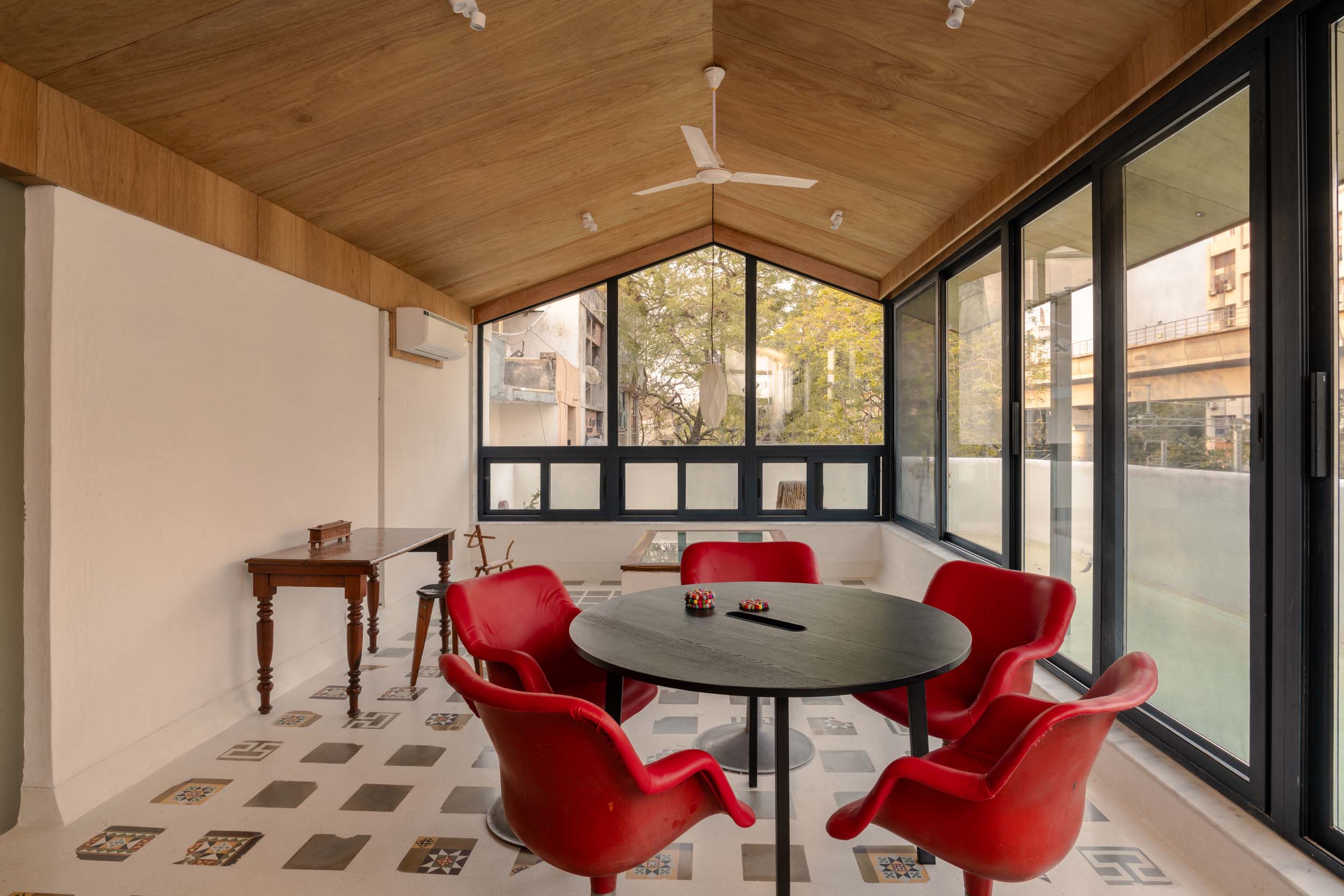
On the topmost level is an open-plan apartment for family and friends, equipped with a full bathroom, kitchen, and Japanese-style flat mattresses that can be moved around easily. “The idea is for the kids to be able to enjoy this homelike space while we’re working on the floor below,” said Smith. “It’s one of my favorite spaces because it’s so open and comes with a terrace…. It feels quite peaceful out there.”

Befitting the layered renovation of the haveli, which preserved elements that were in good condition and made strategic insertions without “trying to match the era of the building,” the interior features a mix of furniture pieces designed by banduksmithstudio and interesting finds, such as the fiberglass chairs by Finnish designer Yrjö Kukkapuro and antique teakwood folding tables.