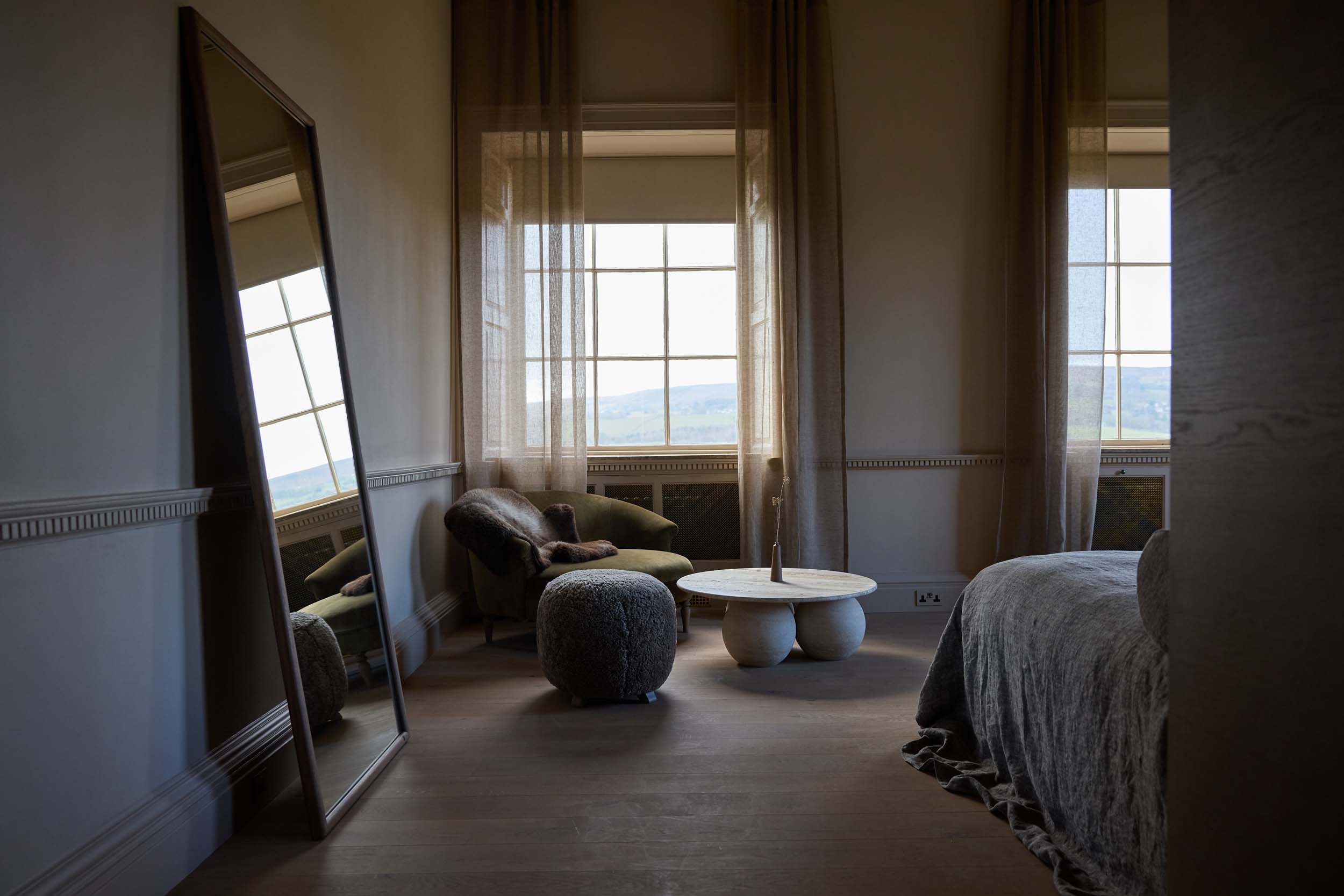
From central “background” roles in Gosford Park to the ever-expanding universe of Downtown Abbey, the English manor house has remained a deeply romanticized emblem of the Georgian and Victorian eras. As fortunes and customs shifted in the early 20th century, many were turned into museums, hospitals, and hotels. Some were even left abandoned. All too often, these grandiose mansions were haphazardly renovated with efficiency in mind.

Denton Hall was one such property. Situated at the center of an expansive Yorkshire estate, the Palladian-style palace was completed in 1778 by period-defining architect John Carr, but over the following centuries it endured numerous alterations. In the 1970s, it was subdivided into offices. Original detailing and sumptuous surface treatments were covered up by heavy wall-to-wall carpeting, thick curtains, and the boldly toned geometric patterns popular at the time.

“Our challenge was to undo the interventions layered over time,” said Lou Davies, cofounder of London firm BOX 9, which led Denton Hall’s recent restoration and transformation into a multivalent events venue. (The entire manor house can now be rented out.) “All of that noise made the space feel intimidating, which of course was intentional, but we felt it needed undoing. We wanted to reorient attention to the architecture, volumes, and light.”


Davies and her team saw themselves as design custodians. They gently guided the historically listed structure back to a certain version of its former glory, all while carefully bringing it up to contemporary standards.


“We wished our work to be respectful, to learn from and honor the past but to not be afraid of the future,” Davies added. “We led with determination and assumed responsibility, ensuring a building of such significance would be renovated in a way that keeps it relevant and keeps generations engaged with history.”

BOX 9 assessed what was worth keeping and amplifying, which took place in parallel to the ecological restoration of Denton Reserve. The team refreshed the estate’s interiors, with placemaking top of mind, not only sprucing up historical detail but also tying the space back to its immediate natural surroundings.


Walls were rendered in tones and materials reminiscent of the Yorkshire Dales’s soil, stone, and moorland moss. The large windows encircling stately rooms were relieved of cumbersome drapery. Many of the meticulously selected furnishings reflect this ethos as well.

“We achieved this by working with materials and makers who honor nature, who work reciprocally with what it gives but without draining it,” she explained. “Designers can no longer just aim to be less wasteful; we must also clean up the waste we’ve already created.” While Sussex-based practice Studio Amos crafted a custom 13-foot-tall chandelier out of moorland heather, the monumental reception desk was hewn out of storm-felled British Oak and propped up by spherical cork legs.

“There’s a quiet refusal to overstate,” Davies said. “There’s an invitation to slow down. The design suggests a degree of endurance.” This ambition is clearly more futuristic than nostalgic.
Unlike with a standard gut renovation, the firm carried out a series of carefully studied and implemented interventions. Favorable attributes already in place were left untouched. “These days, the challenge in restoration often lies in opening up old houses to create larger living spaces,” she explained. “Denton Hall already has that type of layout. A central reception room flows into wings. The rooms upstairs are generously proportioned. Listing constraints led us toward creating spacious bedrooms with vast open-plan bathrooms.”


The sleekly integrated, geometrically shaped exposed bathtubs and showers were a bold yet inspiring move. They allow guests to carry out their ablutions while appreciating the open expanse of the room—and nature beyond.