Behind a closed gate and past a winding path through a long courtyard, this hidden family house with a lovely garden at the end is not only unexpected but unusual for Paris. Located in the bustling and densely populated 11th arrondissement, here is an oasis of peace and quiet living by German firm Holzrausch, a rhapsody in wood that stands in serene contrast to the world outside.

The homeowners, who learned of Holzrausch through design publications and wanted an entire interior concept, sought out the firm. Tobias Petri, cofounder of Holzrausch, told AN Interior, “We didn’t know the clients. They are a couple, and she contacted us when they bought the existing house. The brief was for something very calm, nothing trendy, and not a typical, Instagram interior.”

The clients—a former fashion model who owns and runs an art gallery and her husband, also a creative—had clearly done their homework, as Holzrausch is known for designs with an emphasis on simplicity, materials, and quality.


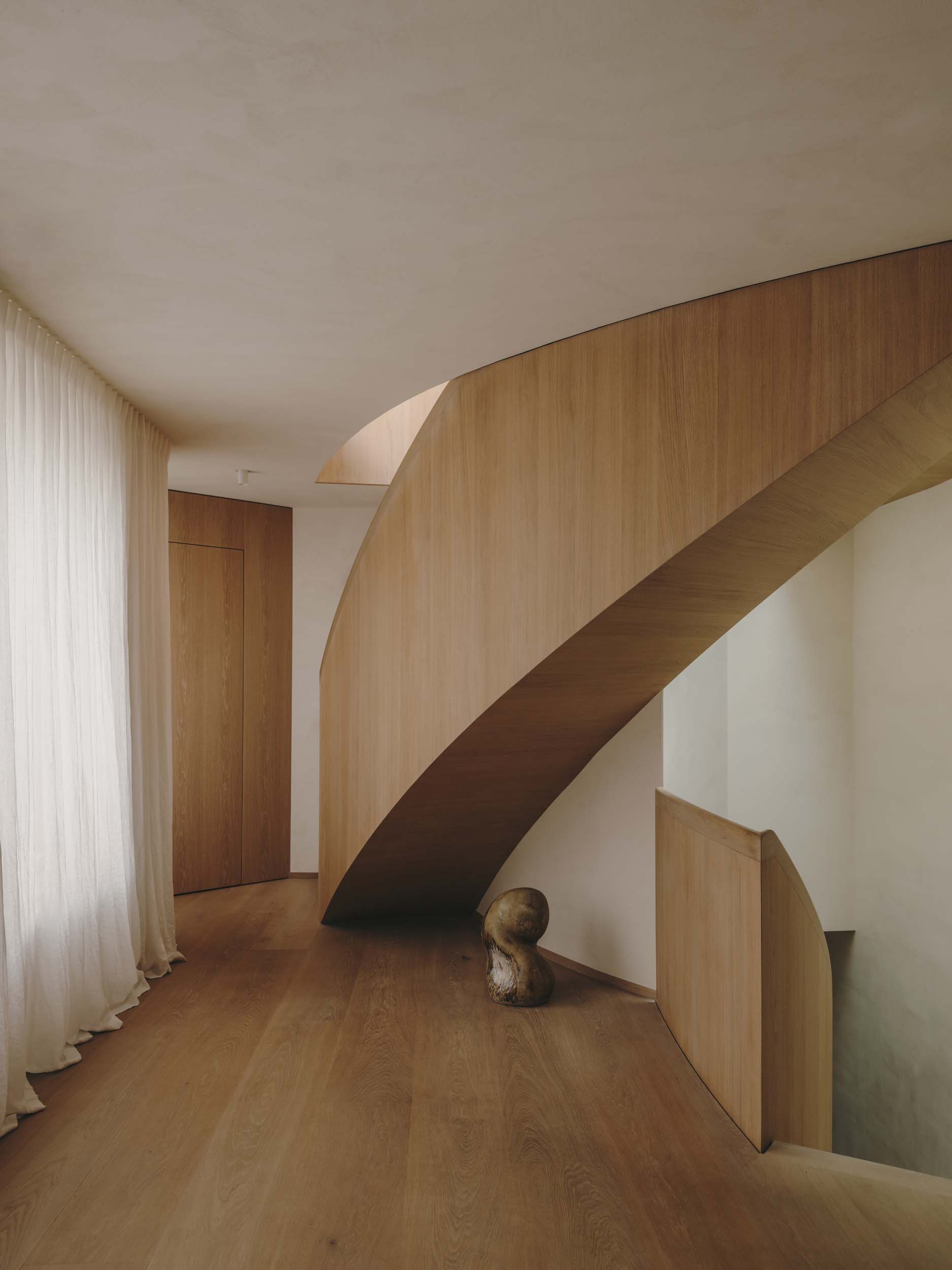
The work started as the pandemic was winding down. “We demolished more or less 80 percent of the existing structure. We kept the concrete floors, but the facade is new [as well as] the skylights, as all the windows of this L-shaped building are only on the courtyard side.” It was important to bring in natural light from the roof, which dictated the design and shape of the showstopping staircase, which brings light into all the levels. Petri explains that the staircase was manufactured in a special workshop for staircase construction in Bavaria and delivered to Paris to be assembled. The wood is the same elegant oak used for the furniture and wall panels.


The house covers 4 floors, including a small basement, approximately 3,800 square feet in all, and includes the private garden in front. The main attraction is the central undulating, sculptural staircase, which serves as the spine of the house and brings in natural light from the skylight. One enters onto the main salon area to the left and the kitchen on the right with a communal long table for meals and conversation. Once the weather gets nice, the doors are open, and it is all about indoor/outdoor living. There are four bedrooms and four bathrooms for this family of four, which includes a young child and a teenager. The project took approximately one-and-a-half years from beginning to end, and the family moved in in 2023.


The project didn’t present any noteworthy challenges, Petri said. In other words, there weren’t obstacles, per se, but it all took time to meet the exacting expectations of the designers and their clients. “What was crazy was all the coordination between the craftsmen, the electricians [and other workers]. We had a plaster blaster from Italy, the massive oak floors from Denmark….We produced the staircase in Bavaria and the lighting from Denmark.”

What is immediately noticeable is the use of very few materials: all oak, plaster, stone, and stainless steel in the kitchen. And why did the client avoid incorporating art? Petri explained, “This is unusual as she owns an art gallery, but they decided to have this Japanese Zen style—nothing to disturb the calmness of the interior. No decorative elements, no art.” True to form, all the lighting is recessed, and most of the furniture is built in, with appliances hidden behind wooden doors.


Petri and his cofounder, Sven Petzold, who together started the firm in 1998, are both master woodworkers. Their partnership began as a modest wood workshop, and then they decided to expand into interior design, using everything that came out of their workshop. A few years later, they opened their design studio, now their main activity, and the two companies coexist under one roof. Petri said, “A lot of clients come directly to us because they know that if we design the interior, we are a very short distance to the woodwork!”
When asked to describe Holzrausch, Petri stated, “We are interior designers. We are interior architects and master carpenters.” The Paris project is completely in sync with their design aesthetic, he added—an important point, since they refuse to take on work that doesn’t complement their design philosophy of simplicity, minimalism, and timelessness.


With his strong point of view, it’s a bit surprising that when asked about the meaning of his firm’s name, Holzrausch, there was a long pause. Petri eventually laughed and said coyly, “It is a crazy word and difficult to translate. It is a fantasy word. It means we are addicted to materials, and not only wood!” Holz means “wood” and Rausch translates as “intoxicating.” Not easily translated, perhaps, but the meaning is clearly seen in Holzrausch’s work.