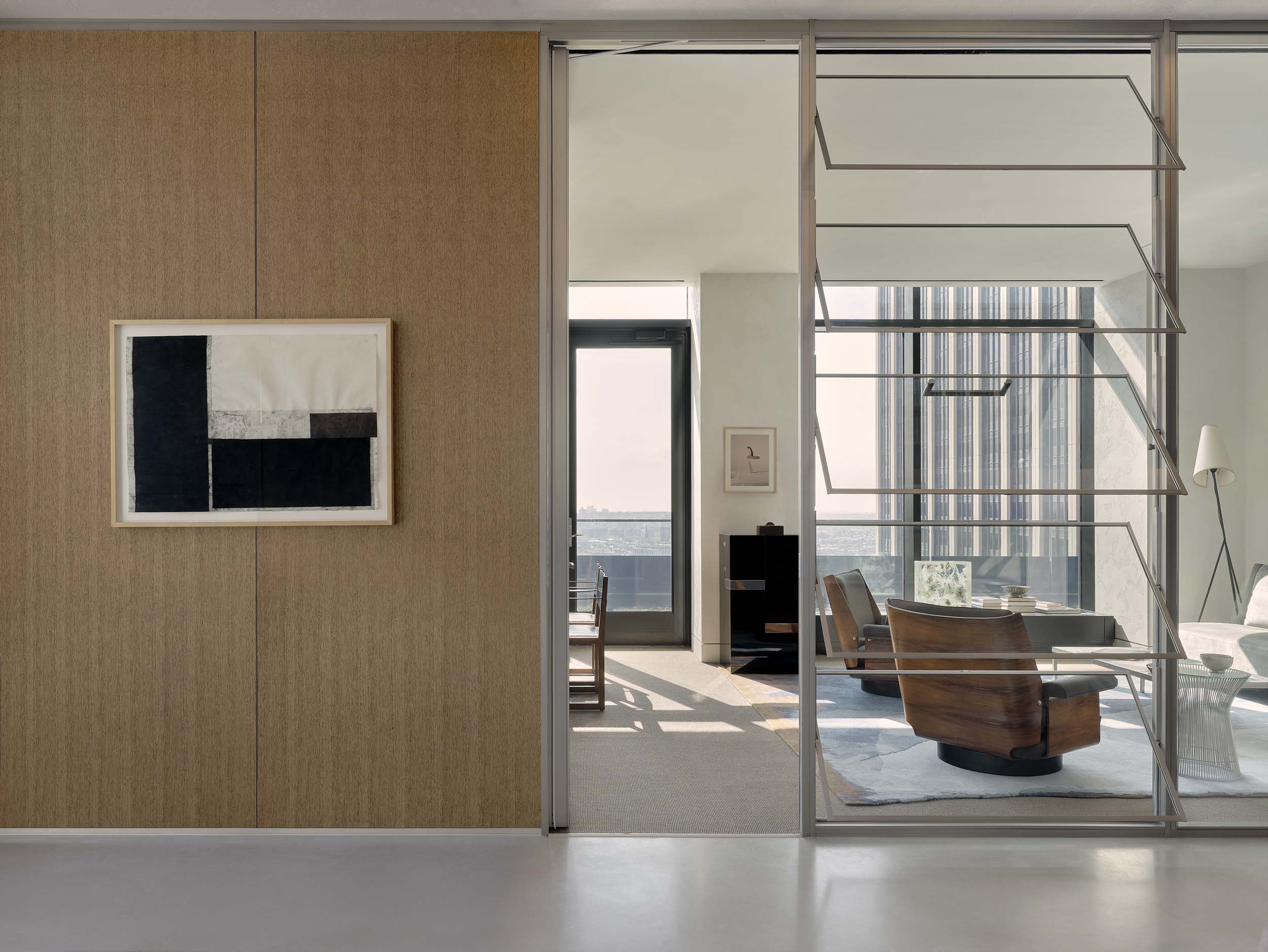
Even as major employers push for return to office in early 2025, few of their employees have welcomed the prospect of re-entering the over-lit, badly laid out, and acoustically unattenuated workplaces they left in early 2020—on a full-time basis at least. Being in ear-shot of those particularly disruptive gong-malleting sales reps has only been bearable three days a week. Adopting a future-forward aesthetic meets tranquil productivity approach, craft-led New York interiors practice Husband Wife, in collaboration with S9 Architecture, outfitted Wall Street hedge fund Alger’s new three level HQ to mollify these disgruntlements. Move over Mad Men Midcentury Modernism, the cues here are far more early movement: the experimental fair pavilions—rooms within rooms—imagined by Mies van der Rohe and of course, Carlo Scarpa.

“This key influence was born from the desire to create an open office environment that also has the capability to provide individual atmospheres for separate teams,” said firm co-principal Brittney Hart. “These pavilion-type spaces are used as anchor points that subdivide the space, offering a sense of intimacy within the larger floorplan.”


Conventional but cleverly implemented materials like stainless steel, wood, and glass cohere the multi-level office. While a 27th floor workspace has desks orientated along the perimeter to make the most of unobstructed views, the 28th floor social hub benefits from ample outdoor space with a scheme that champions the inherent modernist principle of blending indoor and outdoor. The 29th floor c-suite champions the guiding theme of thoughtful functionality.


“The use of oak, plaster, and concrete throughout offers a centering warmth while copious amounts of greenery provide an organic, almost subconscious aid in reducing stress and anxiety,” Husband Wife co-principal Justin Capuco added. Unlike most of the offices utilized in this industry, the environment was shaped with acoustic attenuation and ergonomics as underlying strategies.


The integration of essential technologies was also treated carefully. Another major source of inspiration was 1970s French futurism and sci-fi. Fully equipped conference rooms found throughout embrace the use of new devices but without overlooking the value of human connectivity. On top of that, the volumetric, leaning-amoebic quality of TVs produced during this era informed how Husband Wife introduced daylight-mimicking luminaires. The aim here was to reduce the all too real strain of working on screens all day.

“Embodying connectivity and livability in the workplace with employees returning to the office in a ‘post-pandemic’ world, the space was designed as a place, not shut in from the outside world, but constantly reaching out for it,” Hart explained. “No matter where you find yourself in the office, there’s an ever-present sense of balance through external stimulation—from sweeping views of the East River and the Empire State Building to internal gardens to gallery wall corridors.”


As within any shared environment worth its muster these days, the office was staged with a carefully curated selection of art, adding, perhaps, to that domestic layer which is so appealing to employees. Seamlessly concealed cabinets—hiding the hurried clutter often associated with financial industry workplaces—and customized workstations—denoting the function of different teams—help bring in that idiosyncratic complexity as well.

The overall goal: creating a space that can both accommodate individualized and collaborative work. “We wanted to establish a balance of privacy and togetherness,” Capuco concluded. “While fostering camaraderie and flexibility through an open environment, sensitivity was seen to as well through the use of acoustics and double-glass walls with sealant. There’s a sense of airiness and honesty throughout the space while allowing for the security of ’closed door’ privacy through discreet design elements.”