
Rice University’s MD Anderson Hall is a school of architecture building that is imbued with historical significance. The building was originally designed in 1947 by Staub and Rather in a traditional brick Neoclassical style and renovated by James Stirling and Michael Wilford in 1981 to expand the school and update the facilities. Its location on the central quad of campus provides a close connection to the heart of the university visually and contiguously. Kwong von Glinow, a firm practicing out of Chicago and founded by Lap Chi Kwong and Alison Von Glinow, renovated the interior in a way that would honor its rich history and provide needed space for students and faculty.
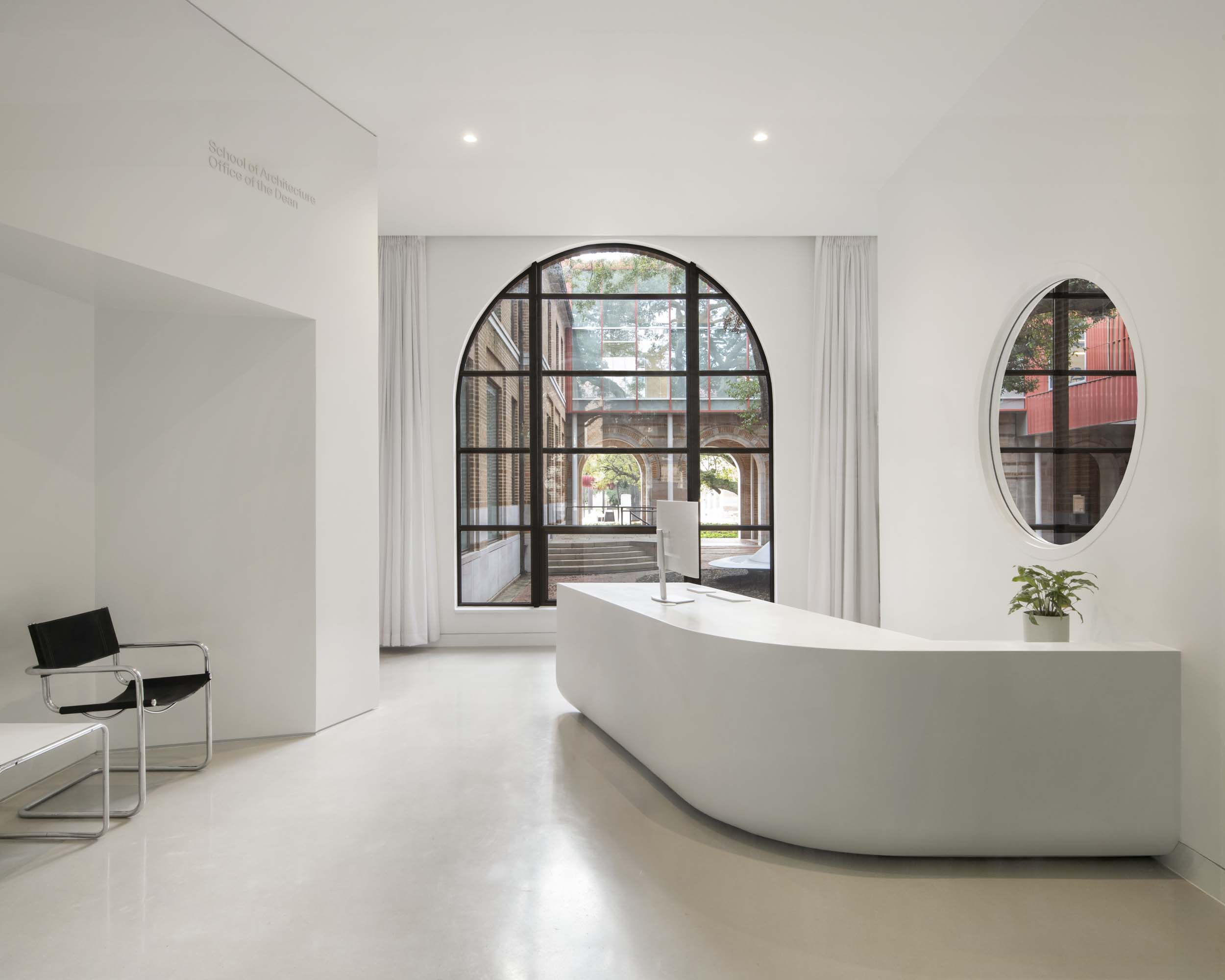
The interior renovation included three new spaces situated along the building’s existing central axis and main gallery space: a welcome center and receptionist right off the quad, a student and community forum on the second floor, and a faculty lounge and new offices. The 3,775-square-foot project was completed in the fall of 2024, following meetings with both faculty and students to determine the programmatic needs of the school. Ultimately, the design goal of Kwong von Glinow was to “find” space that worked with the building’s existing lineage and physical footprint.
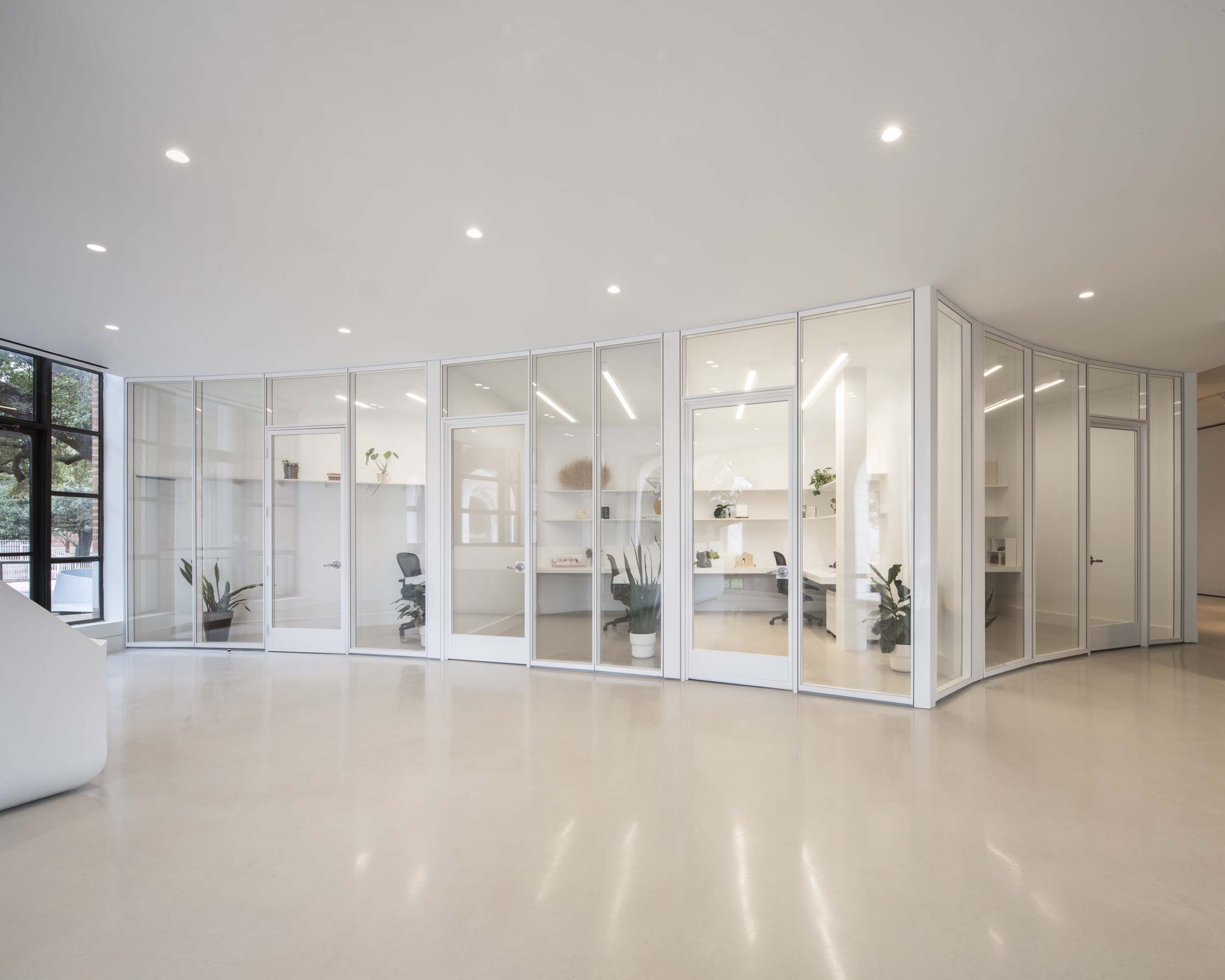
To accomplish this, Kwong von Glinow studied the drawings for the original MD Anderson Hall design. Referencing both Stirling and Staub and Rather, they were able to find key moments where the two designs intersected and chose to highlight the connections and integrate them into their new design. For example, a diagonal wall with an exposed column in the Farish Gallery space was kept intact, as it proved to be a point of intentional convergence of the original 1947 design and Stirling’s 1981 addition. “We like that balance and wanted to find something similar to that,” explained Alison von Glinow. “An ode to that [subtlety] is how James Stirling mitered the original building with his building using the angled wall. So the angled wall plays a large part into how we oriented our spaces and connected to his design.” Despite the potentially awkward geometry it creates, the diagonal wall was kept and serves as a basis for the new wedge-shaped faculty offices, whose curved glass walls accommodate the diagonal formally, and communicate transparency and hospitality to students as they enter the building.
The connection to the surrounding campus, initially enhanced by Stirling through a series of added entrances and vistas to the historic oak trees beyond, was further engaged by extensive glazing, replacing a solid brick wall that faces the quad. This visual continuity between the welcome center and the quad is highlighted, literally, by the interior materiality, which glows with a glossy epoxy floor and a white sculptural reception desk. This literal and figurative reflectivity of Stirling’s design is also seen in a carefully placed mirrored column that structurally supports but visually disrupts the new large window. The member is a deliberate reference to one of the most iconic images of Stirling’s addition: a singular column placed ironically in the center of a doorway in an otherwise monolithic and restrained brick facade.
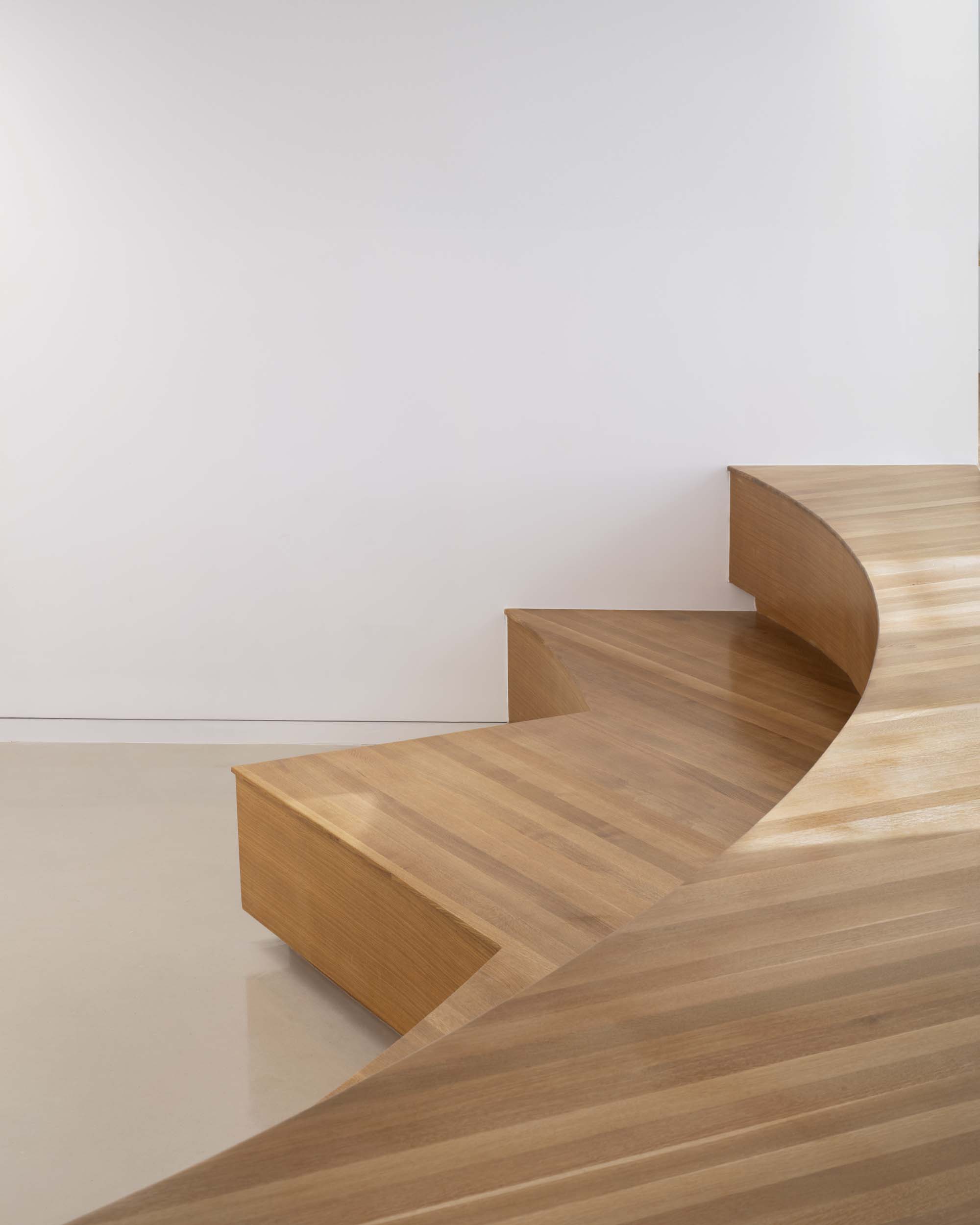

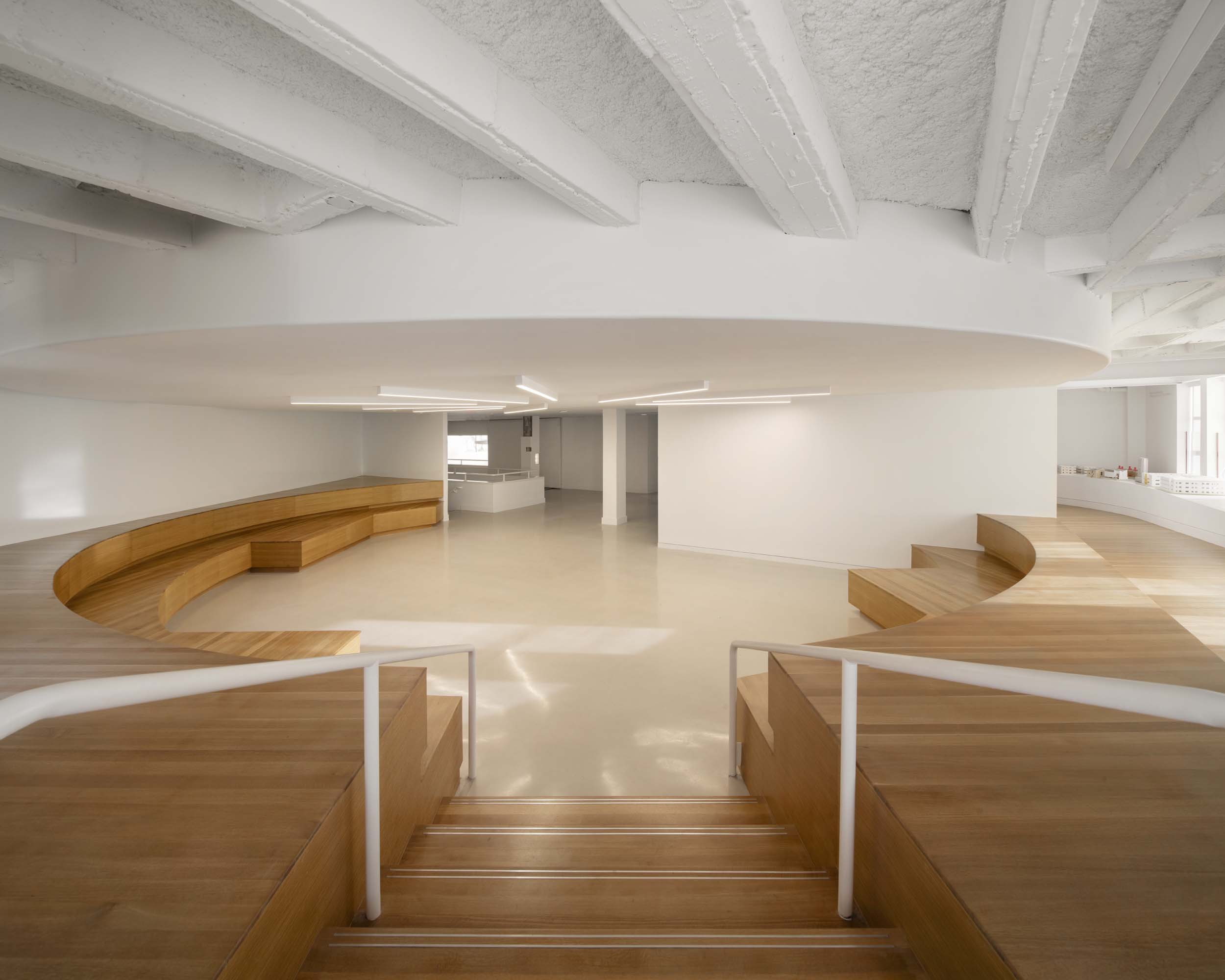
The interior surfaces are gallery-white, fostering flexible pin-up spaces vital to an active school of architecture while respecting Stirling’s all-white design. Touches of warmth, particularly in the more casual lounge spaces, soften the effect. Kwong von Glinow met periodically with student representatives, who expressed their need for a communal space outside of the working walls of their studios. While pin-up walls are available, the student and community forum is “a bit of a casual space,” von Glinow noted. “We wanted to design something that wasn’t so prescriptive.” A tiered semicircular platform that circulates the periphery of the room serves as informal gathering benches, model display platforms, and assembly seating. The form and material of the platform prevent it from feeling overly ceremonial, with warm wood in alternating grains and occasional orthogonal “piers” providing geometric variety and contrast.