Frank Sinatra, Marilyn Monroe, and Elvis Presley were once regular patrons of Las Vegas’s 70-year-old steakhouse, Golden Steer. Just off the Strip, the establishment, the city’s longest running steakhouse, is a time capsule of a bygone era of mobsters and gangs (who also frequented the restaurant), aptly housed in vinyl-clad, carpeted interiors of yore. Its first expansion lands in New York’s One Fifth Avenue, a building that brings its own history. The nearly 100-year-old art deco building was host to the likes of Patti Smith, Robert Mapplethorpe, and Keith Richards. Local firm Modellus Novus married both Vegas and New York mythologies for a sinfully decadent synthesis of East meets West, past meets present.


Spacious revolving doors, the original doors to the historic building, create a portal into Golden Steer’s world. A millwork-clad entry lies beyond, a nod to the mahogany-rich One Fifth Avenue residential lobby nearby. The millwork and cupped wooden column panels set a cozy backdrop for glitzy fanfare: a wooden casino roulette wheel from the 1960, set into the wall paneling, and floor-to-ciling gold fringe curtains rise up near the hostess counter, while overhead orbs of glass lighting appear to go through the ceiling (the trick of a mirrored plate at the top).


In place of mimicking the original restaurant or typical Vegas kitsch, Modellus Novus layers references to the spirit of the city and original location. Custom stained glass mirrors hang above reception and on double doors, crafted by the same artisan responsible for the stained glass at Golden Steer Las Vegas. A custom floral-patterned carpet winks to the carpeted interiors of the original space but with an elevated twist, and throughout the space vintage spurs lend a sense of the old western without falling into pastiche. (It also takes the place of the guns that lined the Vegas outpost, but could not be used as decor in New York.)

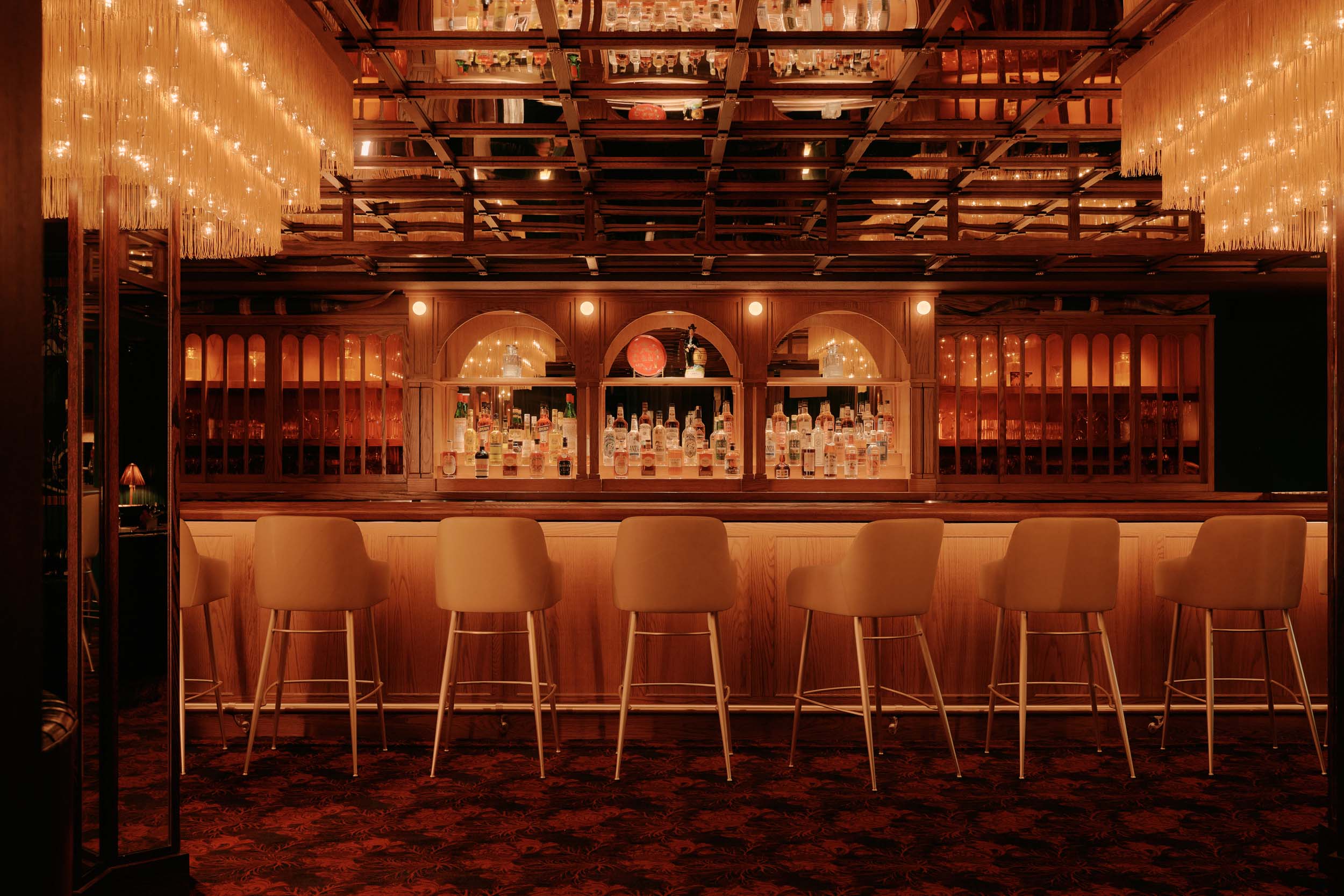
Through the double doors, the cocktail lounge illuminates the darkened entry. Star-shaped columns rise to meet a ziggurat of fringe. They appear endless as it meets a mirrored ceiling, a design chosen to reference the bygone Central Park Casino of the 1930s. A 16-seat bar of cherry wood anchors the space, opposite large tufted booths.


Walk past the life-sized, vintage Doc Holliday slot machine to find a corridor referred to as “The Strip.” The hallway of booths connects the cocktail lounge to the main dining room, and gets its name from the strips of millwork that clad its walls (in place of the vinyl stripes that adorn the first Golden Steer.) Modellus Novus, which delved into the archives and collections at the University of Nevada to design the space, also helped source some of the famous Western paintings that adorn the walls.

In the main dining room, more columns are wrapped in wood in tandem with the lobby next door. Lighting by In Common With and Santa & Cole use contemporary fixtures to illuminate the space steeped, yet not confined, to a wealth of history.