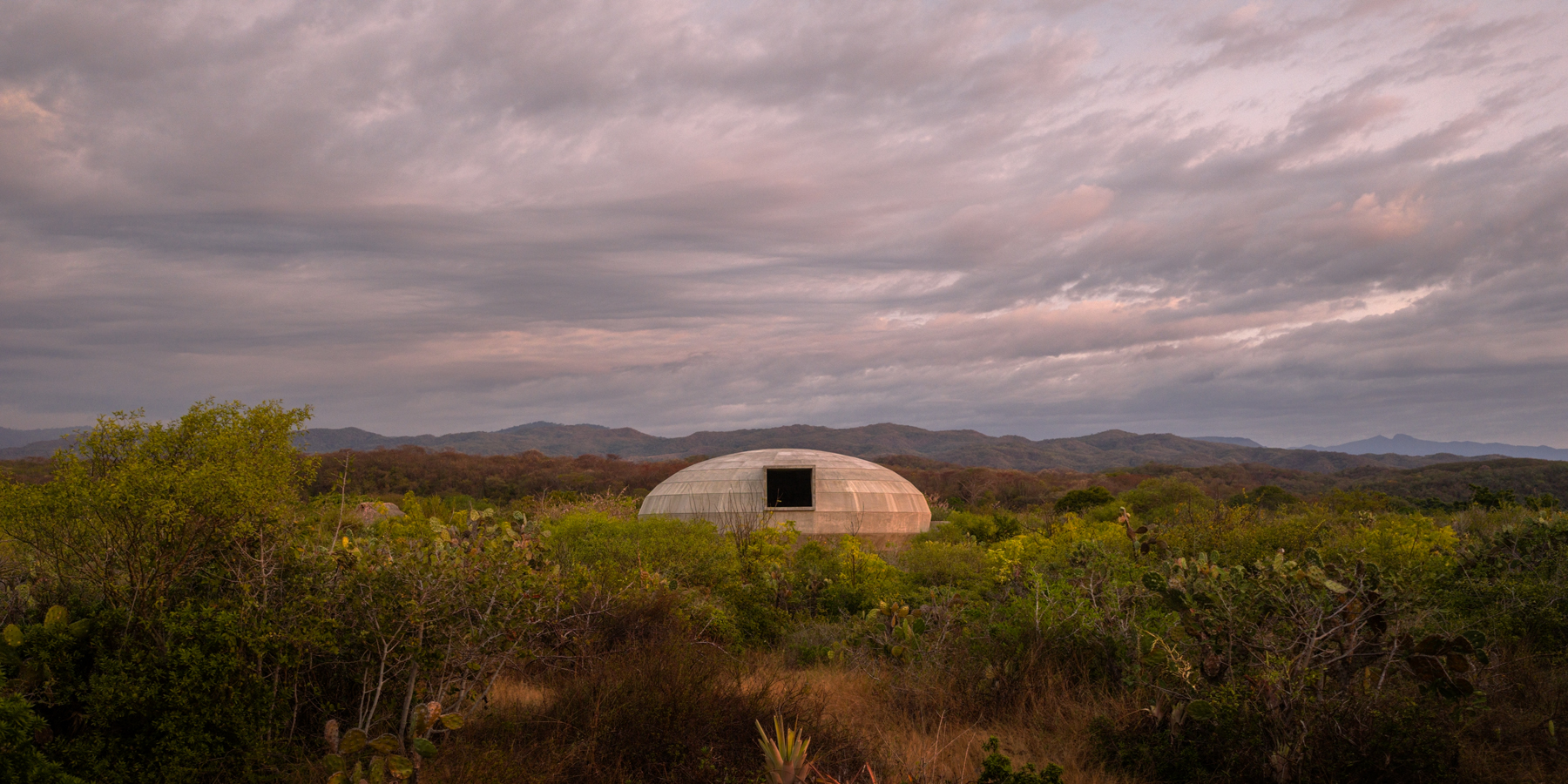
Fundación Casa Wabi, a foundation that fosters connections between artists and communities, operates out of its headquarters in Mexico’s Puerto Escondido, an artist campus by Tadao Ando and defined by its 1,024-square-foot-long concrete wall. OMA recently added onto the campus with its own concrete-clad Mushroom Pavilion.

Dedicated to growing mushrooms and creating connections between art, food, and nature, the Mushroom Pavilion blooms up above the ground. The building’s ellipsoidal form, which curves inward at its base to minimize its mark on the land, is structured by troweled and poured-in-place concrete. Burlap is stamped on the exterior to retain the site’s high-iron water content. The exterior is designed to rust and weather over time, reflecting its own relationship with nature.

Inside, the pavilion is structured like a theater in the round. The bottom half of the bowl is stepped to provide benches for seating as well as shelves for handmade terra-cotta mushroom pots. The areas are portioned into three sections: a fruiting area, incubation area, and worker’s area.

The sections encircle an oculus at the top of the space, lighting both the interior and density of the pavilion. Another portal, a protruding box accessed at the top of the steps, grants views onto the nearby ocean. Two points of entry on opposite sides of the dome provide further daylight and cross ventilation.

“The result is an incubator of both food and community that’s spatially fit to support all types of activities for the locals, visitors, and the foundation,” said Shohei Shigematsu, a partner at OMA who led the project. “As a Japanese architect, it was especially meaningful to contribute an art campus guided by Japanese philosophy and spatial traditions.”