ONO’s latest project in Fairfax, California is dubbed Two-Fold Studio, but its functions are actually three-fold. The client, a family with two teenagers, approached Tyler Noblin and Max Obata’s office with a request to create a pavilion behind their home to accommodate a pilates studio with an attached bathroom; a ceramics studio with a kiln, storage, and kitchenette; and, when needed, a guesthouse. The architects delivered a design that weaves together all the programmatic requirements, while responding to the area’s surrounding nature.

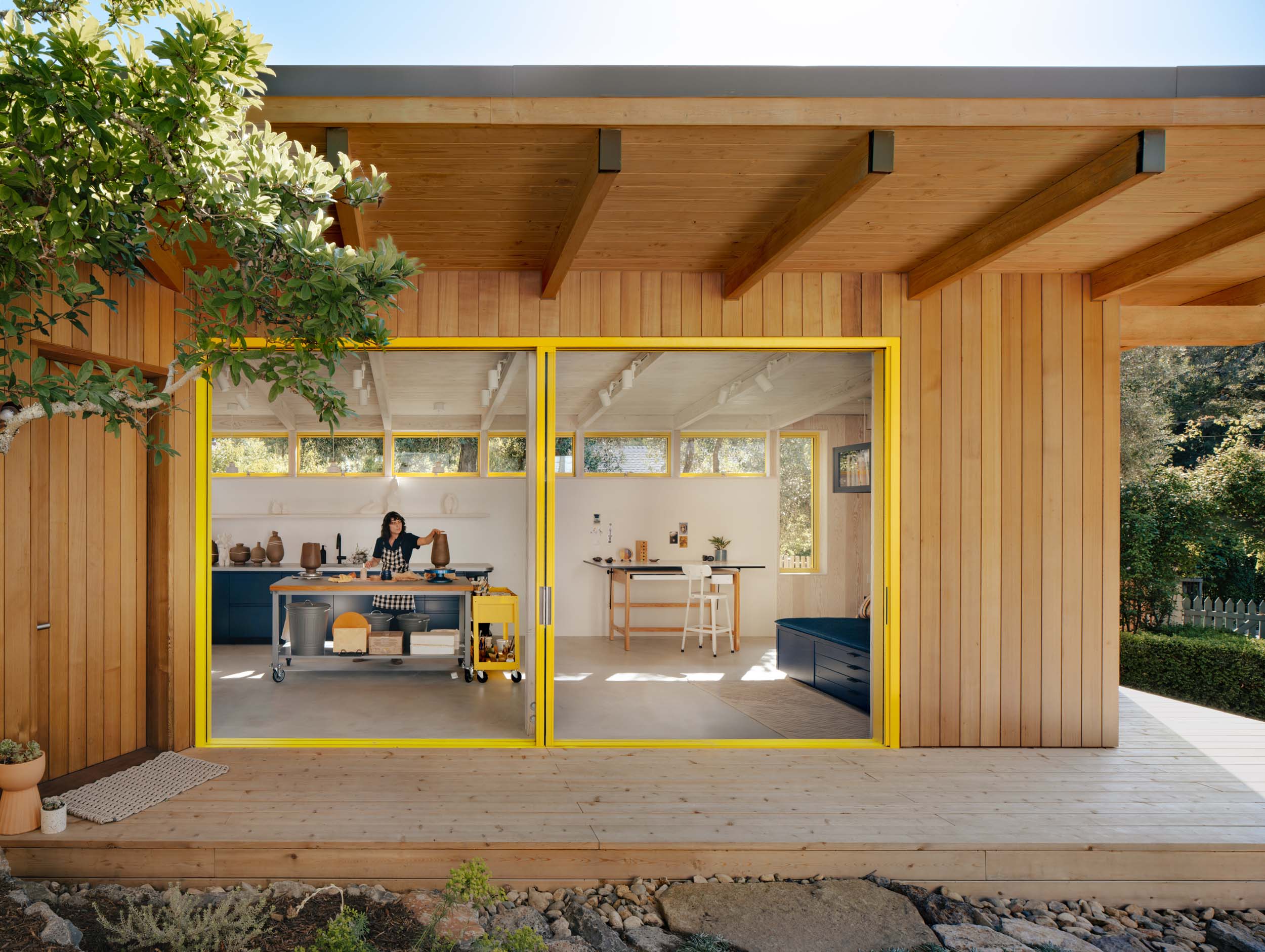
The new 800-square-foot structure is clad in a wood shingled facade that ties to the original home. The building contorts into an L-shape to fold around the pre-existing trees in the yard. ONO looked to Ryoan-ji Rock Garden in Kyoto for the design, treating the structure as a viewing pavilion to create camaraderie with the landscape. Sliding glass doors, cheerfully framed in yellow, open up a side of the structure to the outdoors. It creates a small patio that lines the building, further emphasized by the roof’s overhang.

The side with the glass doors houses the ceramic studio. More wood continues inside here, including for the beams on the ceiling, echoing the roof’s overhang. It’s brightened with blue cabinets and shelving, as well as zinc countertops, chosen for the way it will patina into a silvery blue to match the rest of the furnishings.

A long desk provides a place to work on ceramics, but placed in front of the kitchenette, it also doubles as a place to whip food together. It lies adjacent to the nearby kiln, tucked away into a niche in the wall.
The rest of the room extends into a more informal space with a desk for working and small built-in seating for relaxing. The room is lit by clerestory windows that enable sightlines to the surrounding tree canopies but crucially block neighbors from staring inside. The clerestory continues into a vertical window, forming another L-shape when viewed from the street.


The L-shape is more than a response to the site; it’s also a way to divvy the home. The elbow of the structure, where one side begins to turn to the other, marks the transition from the ceramic studio into the pilates studio. A pivot door grants entry to the latter, though it’s also accessible by a separate entrance so both studios can be used simultaneously without disturbing each other.
The pilates room takes advantage of its position, incorporating slim floor-to-ceiling windows that allow natural light in. With wood flooring and a neutral color palette, the illumination easily brightens the space. It’s also easy to imagine adding furniture to the vacant room when needed to create a place for a guest to stay.


The room opens up into a bathroom, where the architects swapped wood for plaster. The material adds a layer of warmth and softness to the space while continuing the design’s natural material language. More pops of blue and yellow make an appearance, tying the pilates side to the ceramic side. The design connects both halves together and the structure to the site as one seamless whole.