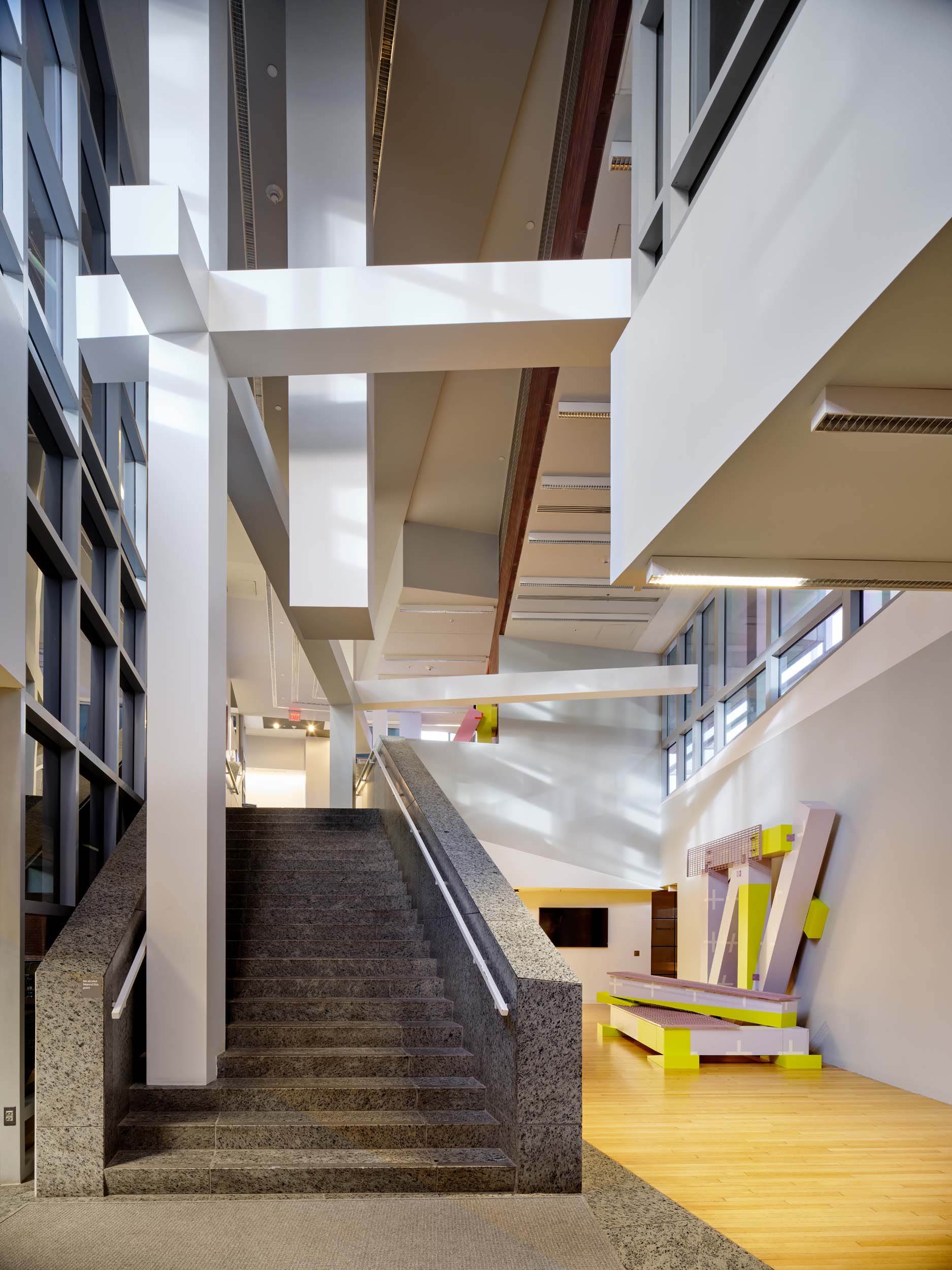
A grid of scaffolding and spilled brick silo coalesce into Peter Eisenman’s Wexner Center for the Arts. Each seemingly unrelated element comes together to form the iconic building that connects the Ohio State campus to the greater city of Columbus. Functioning as a public gallery (it’s not a museum, as it doesn’t collect art), Wexner plays a very public-facing role for the institution, though it still feels off-limits to many. Running with this idea, local practice Outpost Office designed Color Block No. 2 to activate the center’s unusual architecture at the request of Wexner curator Kelly Kivland. The furniture objects are site-specific, but flexibly designed to have a second life at new sites.

The furniture pieces placed around the museum’s campus are collage-like. Boxy columns lean up against one another, while others lay horizontal or stack to double seating capacity. Some pieces were nestled into right corners, and others were installed in open venues outdoors.

Each was conceived to generate informal gathering. While designed to be functional, much like the building they occupy, they too can be viewed as art objects. It’s the blocky forms and heavy use of color—bright pink, pastel purple, and neon yellow—that make Color Block No. 2 both stand out and homogenize.


Outpost Office founders Ashely Bigham and Erik Herrmann told AN Interior that the locations of the four pieces were informed by Wexner-staff-favorite spots around the campus. Many are in between places they wish the public noticed more.

“We didn’t want context-specific to mean that it just tries to blend in,” Herrmann said of the installation. “We didn’t want it to match. We wanted it to bring new qualities to its surroundings.”
Each piece is unique in its massing and was fabricated using paint, plywood, powder-coated metal, and vinyl decals. Local fabricator Edgework Creative suggested using Duraply, a sustainable plywood harvested from European poplar. The material is water resistant and lightweight.

Bigham and Herrmann had ideas on how the pieces would be occupied, but the seating was largely designed to be unprogrammed. The firm was excited to see the unexpected uses the objects play host to—so far, uses as diverse as a puppet theater and a backdrop for protest signs.