
Architects often strive for a sensitive response to context, yet few achieve it with true conviction. In his Phillip Island house and guesthouse, Australian architect Richard Stampton—now based in Los Angeles—demonstrates a deeply site-responsive approach, engaging with the property’s original building fabric and the region’s ever-changing climate to craft a meaningful base for visits to his homeland.

Enamored with the texture and urban rhythm of the coastal hamlet, Stampton took cues from the island’s local vernacular—specifically, its original fishermen’s shacks, one of which had stood on the site for nearly a century. With their consistent roof pitch and timber-framed construction, these utilitarian structures informed his approach. “I saw the ubiquitous style of construction—two-by-fours in a frame with bracing elements—as a historical aspect of the site that I wanted to key in with,” he told AN Interior.

While many might have deemed the architecture unsalvageable, Stampton valued each element’s siting, construction, and urban contribution. “We painstakingly restored the structures, removed a 1970s lean-to, and replaced it with a structurally sound addition with the same footprint,” he described. This careful act preserves the site’s porous layout, now consisting of a main residence and studio, complemented by a separate guesthouse and sauna.

Before shaping the project’s new interventions, Stampton camped on-site to experience Phillip Island’s extreme weather firsthand. “Light changed regularly and dramatically: thin cloud with diffused light, then darkness under a black cloud, then brightness again as the wind picked up,” he recalled. These observations led to the use of translucent screens as a guiding design move—an idea reinforced by Stampton’s frequent study trips to Japan, where he admired the architecture framing seasonal shifts.


A series of translucent panels scale the home’s northeastern wall, tempering light while sheltering occupants from wild winds and rain. At night, the panels cast a gentle luminosity, subtly revealing the shack’s original timber structure. “From the street, passersby see a glimmer of light through the trees and catch a glimpse of the shack’s framed form,” Stampton noted.

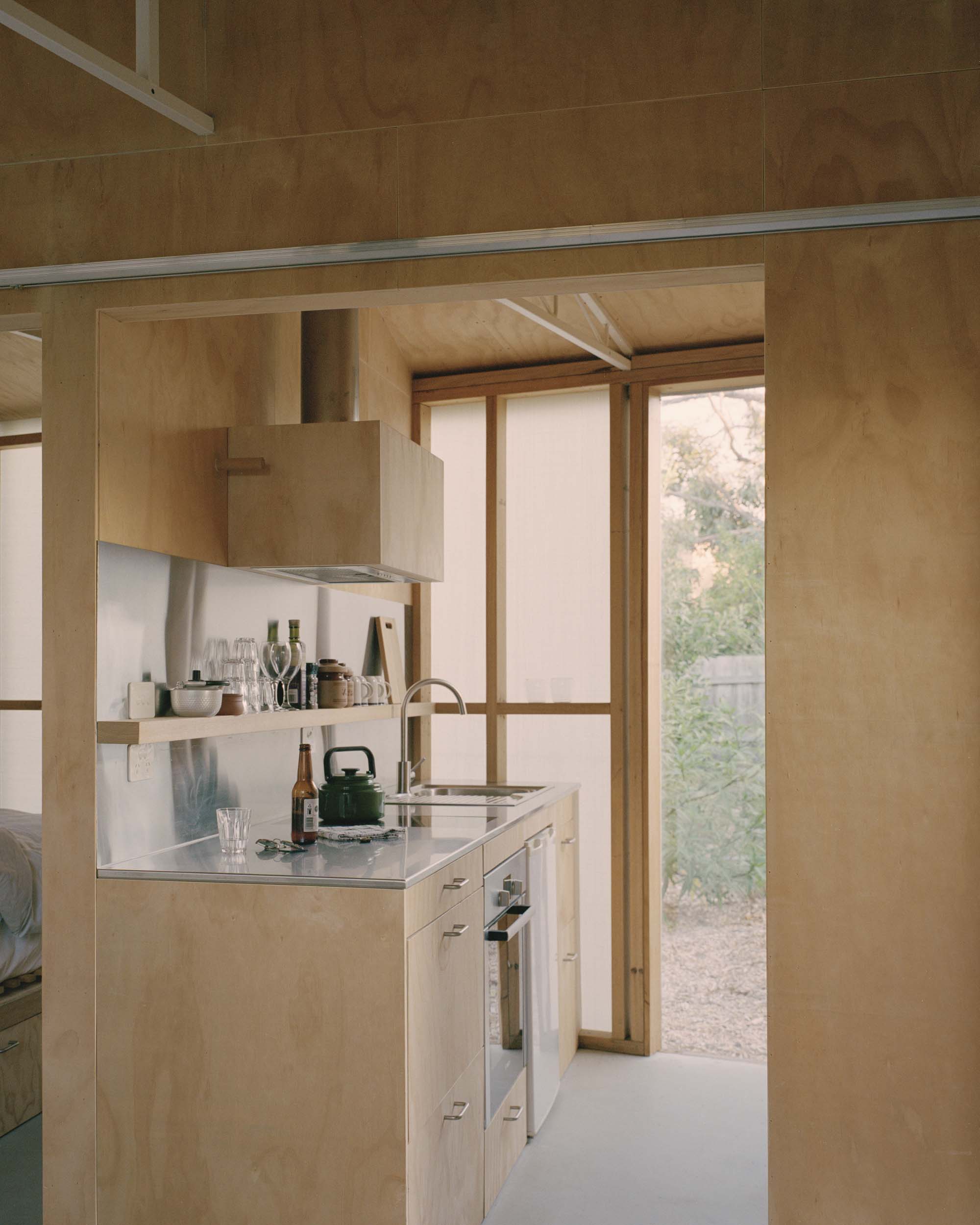
The home’s original central entry remains, with an office positioned to the south and the kitchen to the north. Living spaces sit between, anchored by a central fireplace to disperse heat. The reconstructed lean-to houses two bedrooms and a bathroom, each with garden views. Sliding doors allow light and views to be shared between volumes, and freestanding joinery subtly divides work and living zones, affording the compact space a sense of openness.

The original timber floors, revealed after layers of tile and carpet were removed, restore the shack’s historic warmth. New plywood wall linings and compressed cardboard ceilings introduce low-impact, readily available materials that honor the shack’s humility with a contemporary hand. Stampton’s bold use of color, inspired by Le Corbusier’s “Cabin by the Sea,” includes the raw aqua primer of the sliding doors—which he loved too much to paint over—complemented by green, yellow, and blue accents. “Color takes experimentation and confidence,” he reflected. “I recently painted the ceiling pink. Next year, I might try something else.”
The garage turned guesthouse features translucent screens across two elevations, while the conversion of the outhouse into a sauna offers a moment of respite. Beyond these uses, the project redefines the site’s in-between spaces. “We adjusted the sauna’s angle to create a dynamic spatial arrangement, carving out wedge-like garden spaces that function as courtyards,” Stampton explained. By carefully positioning windows and entrances and infilling the site with landscaping, the project skillfully balances privacy and connection.

More than a restoration, Stampton’s Phillip Island house and guesthouse foster a dialogue between past and present. Through careful spatial reconfiguration, material choices, and an attuned response to site and climate, Richard Stampton Architects has transformed a ubiquitous form into a place of special significance. Acknowledging the shack’s contribution to Phillip Island’s collective integrity, the project functions almost as an urban intervention despite its small scale—an act of resistance against commercial development and a demonstration that evolution and sensitivity are not mutually exclusive.