Milanese modernist Luigi Caccia Dominioni completed the Mondelli building in 1961, a seemingly shiny rational building atop Milan’s Piazza Carbonari. An irregular window arrangement, clinker facade, and the vertical, flush elevator visible from the outside are telltale signs of Caccia style. If it’s not enough to contend with this modern legacy while renovating one of the building’s apartments, Tenet took the project as an opportunity to experiment: What would an architect on the level of Caccia do? And how do you mediate between 20th-century architectural history and contemporary living? The project, Self Modern, answers these questions by dialoging with and then disrupting these connections.

The residence is situated on the first floor of the building. At 1,076 square feet, the unit was originally oriented in a rationalist style. Private sleeping quarters and social gathering spaces were clearly divided. A large glass door and oblique wall separated the hallway from the living room, and a red wardrobe distinguished a bedroom. Tenet reorganized the space, breaking up the linearity in the main corridor with more angled walls. Now, the kitchen is an office space, the entrance has been reshaped and compressed, an ensuite-bathroom was added to a bedroom, the new kitchen takes the space of a former bedroom, and the kitchen now opens up into the dining room and living room.


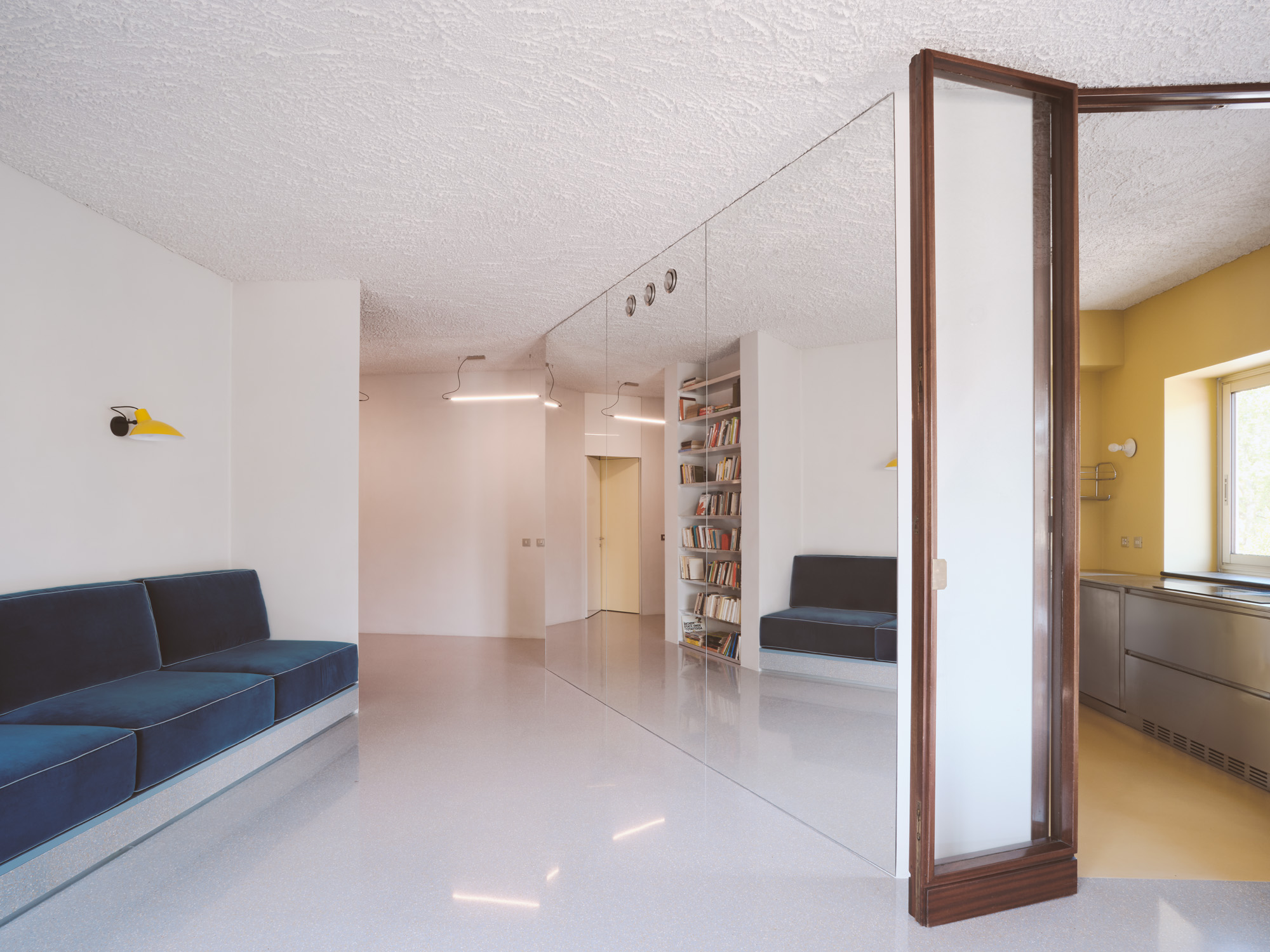
In this new orientation, the original oblique wall now divides the kitchen from the living room. These spaces emphasize the meeting point of new and old. A bold palette of materials refreshes the space, from the yellow-clad walls of the kitchen to the stainless steel counters. Alongside the new appliances are hints of the past: a bright red storage unit that recalls the defining feature of the space when it was previously a bedroom, and glass doors slotted into a wood frame, similar to the ones used in the original design.


The kitchen was opened up on either side to flow into the dining and living space. It lies on the other side of the oblique wall, which is covered in mirrors. Underfoot, reflectivity continues in the glossy finish on the floors. It extends to the steel shelves used in the built-in shelving along the window wall and the dining table set. Tenet contrasts that smoothness with texture like the blue velvet banquette and stuccoed ceiling.


Elsewhere juxtaposing materials continue to collide. The architects mixed raw, analog materials with newer, rigorous ones: custom terrazzo tiles, steel cabinetry, and resin finishes. In one bathroom, a deep blue dominates the interior. The blue appears again on the wardrobe in the bedroom.


Self Modern experiments with an intervention that is both contextual and distinct. “Continuity and disruption are two sides of the same project,” said the firm. “The dialogue between old and new is ongoing and dynamic.”