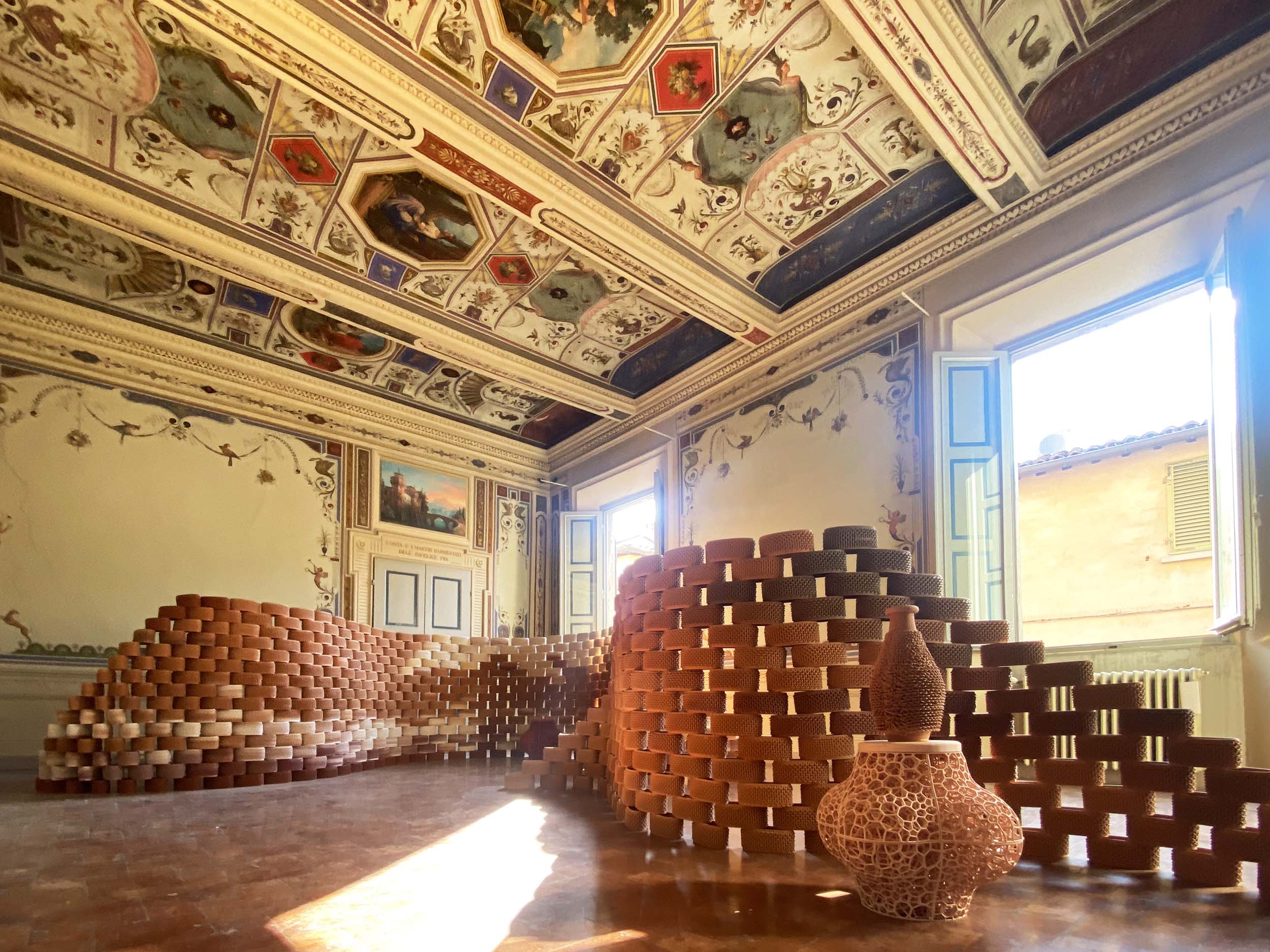
Virginia San Fratello can be found traveling with a 3D printer, self-modified to tuck neatly into a hard-shell golf case on wheels to easily carry through the airport. San Fratello, chair of the department of design at San Jose State University and cofounder of 3D-printing company Emerging Objects, traveled to Faenza, Italy with this setup in tow. The town is home to an international fair of ceramics, Argillá Italia. For the 2024 edition, she staged Future Archeologies 2049, an exhibition supported by Faenza Center for Ceramic Art and WASP3D that places her 3D-printed ceramic bricks within a historic frescoed interior from the 1800s. The installation finds harmony between modern technology and historic interiors, locating the design possibilities of 3D printing within architecture.
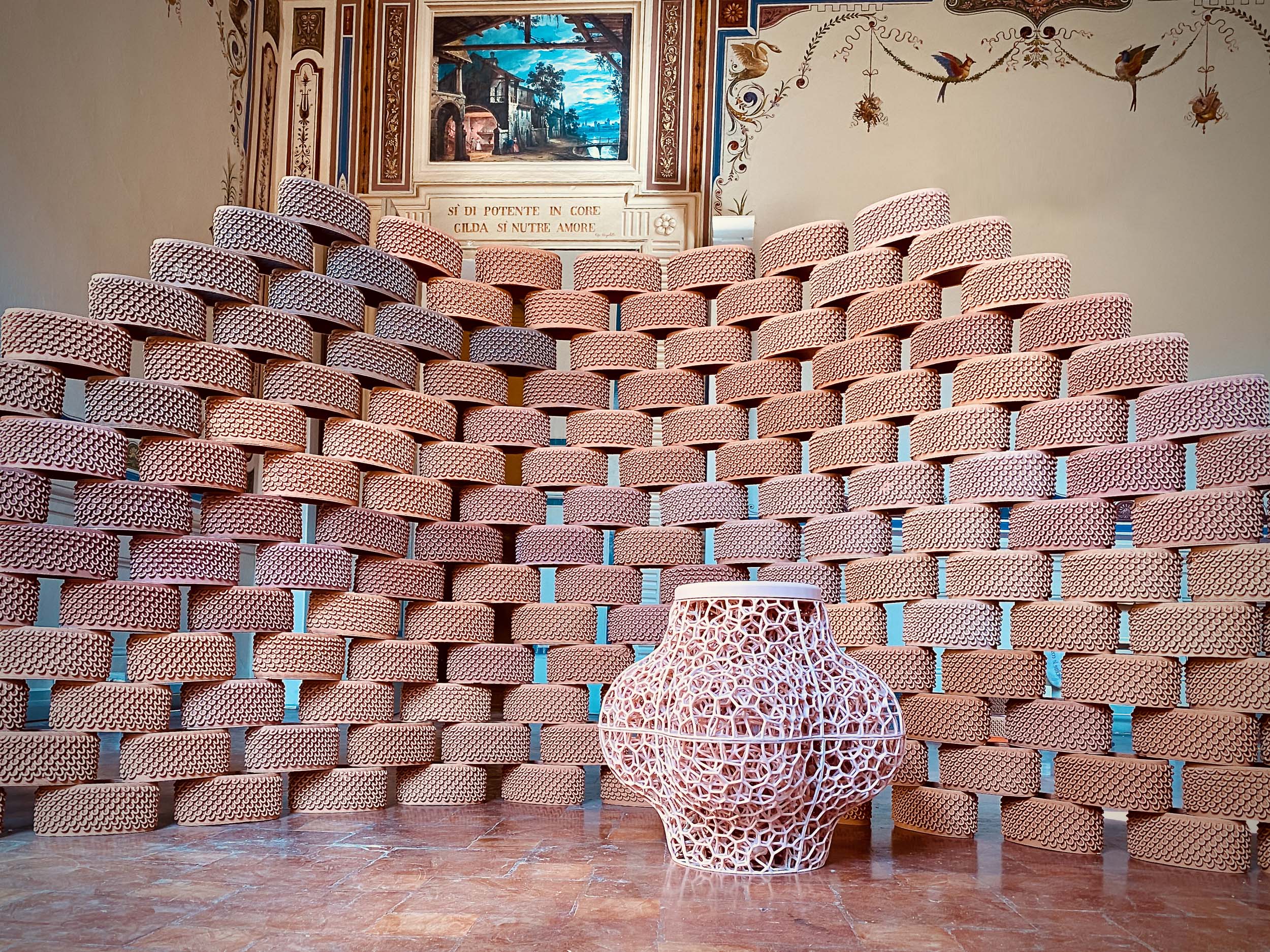
Nearly 1,000 of these printed bricks are stacked atop each other to form a curving wall. While it intervenes through the historic building, the brick walls also cohere with their surroundings, visually and materially. Brown, beige, and reddish hues that make up the bricks also appear throughout the room, and the plaster and stucco buildings found around Faenza. The clay used to print the bricks is local, stemming mainly from the Lamone River, keeping the tradition of the city’s long ceramic history.
The bricks themselves are intricate and delicate, featuring a lacey, crochet-like texture. This design lends the building blocks a light, feminine element. It’s backed by San Fratello’s own production team—and women-dominated ceramic history. “I set up a “mini” women-run, 3D-printing brick factory in Faenza as part of an artist residency I participated in at the Faenza Center for Ceramics and devised a plan for creating 3D-printed bricks that would take advantage of the beautiful soft red clay of the region,” said the creative technician, working alongside Marta Potenza, Frederica Cinque, Mira Principe, and Leela Sirdar. “I think of these as crocheted loop stitch bricks. They have a loopy texture that works well in interiors and is reminiscent of other soft materials we might frequently find in residential interiors. According to historical understanding, the first clay vessels were likely formed by women pressing mud into woven grass or reed baskets while carrying water, essentially using the basket’s shape to mold the clay and creating the early form of a pot.”
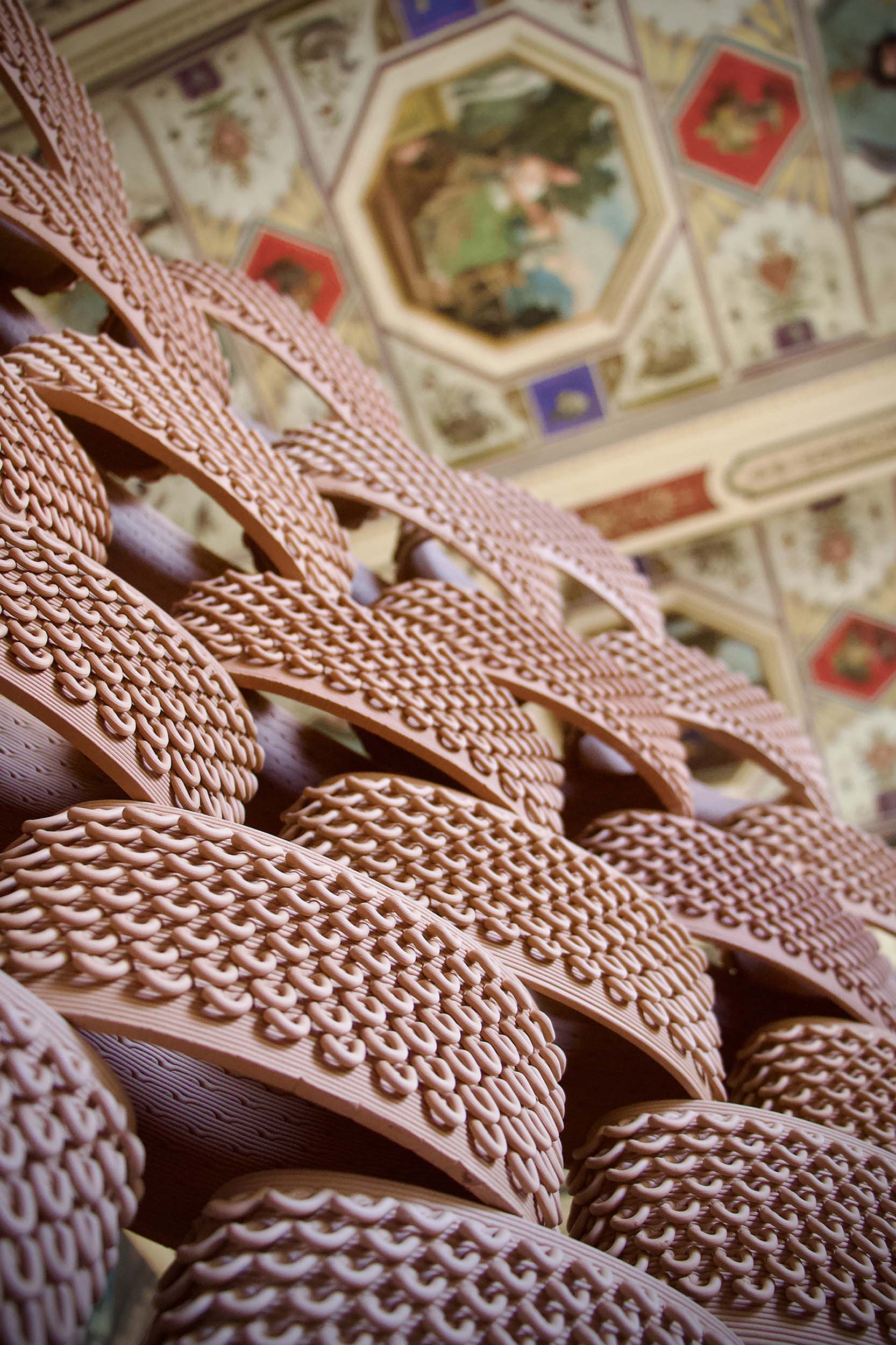
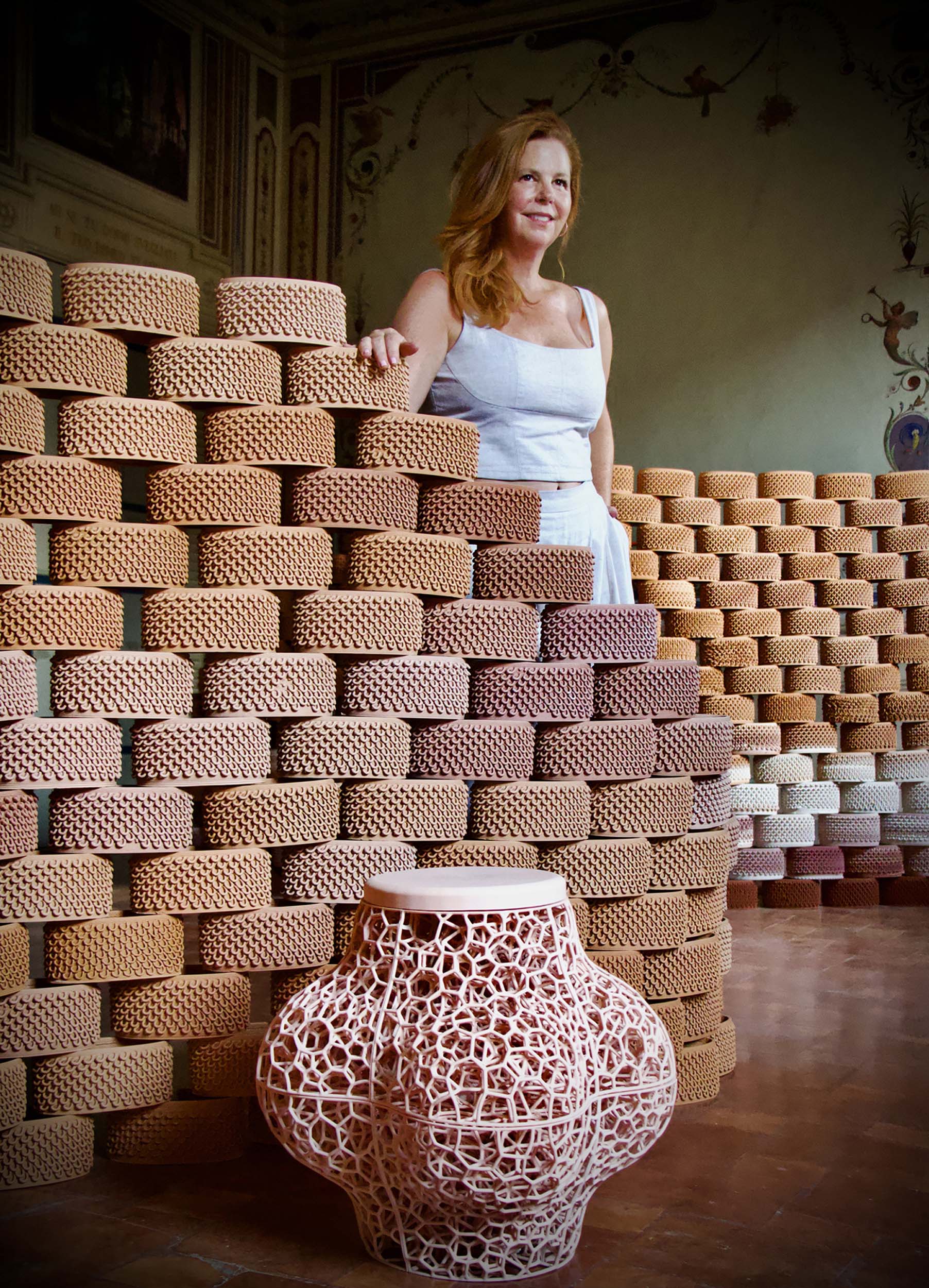
At the mini factory, the bricks are made with Potterware, a software application from Emerging Objects that allows for quick easy printing. With this system, it takes San Fratello five minutes to print one brick. One tube of clay can produce five bricks. Mason stains are added to the clay to achieve the dyes and fired at different temperatures to create the gradient of hues.
The title’s year, 2049, comes from San Fratello’s prediction of the future of ceramics. She told AN Interior, “It takes an average of 39 years for a new technology to become normalized. 3D printing ceramics was invented around 2010, so by this measure, we will see 3D-printed ceramic objects, interiors, and buildings as commonplace by 2049.”
Until then, the educator, designer, and author is continuing to push the innovations offered by 3D printing. “I am currently in the process of building a prototype of an interior screen made of bioplastic that has been compounded with wildfire wood ash from the CZU and SCU lightning complex fires in northern California in 2020. For me this material raises questions such as: How can we rebuild using wildfire waste? Could we rebuild using the ashes from the wildfires themselves? Can wildfire waste be used in conjunction with emerging technologies such as 3D printing to create bio-digital materials?” said San Fratello. The research, as she continued, “potentially opens the door for us to rethink the material of the interior.”