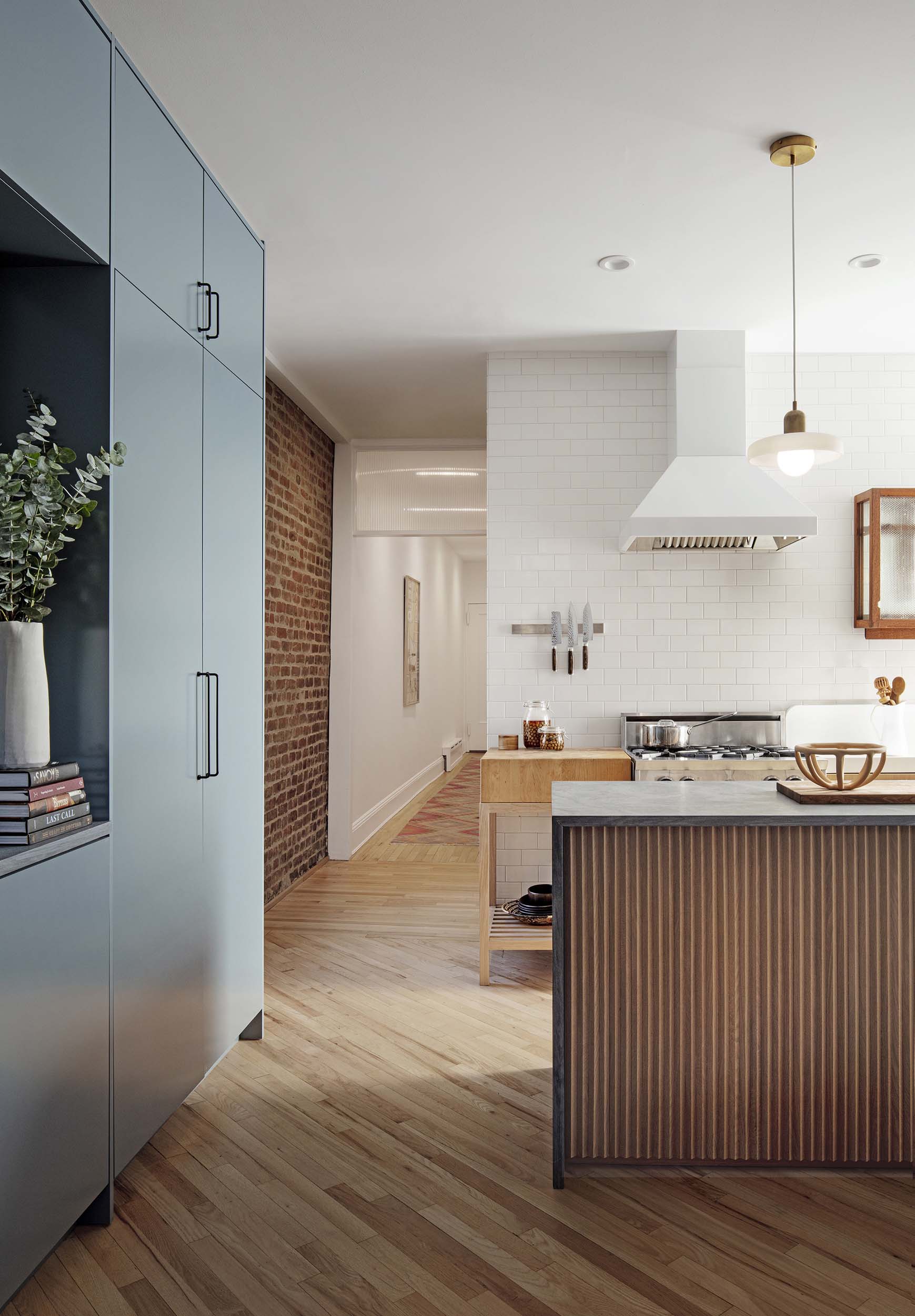
As any new parent will tell you, preparing for the arrival of a new baby is a lot of work. But preparing for a baby in New York City, where apartments are notoriously small and layouts difficult to alter, presents its own unique challenges. It demands that expecting parents fit an entirely new life into an already limited footprint—and often do so per the rules and regulations of the building they occupy. This was the situation one Brooklyn couple found themselves in before deciding to seek the help of a professional: Kalos Eidos.

Luckily for her clients, Ryan Brooke Thomas, founder of Kalos Eidos, has some experience with transforming constrained apartments into free-flowing dwellings. “[The clients] reached out to me because they knew they wanted to expand their family, but their space wasn’t up to the task,” Thomas explained. “It was a case of preemptive family planning through renovation.” The clients’ Fort Greene garden duplex, spanning 1,000 square feet over two floors, offered enough room for a family of three. However, the co-op board set two firm stipulations: The unit had to remain a one-bedroom, and the downstairs powder room could not be upgraded to a full bath. Additionally, the ground-floor living area was overstuffed with mismatched, off-the-shelf furnishings that disrupted the flow of traffic, while the subterranean primary bedroom was overscaled and therefore left largely unused. This presented Thomas with a challenge: How could she optimize the floorplan to make the modest home not just baby-ready, but also comfortable for the activities of daily life, such as entertaining and working from home?

She turned to a familiar solution: custom millwork. “Millwork allows me to achieve multiple goals in a project at once,” said Thomas. “It’s a simple way to solve several design challenges while enhancing the overall aesthetic.” On the ground-floor of her clients’ home, Thomas had a full-height wall of storage cabinets and niches constructed along an exposed brick wall. This new built-in opened a clear flow of traffic from the entry corridor into the open-concept living/dining area while providing her clients with plenty of storage capacity.

Thomas also used a millwork partition with cabinetry and open floating shelving to bifurcate the amorphous basement into two clearly delineated zones. The zone closest to the staircase became a lounge and home office. On the other side of the millwork partition, a sleeping and dressing area was constructed, which included new built-in closet space—the nursery now occupies the upstairs bedroom. “The millwork in this project is on double-duty: It acts as both a functional and architectural element, defining space while becoming an extension of the structure itself,” said Thomas. It also works in tandem with the architect’s insertion of new closet spaces throughout, a coveted detail in historic New York City apartments.

Thomas’s millwork magic also adds texture and color in a way that drywall partitions might not. In this project, the home’s open-concept design and the need to delineate different zones within a small space shaped the material and color selections. The clients wanted to highlight certain features like the exposed brick wall, the garden, the fireplace, and the staircase, but the variety of wood finishes from their existing furnishings distracted from these elements. Thomas’s plan to correct this involved a refined palette of neutrals and calming slate-blue hues that were borrowed from the co-op’s architecture. She’d then layer in textures and materials to maintain cohesiveness without making the space feel monochromatic. The slate-blue millwork on the ground floor became a key player—it complements the other materials while having enough versatility to work with anything placed in front of it. Thomas echoed that color downstairs with a slate-gray couch underneath the staircase.
In the end, the project couldn’t have been any more prescient: The couple’s daughter was born on the first day of construction.