Walking out of Homerton train station in London’s Hackney neighborhood, one is immediately surrounded by blocks of postwar social housing. The East End borough, home to Homerton as well as Hoxton and Shoreditch, has many reputations: For over ten years, it has been a hipster paradise teeming with trendy cafes, galleries, converted studio flats, and glamorous houses, especially near Homerton’s Chatsworth Road. But as recently as the early 2000s, it was one of London’s roughest areas.

A row of nondescript, 1970s split-level terrace houses occupies a block among this diverse mix, and one of these houses has been overhauled by local architect Johan Hybschmann for himself, his wife, and their son. Hybschmann runs a small practice called Archmongers that he founded with his university classmate Margaret Bursa in 2013. The two studied together at The Bartlett School of Architecture, at University College London, and spent a few years apart working at larger firms before teaming up. “The name of our studio is a riff off ‘fishmonger,’ like you’re mongering for architecture,” he told AN Interior. “We started our practice by doing our own houses quickly. Then we could show them. We were lucky enough to have been able to do that.” The proof is in the pudding: the U.K.’s design-led realtor Modern House has listed and sold five of their residential retrofits.

Back in 2015, Bursa renovated a similar 1960s terraced structure, akin to a traditional row house, for her family in north London. The duo went on to do several other residential revamps across the city, including a home for Bursa and, before this latest project, a first home for Hybschmann’s family just up the road.


After reviewing their portfolio, it’s clear that these homes act as laboratories for the studio. Many, including this one completed last year, known as Elemental House, feature quirky details like tiled floors and black rubber gym flooring for stair treads. These sturdy elements stand up to the wear and tear of coming and going in London’s often dark, cloudy, and wet climate, plus busy life with a young boy who loves to play outside in the communal alleyway behind the garden. Their rationale? “We wanted never to feel scared of fully using the house.”

After Hybschmann’s wife toured the derelict and blocky property a few years ago, they both jumped at the opportunity to begin again. “This is our house,” he said. “It’s not for everyone. It’s a testing ground for pushing ideas.” Archmongers stripped out the outdoor front steps, creating a more accessible entrance to the foyer. From there, stairs lead down two sections to the kitchen and dining area. A home office doubles as a guest room, and two bedrooms occupy the top level for the couple and their son.


With each project, Hybschmann and Bursa learn and evolve, honing their eye for detail in residential refurbishments. Aspects like longevity, natural materials, and functionality are key to any Archmongers project. The studio iterates with durable materials, especially wood and steel. “I referenced the Louisiana Museum of Modern Art, Denmark, which shares many of the materials [with the house],” Hybschmann said. “The museum buildings are the same as I remember them as a child, and they’ve aged beautifully with use.”


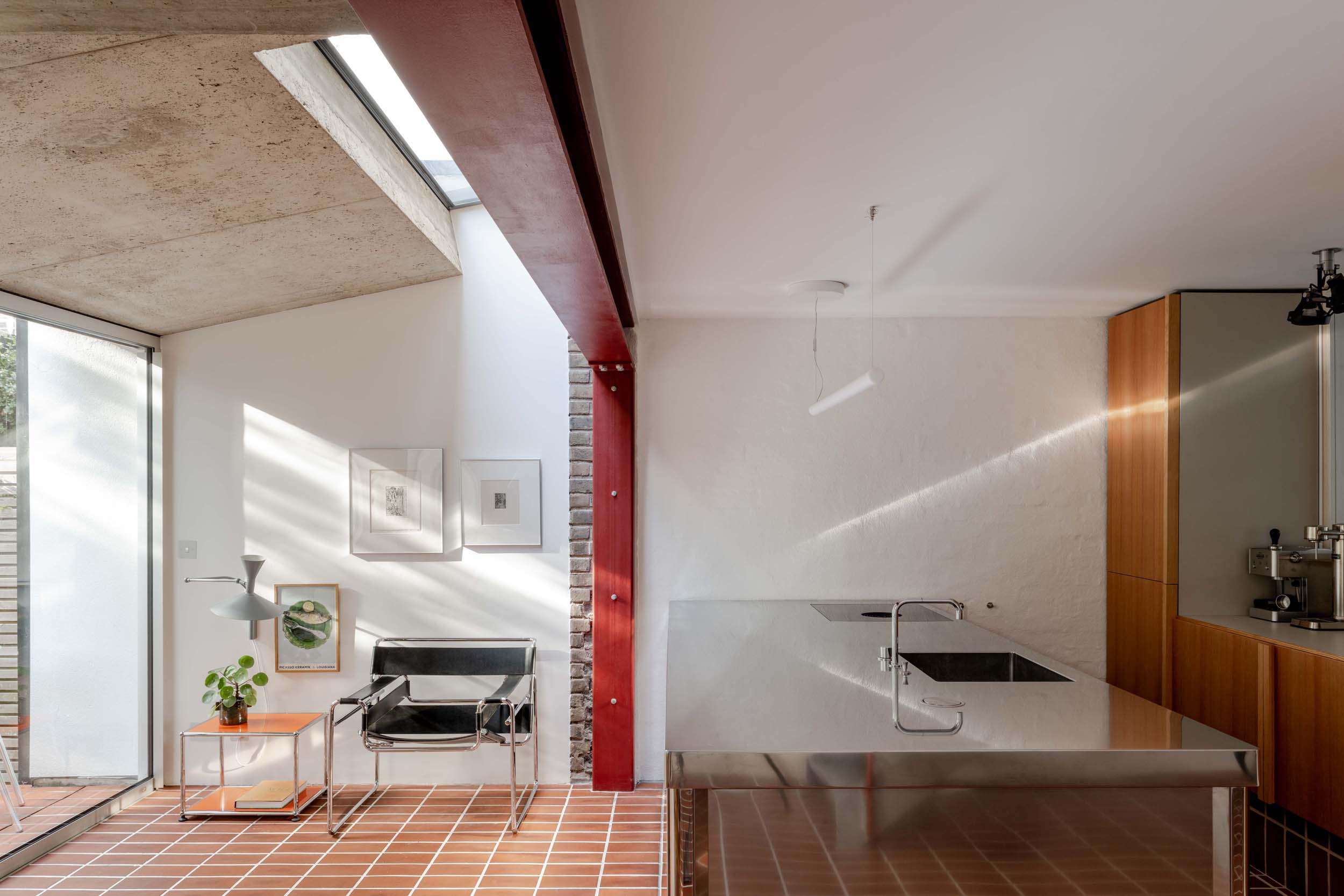
At Elemental House, a galvanized steel staircase opens up views from the front to the rear garden. The skinny structure was easy to assemble on-site and is “completely indestructible,” according to Hybschmann. A former garage has been swapped for a guest bedroom and home office, allowing natural light to penetrate into the core of the home via a translucent panel doubling as a kitchen backsplash. Upstairs, a living room replaces an existing bedroom. “The design is about making it tough enough to withstand the life that the house needs to take,” he said. “Some people would see it as industrial, but I don’t see it like that.”


The architect then opted for two techniques typical in his native Denmark. For the floors, he sanded down the existing wood floorboards and coated them with lye soap. Then for the walls, he lightly plastered instead of painting, a technique known as vandskuring. These noninvasive methods are examples of what Archmongers is focusing on now—being pragmatic but also sustainable. “What we’ve tested in this house, and what we want to do more in the future, is to try not to cover up things too much,” he said. While the house’s interiors are opposite of London’s iconic Victorian homes, they have a history that Hybschmann seeks to highlight. The idea is to let things wear over time. “We want to show the house’s history but also let things be quite simple and direct in terms of how they are made.”

Two hidden things, however, are a mirrored cabinet at the entry concealing coats and shoes and a linen curtain in the upstairs bathroom to hide away a stacking washer and dryer. Both of these are almost nonexistent in London homes, even renovated ones, and incorporating them alongside the Danish soap floors and plasterwork are signs that Hybschmann is not English. However, he is quiet about being from Denmark: “It comes with so many design connotations; I don’t want to be pigeonholed as a Danish architect.”

While some features of Elemental House seem rather industrial, including a stainless-steel kitchen island, Hybschmann argues otherwise: “I’d like to think the design is honest and simple. We need to shift our idea of what home looks like. The details can be soft and sturdy, and then it becomes domestic.”