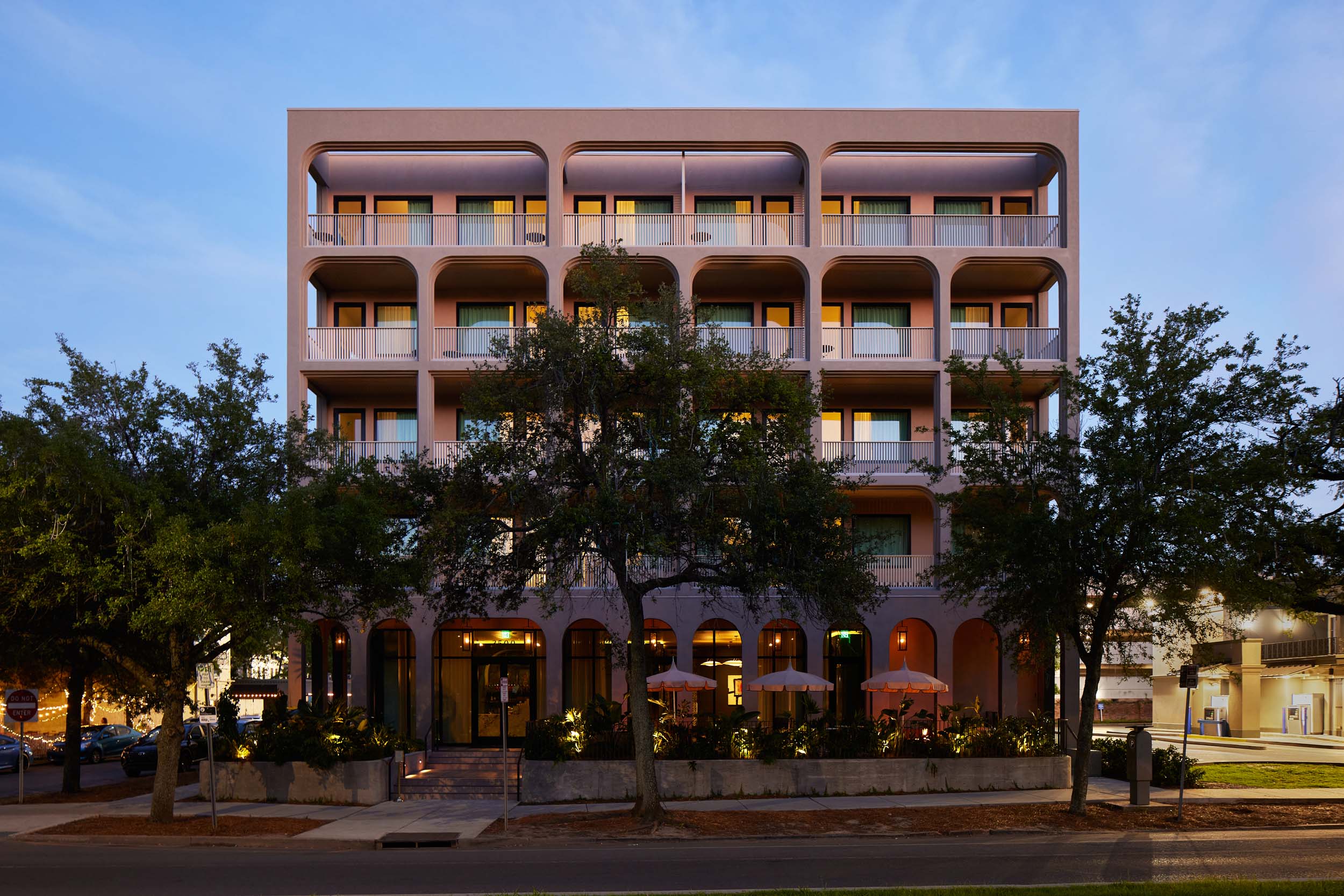
For the first time in 30 years, a new hotel construction has gone up on New Orleans’s historic St. Charles Avenue. Hotel Henrietta is a boutique property operated by the same group as the Columns Hotel, a building, just two blocks away, that was built in 1883 and listed in National Park Service’s National Register of Historic Places. Thus, history surrounds Henrietta. For Caroline and Sabri Farouki, the cofounders of local firm Farouki Farouki, the property served as a chance to put a modern take on local history—while making some of their own: The hotel is the firm’s first full-service architecture and interiors project since the studio was founded nine years ago.

The design concept honors both the contemporary hotel and the historic space with a twist on vernacular architecture. Galleries, arcades, a porch, and a garden were obvious inclusions—and the context is apparent immediately. Farouki Farouki settled on a facade of arches on a simple, rectilinear volume, set back from the street. The top most gallery is open to the sky, making the building appear inviting to its surroundings even more.

The arches continue inside in alignment with the facade, made possible by the full-service nature of the project. Arches appear on the motif of the millwork used throughout the lobby. It appears behind the check-in counter that also doubles as a coffee counter for the hybrid lobby-cum-coffee shop. Here bold material, color, and pattern collide, a confluence of the many inspirations for the hotel’s references. Caroline tells AN Interior these include “modern interpretations of those historic designs, timeless eclecticism, and lastly, subtropical flora and landscapes.”

The allusions refer to Columns, the sister hotel. Farouki Farouki used the hotel’s color and material palettes as inspiration for Henrietta. As such colorful mosaic tiles, like the Rojo Alicante Marble tiles used in some of the bathroom floorings, reference Columns’ many custom tile work. The same applies to fabrics and wallpaper. Case in point: the banquette upholstery used in the lobby, Dedar’s Tiger Beat, adds an idiosyncratic touch to the space in line with Columns’ own bold tones.

From the lobby, the hotel features 40 units across four floors with four different room types, including what the team refers to as a “micro,” an almost apartment-style room with a kitchenette. “The layout was somewhat unique because of the shape and size of the floor plate. Our rooms are essentially 11 feet, 8 wide,” continued Caroline. “If you do a lot of hotel rooms, you know that’s pretty skinny, but it’s pretty long. So the challenge was: how do we break up the bathroom and the closet?” The answer came by pulling out the vanity from the toilet and shower space, and then inserting fluted millwork and glass to break up the bedroom and bathroom while still allowing light and an open feel inside the rooms.

While it’s easier to copy and paste the same color and material palette in each room or unit type, Farouki Farouki took the circuitous route. “Each one has a slightly different palette, which from doing other hotel brands we don’t see as much,” said Sabri. In one palette, burnt orange, blue and dark wood combine in hue and texture, interchanging as headboard upholstery, seating, or as plush carpets.


Each accent was considered in regard to material, color, and pattern throughout the process, from Caroline’s hand sketches (which begin every project) to the final form. “The push and pull throughout the project—whether it was a wallpaper or a mirrored wall, or pedestal sink or stone built-in sink—was constantly: How far modern do we push it and how traditional?” shared Sabri. The studio often leaned toward the former in its overall ethos to maintain an honesty with the design.

As Sabri explained, “If you’re going to build a brand new hotel, you don’t really want it to try to look historic. You want the historic stuff to do what it does, and for this to be kind of new, but fit into the neighborhood.” The approach’s transparency and careful balance creates a lush hotel built for any era.