On a warm August afternoon in Mexico City’s Condesa neighborhood, I met Carlos Couturier at Condesa DF, the boutique hotel that helped put the charming area back on the map as a stylish enclave favored by art-conscious visitors to Mexico’s capital. Along with brothers Moisés, Jaime, and Rafael Micha, Couturier is a founder of Grupo Habita, Mexico’s design-forward hotel empire; Condesa DF was its second hotel in the capital. Located in a converted triangular building from 1928, it looks as fresh today as it did when it opened in 2005.
Since launching its first property 25 years ago, Grupo Habita has both shaped the evolution of design hotels and responded to global hospitality trends. Today, Habita operates 17 hotels across Mexico, as well as the Robey in Chicago. (Habita also ran the Americano in New York’s Chelsea neighborhood from 2011 to 2018, when it handed over management to other parties.) Five new properties are in the works, one of which is the fourth Habita location in Mexico City.
Grupo Habita’s efforts have contributed to Mexico City’s rise as the go-to destination for a specific profile of traveler—someone who is cultured, proactive, and more interested in discovering the latest speakeasy or under-the-radar artist than trekking to Teotihuacán. What unites Habita’s clients is their intelligence, Couterier told me during our conversation.
“We try to do a hotel every year,” he continued. “It takes lots of energy doing something differently each time—working with different architects, interior designers, chefs, and so on. My job is to pare things down and make them sharp.”


Suleman Anaya (SA): What has Grupo Habita done differently?
Carlos Couturier (CC): We weren’t hoteliers when we started Habita. We were developers helping preserve architecturally significant residences at risk of being demolished. We converted big neocolonial mansions people didn’t want to live in into offices. One day a tenant asked why Mexico City didn’t have a hotel made with this approach, and that’s how we became hoteliers. It was unplanned.
SA: How was Mexico City different when you opened the original Habita in Polanco?
CC: It was 2000, and we couldn’t find an operator for such a small hotel, so we decided to do it ourselves. That property—the 36-room Habita Hotel, designed by TEN Arquitectos—changed how Mexico City was perceived in terms of tourism. Back then, Mexico City didn’t have the ecosystem of walkable vibrant neighborhoods it has now. We wanted to build an oasis in what at the time was considered a chaotic, unsafe, polluted city. People came to Mexico City only briefly on their way to the country’s beaches and historic sites. Even the art scene wasn’t what it is now. We helped change that through hospitality and architecture, in concert with how the film and food industries bolstered Mexico’s public image.
When we opened Condesa DF, the publicist who organized our opening event asked, “Who is going to come here?” At the time, the neighborhood was on the fringes of what some Mexicans considered fashionable. The same happened when we opened our two hotels in Centro Histórico, the downtown and later Círculo Mexicano. But we didn’t care, because we were betting on these areas and knew that adventurous travelers would be drawn to them.
SA: When did you decide to make architecture one of Habita’s calling cards?
CC: It started with the first Habita Hotel in Polanco. From there we decided to link our brand to architecture and creative design, including interiors and graphics. We weren’t concerned with the size of the hotel but with the singular experience guests have through architecture.
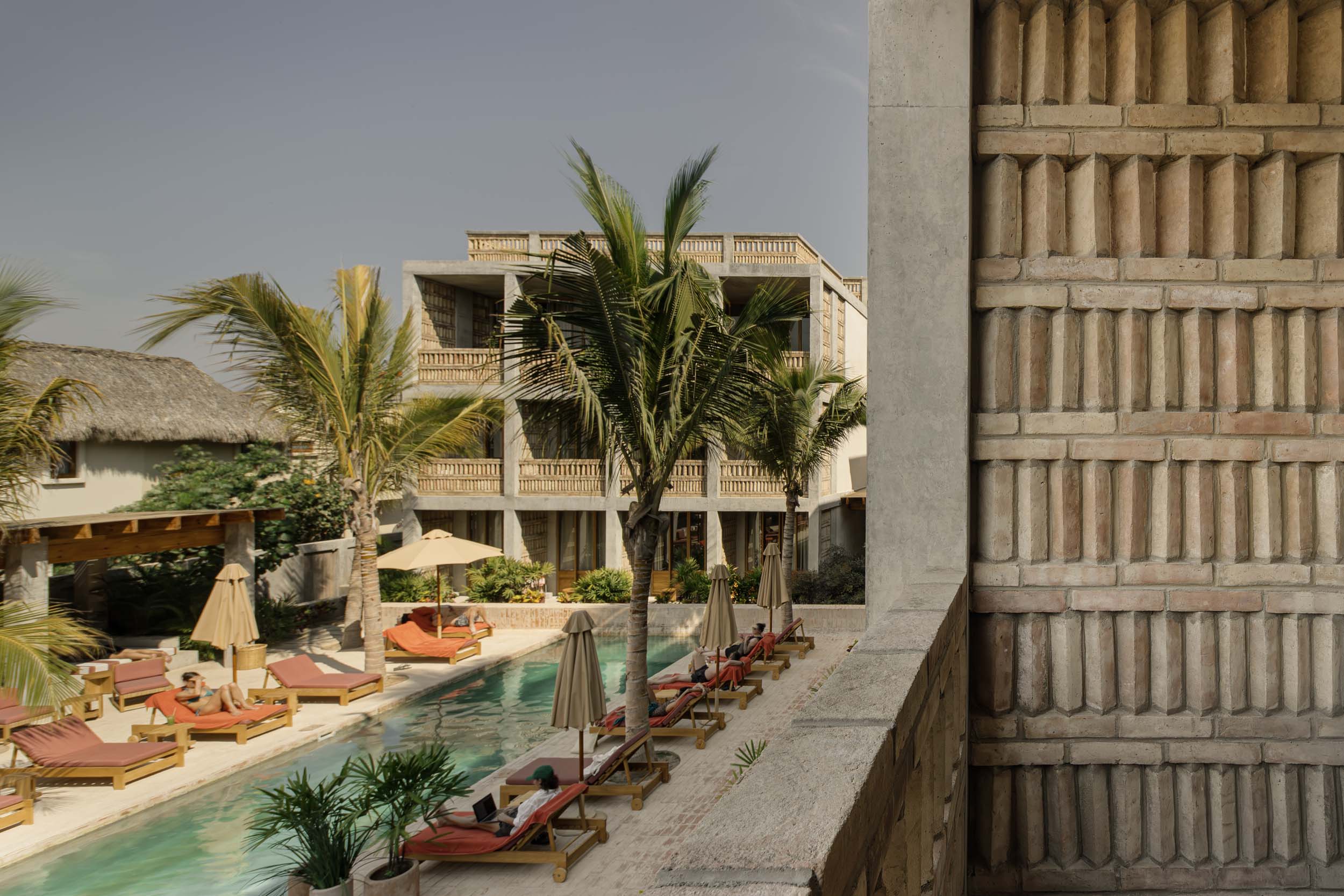
Terrestre is the most extreme example: It is a radical hotel with no TV and air-conditioning on a rustic stretch of coast along the Pacific Ocean. You only have solar power, nature, and one’s own company. Ultimately, a stay there is shaped by the phenomenal building by Alberto Kalach.
SA: A stay at a Habita hotel is not for every luxury traveler, right?
CC: We attract a sensitive, art-oriented clientele. Our guests come from all fields, but they care about the social aspect of a small hotel—think of the people you meet at breakfast or by the pool. Good architecture brings a clientele that becomes part of the hotel’s identity. You can’t do good design without building a mixed community; it must be universal. Both a 5-year-old and his 80-year-old grandmother need to feel comfortable, like they belong. We can’t just think of an idealized guest as some slim, hip young person. Intelligence is the only thing our guests have in common.


SA: You have hotels in cities and remote areas; all look different yet offer a consistent aesthetic. What defines Habita’s signature style?
CC: Natural light and ventilation are paramount. At all our properties, you can open a window. The room has to simultaneously feel like a cocoon that allows the best rest while also offering a degree of stimulus. It’s a tricky paradox, so you need a good relationship with the architect to create it. The room needs to be as dark as possible at night, but as lit as possible during the day, maybe with a balcony over a lively courtyard. We are also known for active rooftops, where something is always happening, often around a pool.
Our properties are inviting; no one is ever going to ask you why you’re here. It has never been an issue, even when celebrities stay. Recently Rosalía took over Condesa DF. She would come in and out, but the hotel remained open the whole time. It was friendly and alive as usual.
As different as our hotels are, you can always tell we love architecture. All Habita spots are human-oriented—we prioritize comfort through architecture, lighting, and our staff. At the same time, we hate repeating ourselves.
SA: How did you decide to work with the best emerging and established architects?
CC: Our properties must express a local essence. That has been in place since we did Condesa DF with Javier Sánchez of JSa and brought in India Mahdavi for the interiors. This project, our third, started our practice of pairing exceptional local architects with extraordinary non-Mexican interior design studios. Over the years we’ve commissioned people like the Parisian Joseph Dirand, the Madrid-based Plantea, Milan’s Dimorestudio, and the design duo Jaune from Marseille.
For each project, we work with great Mexican architects like Frida Escobedo, Mauricio Rocha, Max von Werz, Estudio Macías Peredo, and Kalach. I love architects that stay small and don’t become huge enterprises. It reminds of how Luis Barragán practiced. I think what he did at his own house hasn’t been surpassed.
SA: How do you work with designers?
CC: We meet, give them a brief, and make sure we feel comfortable with each other, because we are going to be stuck together for at least a couple of years. We eat and travel together, discover things, and nurture each other. I’ve never worked with someone I don’t appreciate.
SA: What have been some of your favorite collaborations?
CC: Condesa DF was one; we learned so much from India Mahdavi. Another was La Purificadora in Puebla with the famous, late-20th-century architect Ricardo Legorreta, who took inspiration from Barragán. He was older at the time, and when we met he looked at me and asked, “What do you expect from me? What special trait do you want the design to have?” I asked if he could deliver something with no color. Of course, Legorreta was known for his use of colors, so it was a bold request. Legorreta replied, “I’ve never been asked that. What a challenge. I love it!” This is when you know it’s a good fit: when the people you work with, no matter how famous, have an open mind.

SA: Do you ever give an architect carte blanche?
CC: Rarely. The closest we have gotten to it is with Kalach at Terrestre. It was his second hotel for us, and by that point his success and experience had made him more commanding, so we gave him free reign to do something unusual, even though we made sure it fit our brand and was right for our guests. The result is extraordinary. The hotel is great for a monk who wants to commune with nature or for a couple who want to have sex for an entire weekend. It’s equally sexy and spiritual, depending on the mood.
SA: What about other architects?
CC: I am a huge fan of Mauricio Rocha; I love working with him. He, along with Gabriela Carrillo, designed a vacation house for me. My brief was simple: I wanted something that felt like a small, sheltered monastery by the beach, vaguely pre-Hispanic. I fell in love with what he delivered. It is a bit like Casa Malaparte but completely suited to its location. I’m happy that we have a hotel designed by Rocha in the works. It was my dream, and it’s coming true. Macías Peredo, from Guadalajara, will also design a Habita property soon. And at some point, I would like to do a hotel with Manuel Cervantes.


SA: How have hospitality and the needs of travelers you cater to changed in 25 years?
CC: Accommodation choices have multiplied, so today’s travelers are savvier. There are options for every sensibility and budget. Thanks to social media, people are now experts on what they want and aren’t as intimidated by a big foreign city as they used to be. They follow their instincts, but they also rely on what other people have said and care about ratings. That has made hotel concierge service redundant. Instead, people make their own itineraries and their own reservations.
This means we need to be more careful and stand out when designing and running a hotel, because people can easily stay somewhere else. Innovation and creativity are important; people get bored quickly these days.
SA: What is nonnegotiable for guests these days?
CC: Internet! It sounds banal, but people go crazy if you don’t have fast wi-fi. Something less obvious that you have to get right—and wasn’t as important before—is sustainability. Guests, and especially younger ones, ask questions and care whether your labor and material-sourcing practices are responsible. People don’t want to stay at a place that adds trash to the ocean, disrespects the local community, or treats its staff poorly. Those factors are now as much part of what it means to be a luxury establishment as the quality of the mattress.
Our guests desire authenticity and original experiences; they want more than sunshine and a nice pool. Some travelers today are a little bit like reporters in that they avoid what’s trendy and instead want to discover something unique.
SA: Some of Grupo Habita’s spas are quite rudimentary. Does Escobedo’s project in Puebla indicate this will change?
CC: Yes. At Hotel Sevilla in Mérida, designed by Zeller & Moye, which we’re about to launch, we will be retooling the spa component. Increasingly, we’re developing private wellness offerings. For example, Otro, our second hotel in Oaxaca, has a cenote that you can have all to yourself for an hour.
I appreciate Escobedo’s intelligence, aesthetic sensibility, and well-roundedness. Her hotel in Puebla, her second for Habita, repurposes a house made from lava stone that dates from 1890. We’ve spent two years just building out the wellness areas. When it opens, I think it will be my favorite hotel.
SA: Will you keep working with Mexican architects on future projects?
CC: Yes, even if we go abroad, we will only work with Mexican architects. Mexico has such an exceptional pool of talent. Why look elsewhere?