Across from London’s St. Paul Cathedral, Club Quarters occupies a postwar building first completed in the ‘60s. The hotel was originally designed to cater to business travelers but the operators wanted to expand the reach of their audience. Studio Holloway Li performed the double duty so often dealt to architects and designers: to guide the brief befitting the company’s goals and redesign the building. The interior architecture studio, run by Alex Holloway and Na Li, opted to incorporate lifestyle-leaning designs to open up the clientele, creating a tailored, bespoke approach that speaks to both the hotel’s previous traditions and the building’s history.

“The most interesting thing about [the building] was that it had quite an adventurous facade of a textured stone motif. And on top of that, it has cast-iron sculptures by Geoffrey Wickham,” Holloway told AN Interior. The reimagined hotel pays homage to these idiosyncrasies. The entry is greeted with a 10-meter-long feature wall of carved cherry wood, a riff on the motifs found outside. Holloway Li designed the wall, which breaks up the line of elevators, with furniture maker James Trundle, using digital modeling to create the textures of each tile that is then carved with a CNC machine before they’re finished by hand.

The London-based studio relied on a number of bespoke details to engage the public areas and create a tailored, elevated experience. Beside the feature wall, custom oak-clad, self-check-in service areas were designed by the architects. They fall alongside fluted glass, bronze-tinted mirrors, and patterned tiles that join the millwork and floor. The diversity of materials and textures hints at the many bold mixings and eclecticism found deeper within.


“So the hotel could offer more to guests, we added an F&B facility to the front desk. The front desk now also doubles up as a coffee shop,” continued Holloway. The counter’s multiple functionalities come with a makeover. The reception-cum-coffee-counter was designed by the architects to feature an oak base interrupted with bronze bars and stone columns, made in collaboration with Marble Collective. The columns are in reference to the building’s original architecture.

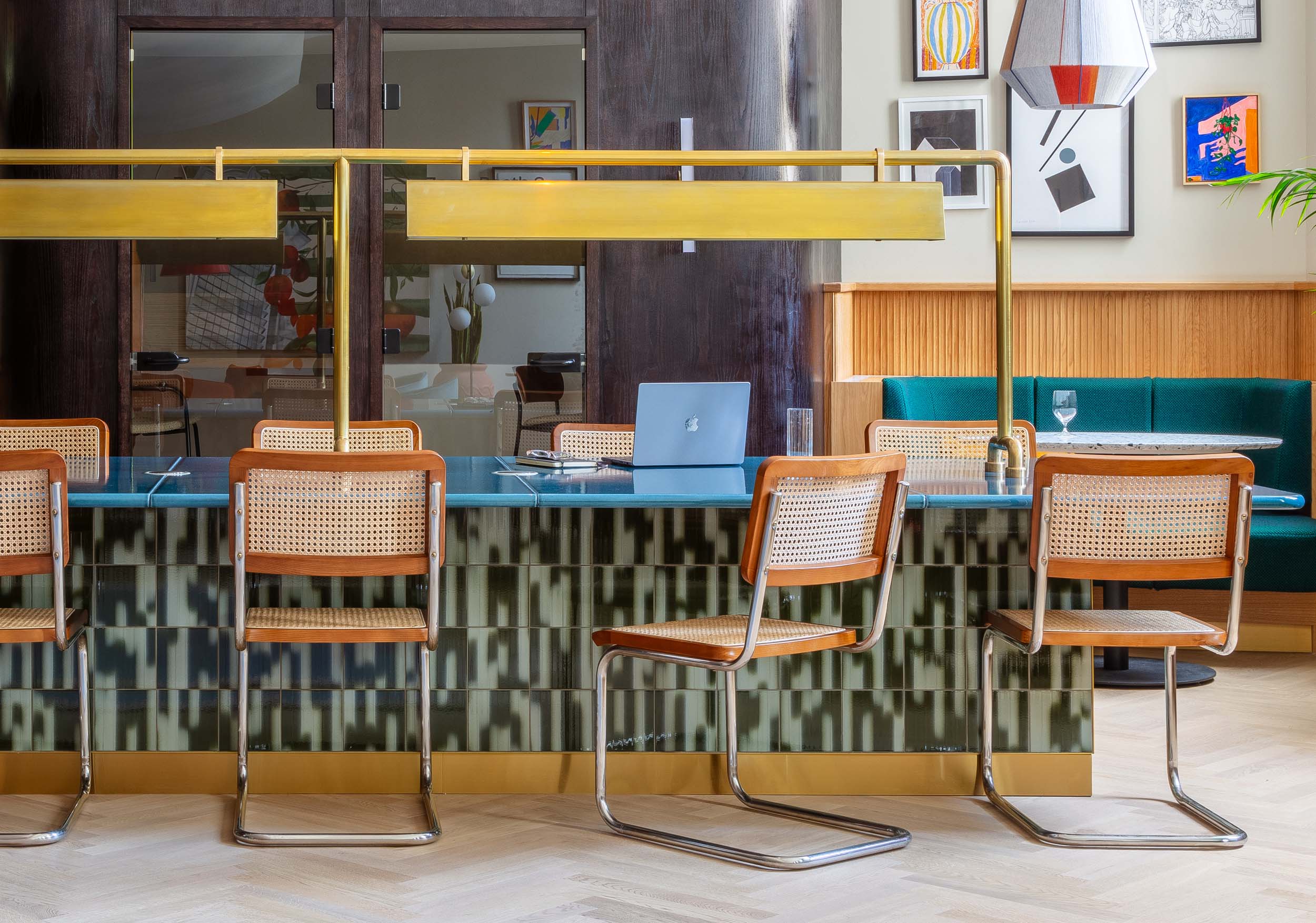
Beyond the lobby, the hotel previously offered a lounge that wasn’t much used. Holloway Li reactivated the space by reimagining it as a relaxed coworking space that can also transition to a lounge at night. The area is oriented around a five-meter-long, blue lava-stone communal table. It’s surrounded by custom banquettes, booths for private working, and other varied seating to accommodate different types of work.


While bright blues, yellows, and oranges saturate the coworking and other public spaces, the architects pared down the brightness for the guest rooms. “The design was about trying to find a balance between classic hotel design, but also something that still feels tailored, useful and with moments of luxury,” said Holloway. A small desk, sofa, and ottoman are included in each of the 256 rooms to provide both a place to relax or keep working. Details add sophistication: artwork from midcentury artists and architectural drawings of local landmarks (whose hues inform the room’s design), fluted headboards, bespoke bedside tables, and desk lamps created for the project by Joe Armitage. This lighting is inspired by the work of his father, architect Edward Armitage, and uses a paper polymer to create a paper-like material to create the shade. The same material is used in the entryway’s undulating lighting, made in collaboration with Armitage and the architects.


“The company is characterized by an approach to materiality that is off-beat, eccentric. And that is through testing the traditional expectations or parameters of a given material,” explained Holloway. From the many glossy, textured, and plied surfaces in the project, it’s an easy statement to believe.