In the hilly Ashbury Heights in San Francisco, Quarter-Round House recently underwent a vertical expansion by local firm SAW, Spiegel Aihara Workshop. A third floor added to the residence offers more natural light and space for the family of four, while the levels below it maintain original 1910 elements. The project emphasizes the idea of transition, as expressed in its titular reference, the quarter-round molding. Both a way to conceal gaps and a visual element on its own, the quarter round is a bridge between parts. This blend of old and new—that connects the two but critically doesn’t fuse them—informs the renovation.

The preserved elements include the custom purple and grey stucco facade, the entryway, living room, kitchen, and dining room. In these rooms, SAW left the original bones of the home: the Edwardian details, bay window, and fireplace. New paints and finishes emphasize this traditional style. SAW collaborated with Melanie Love from Love & Interiors on this effort. She said, “We thoughtfully selected furnishings, fixtures, and wallpapers to harmonize with the traditional architecture of the existing areas while also embracing the modern design of the remodeled spaces and the addition.”

Love covered the moldings, window trims, and fireplace in the living room in periwinkle. The hue continues to the dining room where ornate moldings, coffers, and a built-in pantry were finished off with the color. The blue-purple isn’t the only accent in this room to call attention: In between the moldings and the wall side panels is a floral wallpaper. With clashing patterns in the dining room, the rest other rooms opt for a softer base with light wooden floors interspersed with accented wallpaper and patches of teal.


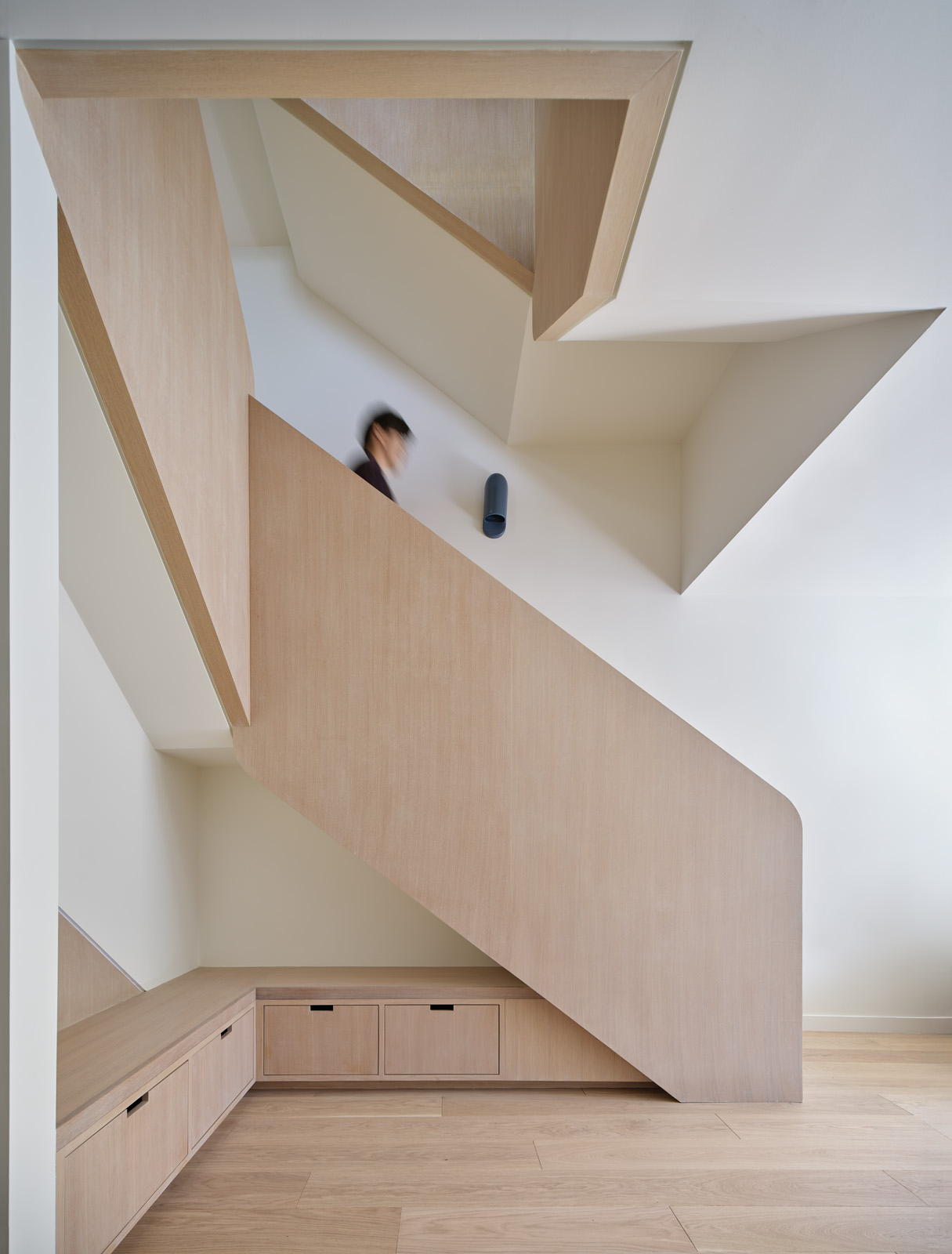
Old and new transition where the floors do, at the custom white oak staircase. It is built on a series of rounded-off parallelograms tied together with a steel flatbar handrail. The new stairs lead guests from the first two floors that maintain the historic features to the new addition on the third floor, which includes a new office, primary suite, and two outdoor terraces with views of the Golden Gate Bridge. In a project description SAW noted, “The stair, just one of several vertical voids that cast light piercing through the floors and deep into the structure, is the primary organizer of the spaces below, spilling sun all the way into the basement-garden level.”


SAW incorporates playful forms while also programming pragmatic components for the family through angular and curved geometries, as exemplified in the floor-to-ceiling wood shelves in the hallway and the master suite walk-in closets. The storage units were backed by panels made out of a delicate mesh to allow objects to tuck away neatly, while still permitting in natural light from the skylights. In the children’s reading nook, occupying a small pocket of the third floor, are three splayed, curved wooden shelves stacked to create stairs that double as seating and shelving for books. Both implementations offer simple yet unconventional solutions that bridge two design elements together.


Dan Spiegel, founding partner and principal of SAW, shared with AN Interior, “There’s often a desire to produce a separation of the new and the old in a project like this, or perhaps smooth over all of the differences into some sort of non-specific fusion. We were really conscious of wanting to produce an exaggerated sense of transition that allows the act of living between time periods and styles as a definitive, distinct condition.” Rather than collapse time, SAW and Love & Interiors let the bridges between eras be a considered a moment in and of itself.