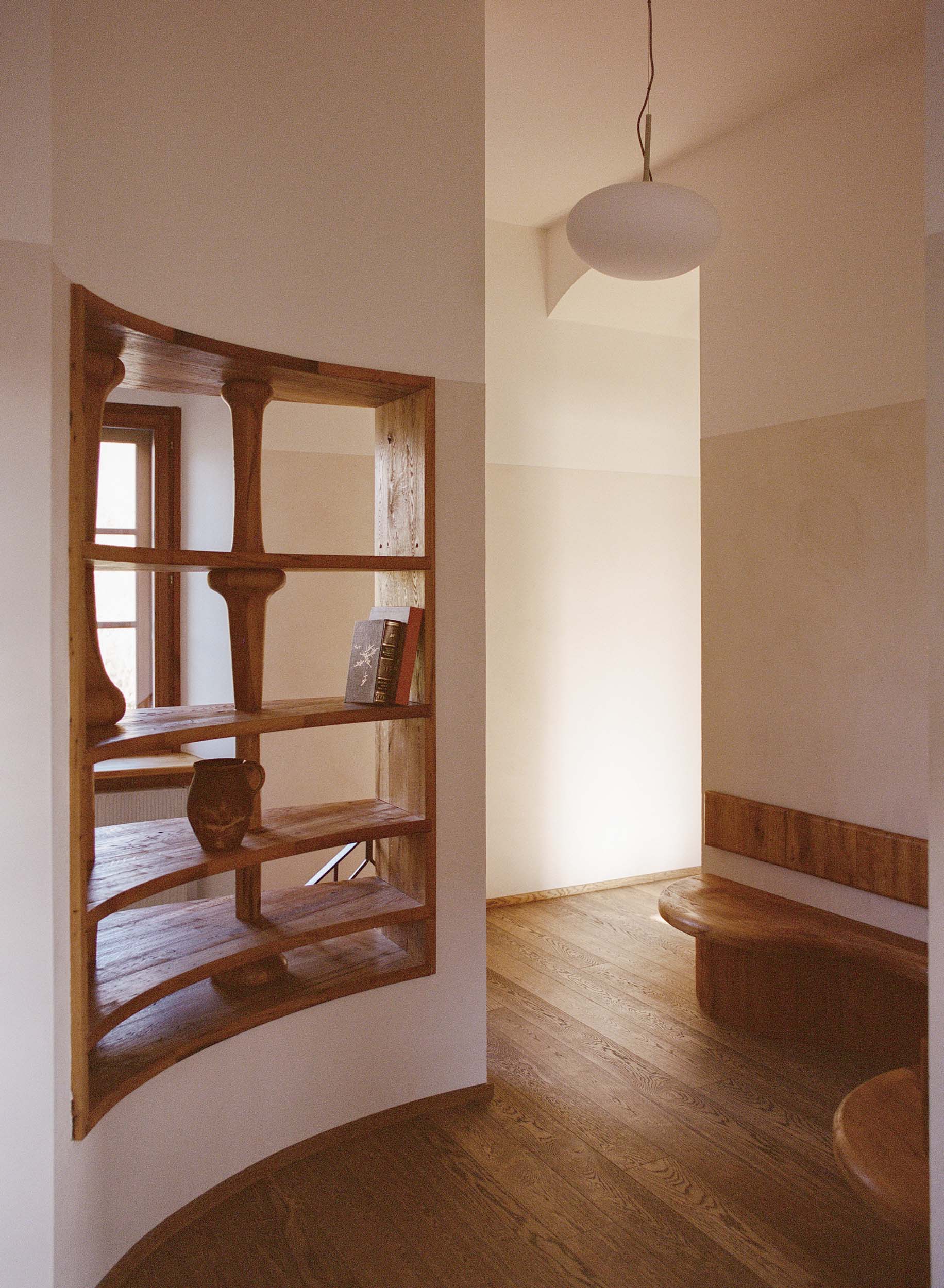
Set along a religious pilgrimage route just southwest of Vienna, dotted with well-preserved and historically significant baroque churches and monasteries, Neuhaus Castle is a 13th-century fortification long left in ruins. Seeing its potential as a country residence, a family has spent the better part of the past four decades slowly but surely restoring this 10,500-square-foot installation and bringing it back to its former, if also updated, glory. Helping them move the meticulous and at times arduous process along is Some Place Studio, which recently outfitted the guest quarters, a modest yet cohesively designed suite of rooms with key details nodding to the locale’s rich history but also contemporary convenience.


Working with the peculiarities and existing conditions of the structure while also introducing new elements, the Berlin- and Vienna-based practice—headed up by architect, educator, and curator Bika Rebek—enacted a holistic intervention both in terms of a methodical spatial reorientation and the implementation of custom furnishings. The use of locally sourced materials, culturally appropriate color palettes, and decorative motifs implicitly, rather than explicitly, hint at the castle’s past eminence.
“Conceptually, the renovation avoided the opulence of baroque and ornate Habsburg styles in favor of a refined, understated look that emphasizes high-quality craftsmanship and materials,” said Rebek. “The arches and ovals, prevalent in the original castle and the surrounding local baroque architecture, are reinterpreted as defining spatial elements in the renovation.”

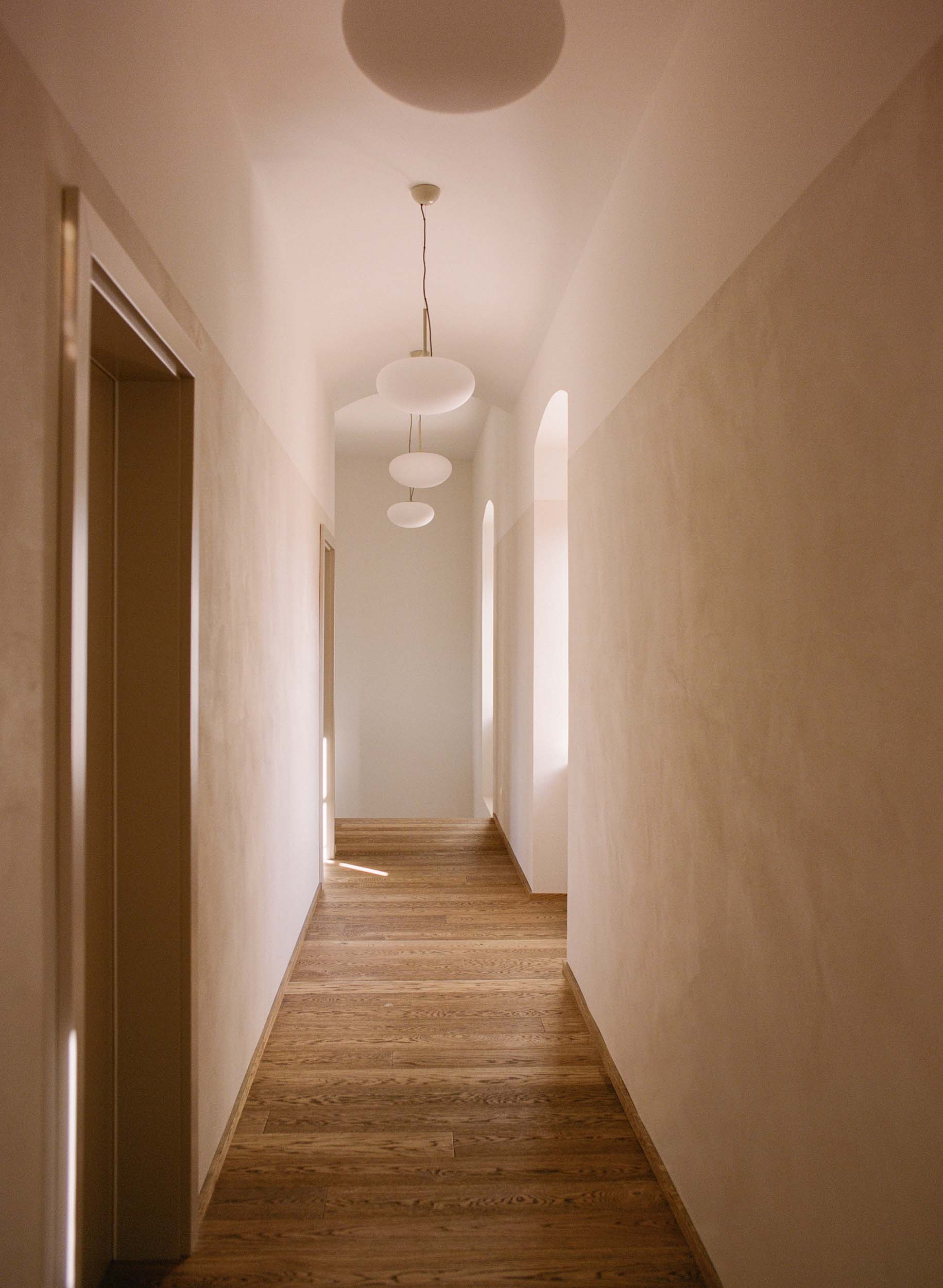
Rebek and her team had to contend with an awkward layout when carving out a 1,119-square-foot enfilade of three en suite bedrooms and an intimate oval-shaped library defined by a semi-spiral staircase. “The existing architecture was characterized by a relatively long and narrow space, limiting us to a layout featuring a single corridor along one side and relatively small rooms,” the architect described. “To enhance this elongated interior, we designed an arched ceiling above the hallway, creating the illusion of an original feature.”
Bringing these guest quarters up to present-day standards posed another challenge. “The castle’s walls are composed of stone and brick, with thicknesses reaching up to 4-feet, complicating the installation of modern systems like HVAC and ventilation shafts,” she explained. “We had to utilize existing openings to the outside and route piping through the existing floors, ceilings, or newly built walls. We also encountered two strangely carved niches in the walls from previous renovations.” Rather than removing these features, Rebek and her team decided to incorporate them into the new design as storage space or recessed niches for displaying sculptures.


Integrated built-in furnishings were added to conceal these imperfections while maximizing space and functionality in the bedrooms. Celebrating the area’s architectural history while also achieving a level of efficiency, ovals—a geometric form that is equal parts baroque and contemporary—are found throughout, such as in custom insert walls and pendant luminaires in the library, masterfully crafted by local carpenter Alfred Pröglhof using reclaimed wood from an old wine press.
“The use of upcycle components was crucial for two reasons,” Rebek noted. “First, it aligns with sustainable practices by reducing the demand for new resources, minimizing environmental impact. Second, reclaimed wood brings a sense of history and texture into the new spaces and establishes a continuity with the castle’s existing interiors, which is largely defined by beautifully aged hardwoods.”
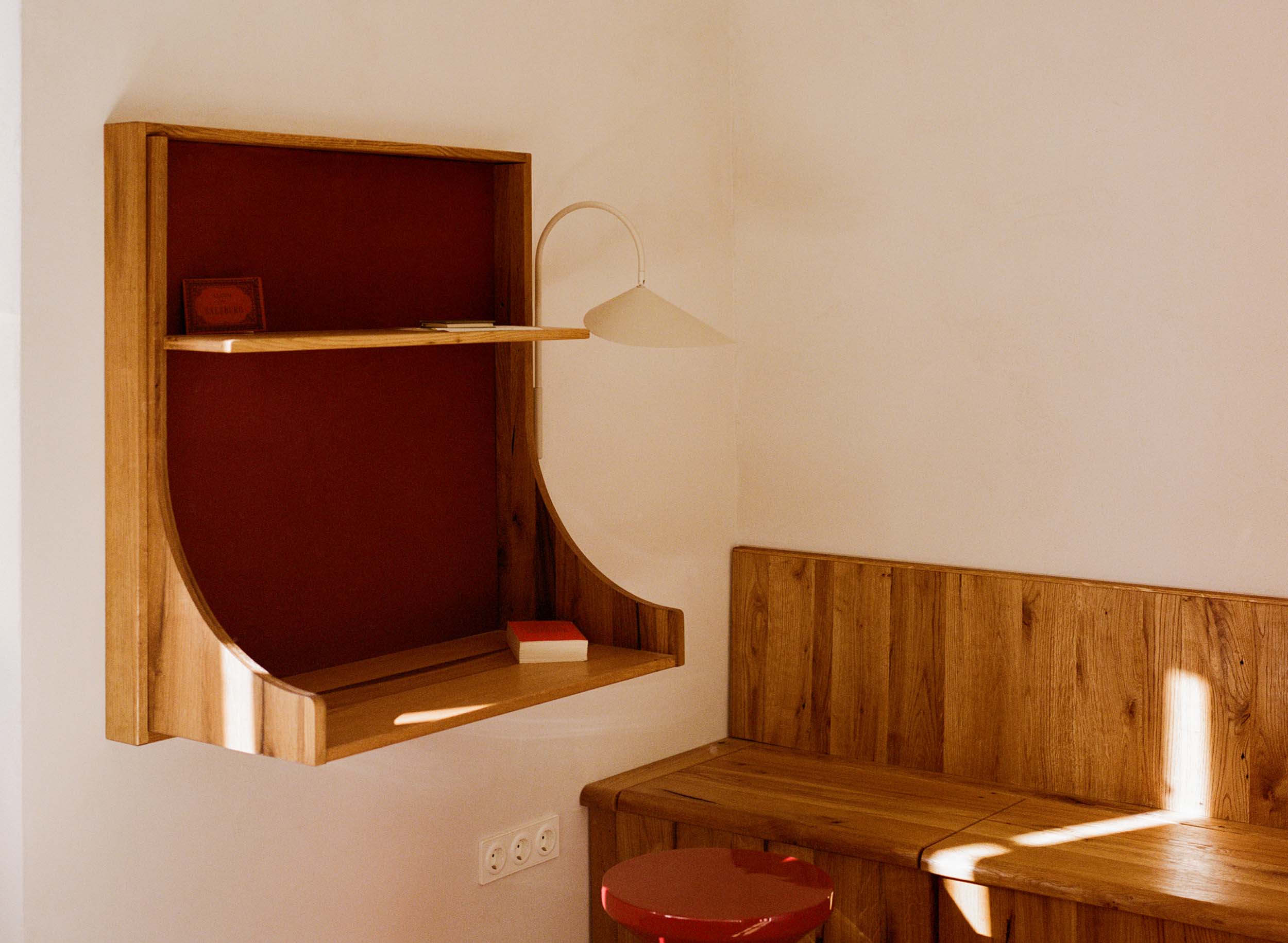
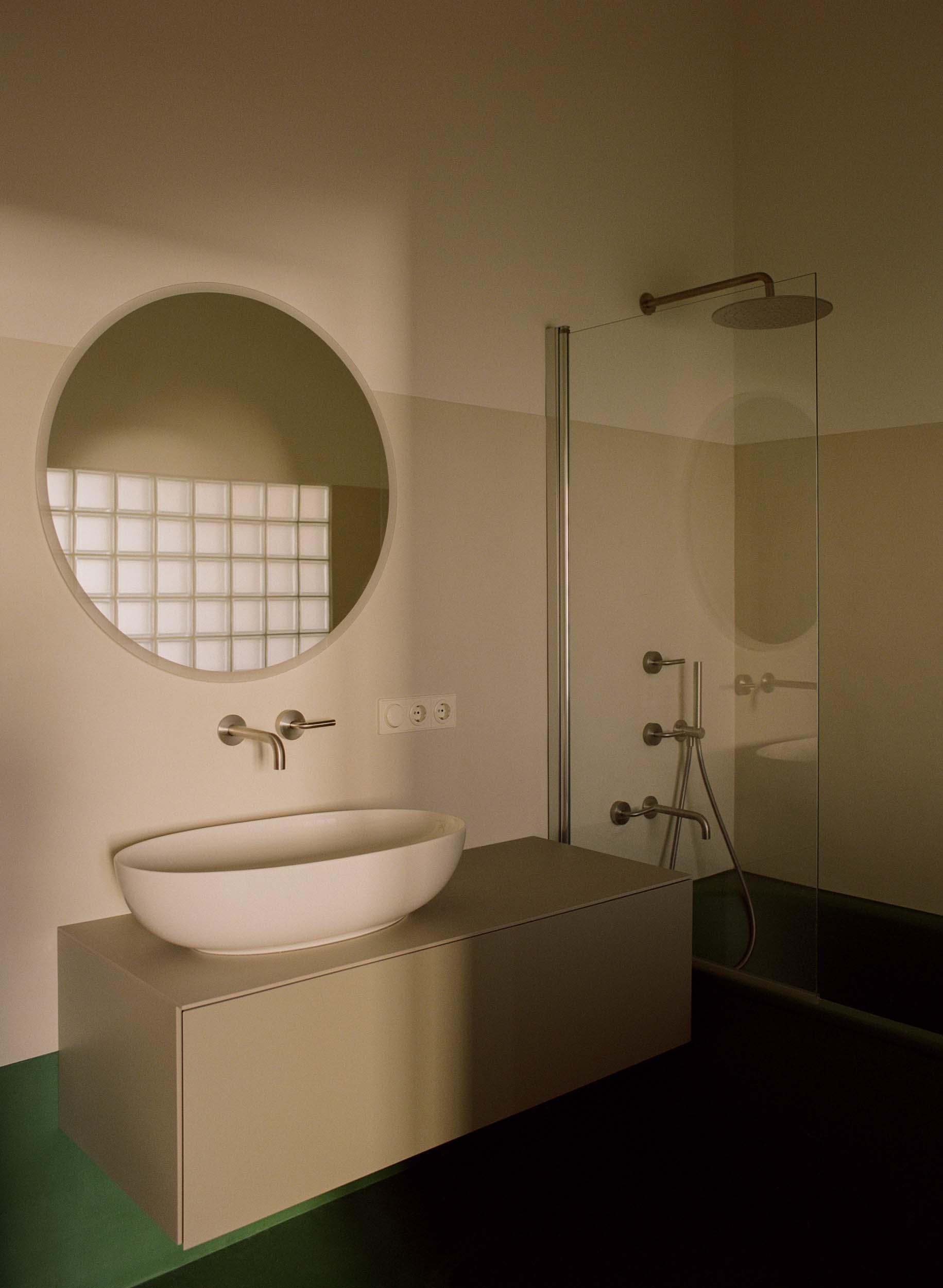
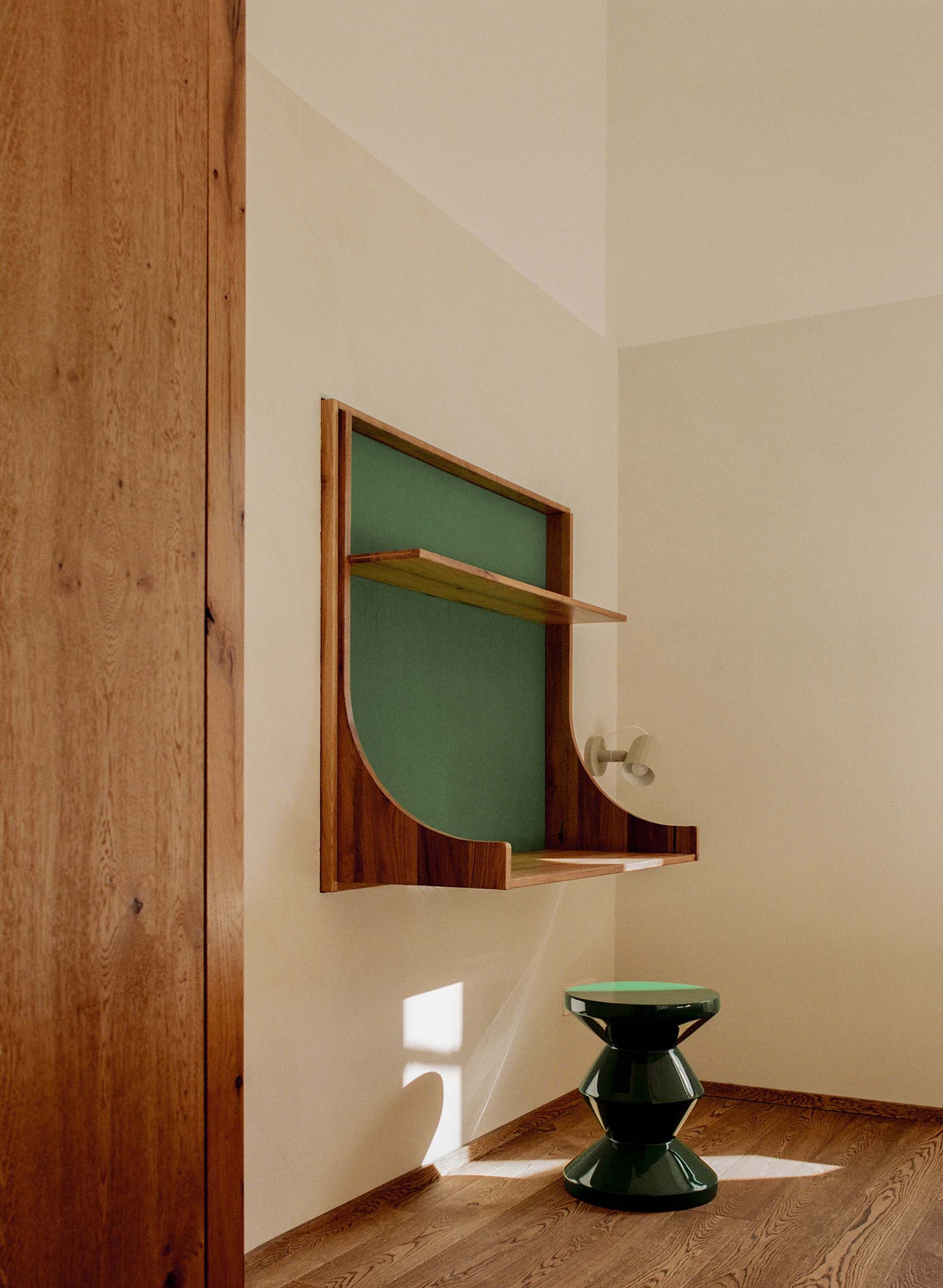
An emphatically Austrian Forest Green, also found throughout the property, is the predominant element in the three bathrooms. Each of the adjoining bedrooms is defined by a distinct hue. The red room is situated behind the library and contoured by the same curvilinear wall and so is imbued with a cozy cave-like atmosphere. Programmed for longer stays, the larger green room is equipped with generously proportioned built-in wardrobes. Rendered in Italian stucco walls and hardwood oak floors, the master suite takes on a more subdued palette and features a desk for quiet work.
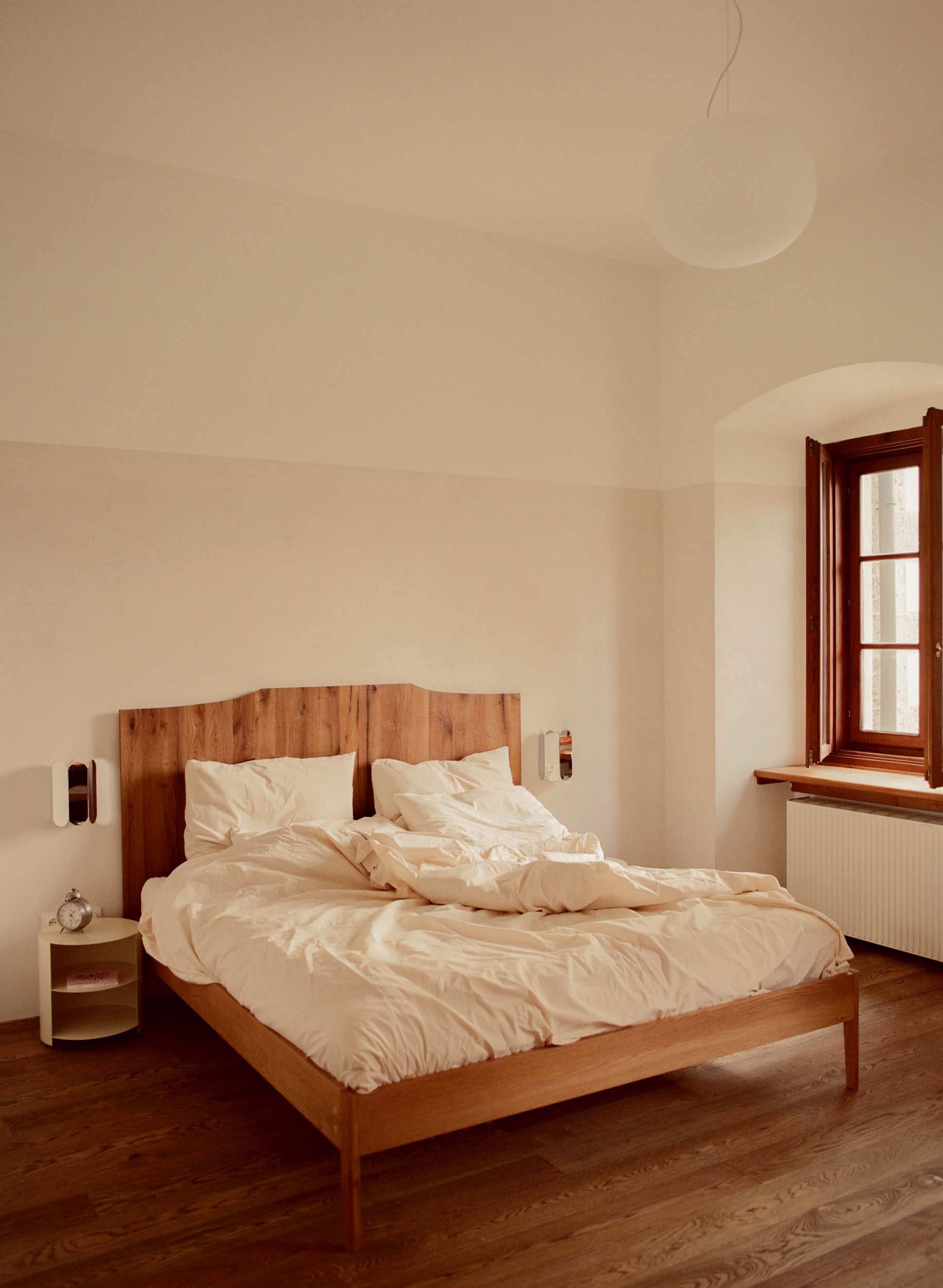
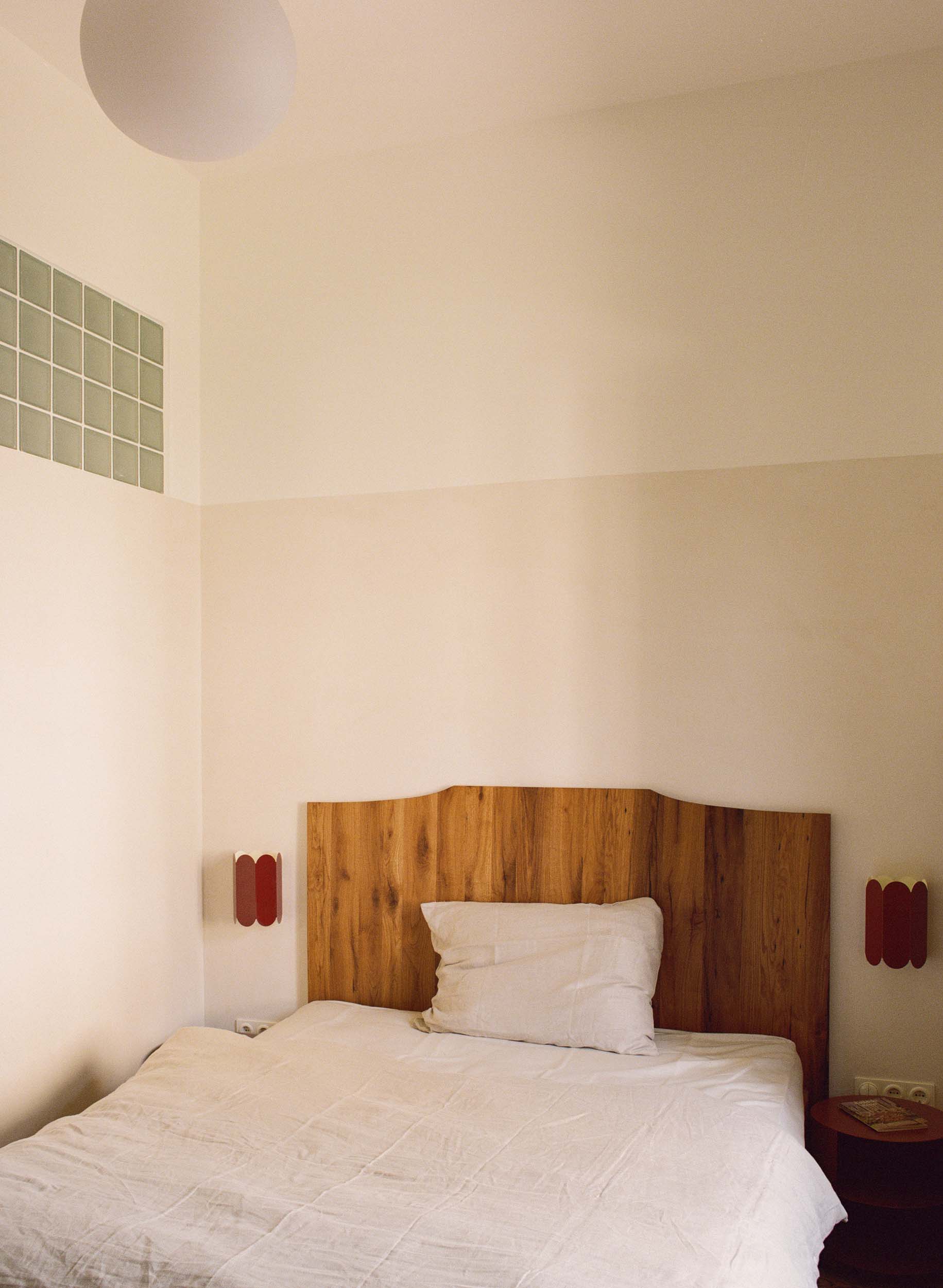
“The bedframes, with their subtly curved outlines, evoke the grandeur of historical regal beds and large medieval bedframes, with contemporary turret-like lamps on both sides,” Rebek concluded. Her and her team also added contemporary finishing touches: colorful furniture pieces, furnishings and fixtures from premium brands like Hay, Ferm, Gubi, Hem, Flos, and Laufen. Zig Zag stools scoured from purveyor Polspotten were rendered in a green similar to that of the bathroom cladding and some other key features.
Some Place Studio will also be tasked with the same thoughtful design of other spaces within the castle as its overall renovation continues to unfold in the coming years.