Before the wild stretch of Central California coast that is Big Sur was a place of legend, a haven for artists and hippies and their hand-built homes, it served a more practical purpose for the timber industry. The canyons contained rustic log cabins built for the loggers harvesting redwoods and tanbark. When environmental efforts in the mid-20th century led to the protection of these hallowed canyons, loggers moved out and families from Fresno and elsewhere began summering in the cabins. Soon, bohemians entered the scene and put their own spin on the homes. Many of the cabins were held in families for generations. More recently, as younger heirs opt for year-round residency, cabins are being modernized or entirely rebuilt.

Studio Schicketanz’s recent project replaces one such unsalvageable cabin at the base of a densely wooded canyon. “With projects like this one, the task is to modernize without losing the original essence and charm,” Mary Ann Schicketanz, the firm’s founding principal architect, told AN Interior. “At the outset it is important to really think about and analyze what you have to work with and develop a concept that becomes your North Star, guiding every decision you make. You really feel it in the house if you have a strong underlying idea,” she added. For the Big Sur cabin architecture and interiors, that North Star was staying within the historic context: scale, materials, and colorways. “Everything falls back into the concept and nature of the place,” she said.

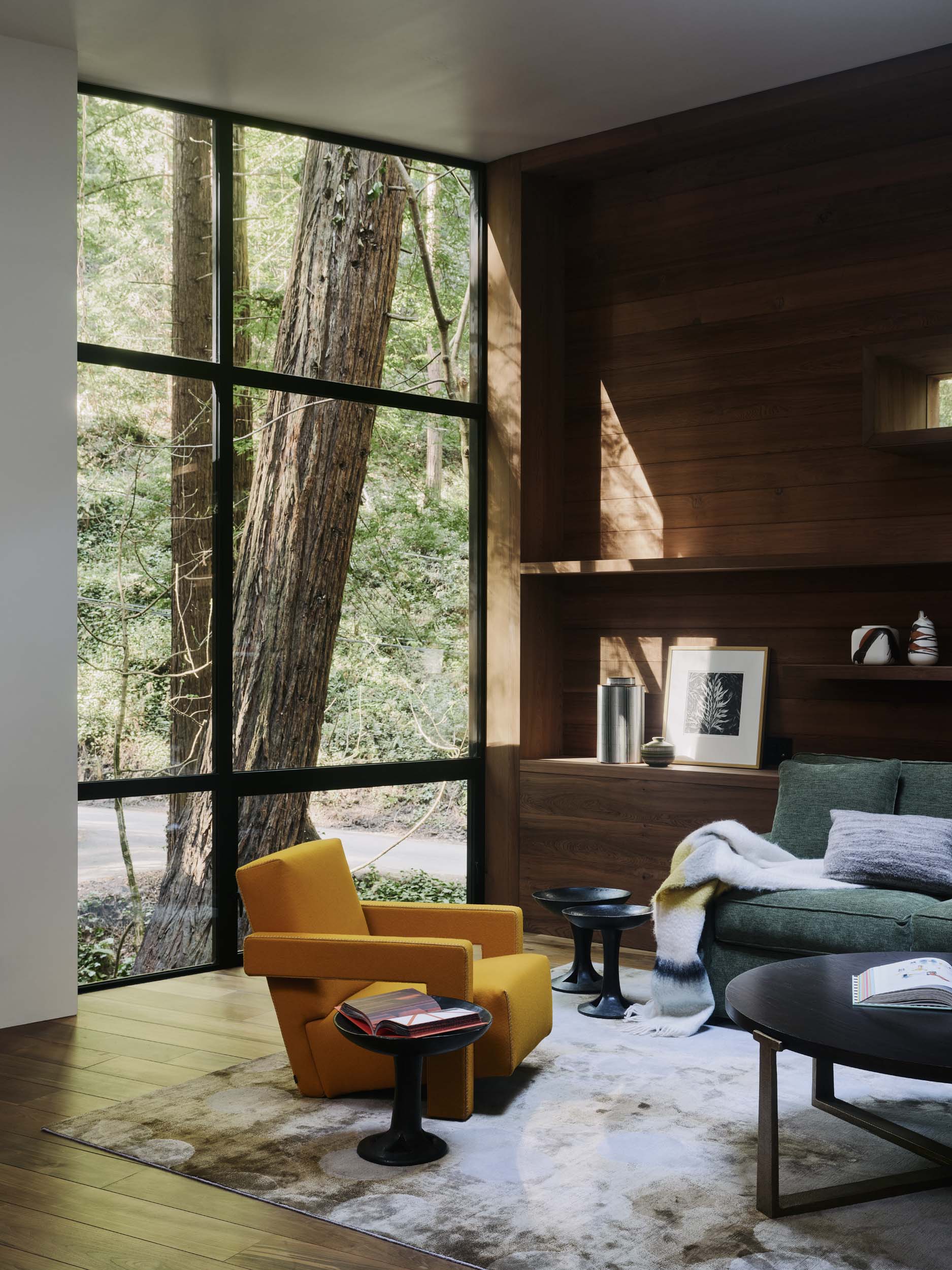
To stay within the previous footprint, Studio Schicketanz divided the new 1,194-square-foot home into three volumes. The living room, bath pavilion, and bedroom are spacious; a private patio adjoins each and includes a beautiful outdoor courtyard with a Japanese soaking tub. Elevated windows throughout and a round skylight in the central room draw light in from among the towering redwoods. A high horizontal slot likewise captures every bit of late-afternoon sun that filters through the canyon.


Concrete, wood, and metal siding—apt materials for fire country—compose the envelope. The redwood for the siding, wall paneling, and cabinetry was milled on-site from fallen trees. While the process of getting the logs for the project out of the canyon, dried, and stored took years, it resulted in a tight-grain, old-growth redwood “that you just can’t buy,” Schicketanz remarked. Concrete was poured for the foundation, entry, and connectors. Atop the living room, the studio placed a green roof, where the owner grows vegetables.

“You don’t often get to do very small projects where every detail matters,” said Schicketanz. “Here, nothing goes unnoticed. You have to use every square inch of the house.” Nearly everything is built in: The hallways are lined with tall redwood closets, the rooms outfitted with perfectly simple shelves and cabinets.
“Our approach is real attention to detail, appreciation for everything we use, and a sensitivity to have as little waste as possible,” Schicketanz explained. That attention to detail comes through [in] everything from furniture and appliances to art and linens. Sustainability is baked into the studio’s philosophy, with architecture, interiors, and landscape integrated through thoughtful choices. “As a small firm, we seek out certified products, energy-efficient appliances, and trusted vendors,” she noted. Schicketanz, a native of Austria, came to the U.S. as a Bauhaus-trained architect 20 years ago, with no experience working in open or rural environments.


She landed in Big Sur and befriended architects who “really worked with the landscape,” she said. She attributes the direction her practice took to that place-based education and her affinity for land art. What sets her studio apart may be how Schicketanz fused this California ethos with the discipline of her German engineering background. “It’s a good combination,” she explained. “These buildings are not easy to execute. When you bring that discipline to the table you bring the deep idea all the way through the smallest segment of the project.”