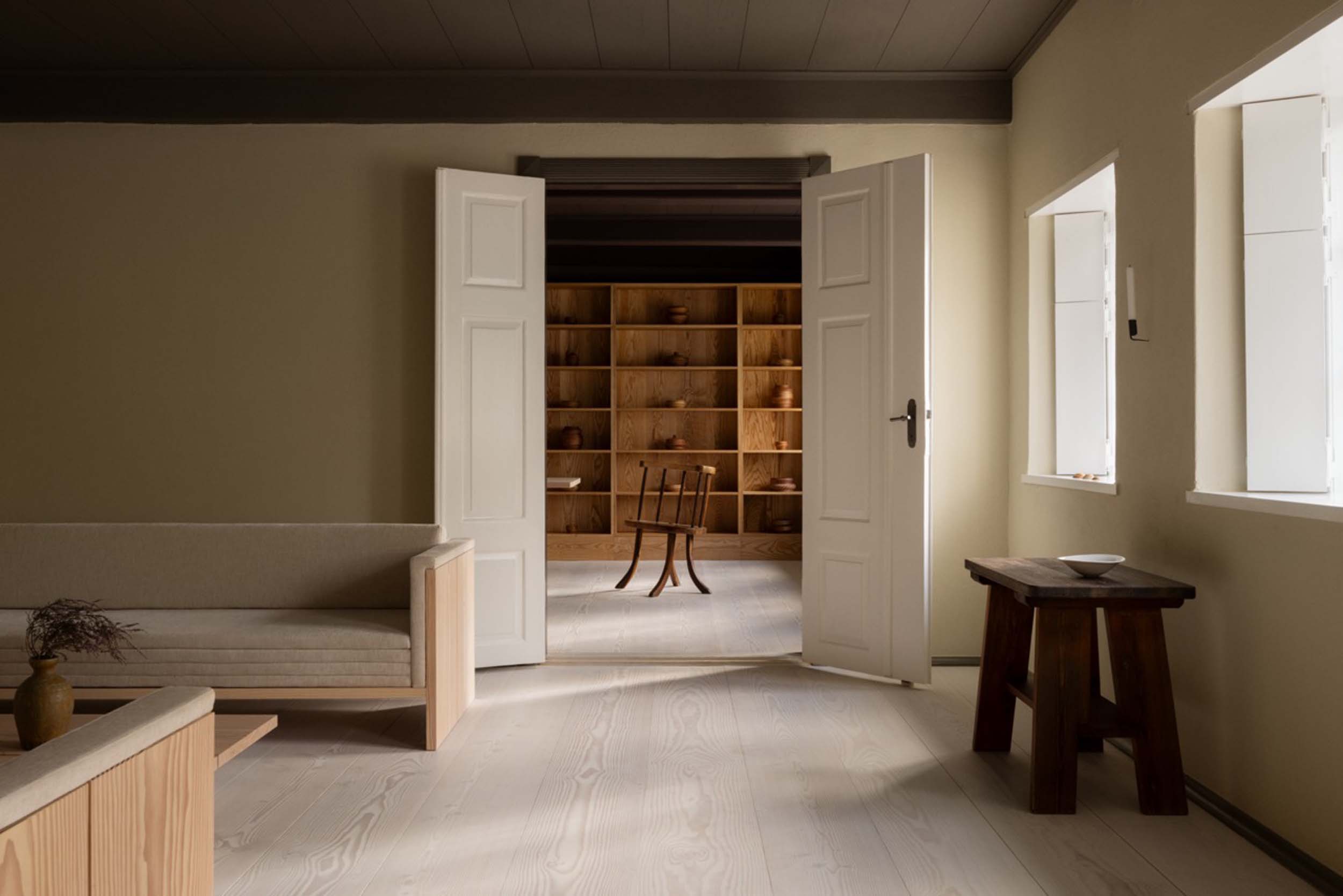
At the southern end of Denmark’s Jutland peninsula lies the small town of Jels. There a quiet, white thatched-roof home built in 1885 is tucked in a meadow, located at the end of a long gravel road. The Dinesen Country Home, a former residence for the family of the esteemed wooden floor company Dinesen now acts as a guest house for friends and select clients of the brand—and may even be open for public bookings. The new era is ushered in by Copenhagen-based architecture firm Mentze Ottenstein. The refreshed Dinesen Country Home proudly holds true to its original bones, while also embracing new Scandinavian notes to create a hygge atmosphere.

The 2-story, 3,636-square-foot abode was first acquired by the Dinesen family in 2004. Shortly after purchase, it commissioned family friend and architect, Jørgen Overby, to restore the house to its roots. Overby highlighted original elements to the home by reinstating them, such as the thatched roof, fireplaces, historic windows, and custom kitchen carpentry. For the cofounders of Mentze Ottenstein, Mathias Mentze and Alexander Ottenstein, the task then became adding to this initial groundwork by converting the private residence into a contemporary showroom and guesthouse for the Dinesen company and adding new material ornamentation.


“To get the right balance between a clear spatial experience and something more complex like a personal home was a challenge,” Mentze shared with AN Interior. “We find it important as architects to allow ourselves to work with the interior scale of architecture and not see it as a less important aspect of the built world. To us, this is where you can be playful and work with layers of time which fascinates us a great deal.” The design team conducted research on how to best respect the original history and Overby’s work while also introducing new elements. One thing was clear: The use of Dinesen Douglas fir hardwood floors had to stay prominent throughout the residence.


Mentze Ottenstein furthers this wooden language. The studio introduced custom furniture pieces that it designed and built from Dinesen ash wood with amber oil finish. A set of kitchen tables and stools, as well as various cabinets use the material.

While the wooden application and soft eggshell base keep the Dinesen Country home neutral, Mentze Ottenstein incorporates some pockets of color to further accentuate the custom carpentry work. An example can be found in the handcrafted Garde Hvalsøe kitchen that was drenched in a soft, light green. The color takes cues from the surrounding landscape. On the second floor a hue of golden ochre warms the hallways and bedrooms.

Other elements tie the outdoors to the inside, like the hand-printed wallpaper produced with linseed oil paint on Hahnumühle cotton paper, made through a traditional copper printing press. The wallpaper features botanical designs, an idea inspired by Carl Linneaus’s home where his botanical illustrations from the 1700s were used as wallpaper in his study. The design team collaborated with students from The Royal Academy in Copenhagen to incorporate leaves from the surrounding area into their own take on botanical wallpaper. Mentze explained, “We examined the tree species in the area and collected leaves to make monotypic printings of them. The sheets we produced are glued to the walls, creating an intimate atmosphere, being a sort of portrait of the surrounding forests.”


Mentze Ottenstein and Dinesen incorporated work from local Scandinavian artists, designers, and craftsmen to play along with the original craftsmanship of the home. These additions include lamps from Christian+Jade and Wästberg, glass from Nina Nørgaard for the staircase, chairs by RønholtKurz, and frames and mirrors by Casetta. These touches add diversity to the residence while also tag-teaming with high quality materials Dinesen takes pride in.


The Dinesen Country Home is an example of how to cohesively marry new with old. Ottenstein shared with AN Interior that this project can be described as, “Layers; It’s really about adding layers and narratives, the opposite of cleaning up.” He continued, “But the aim has been to let things from different time periods coexist and by juxtaposing them, create something new.”