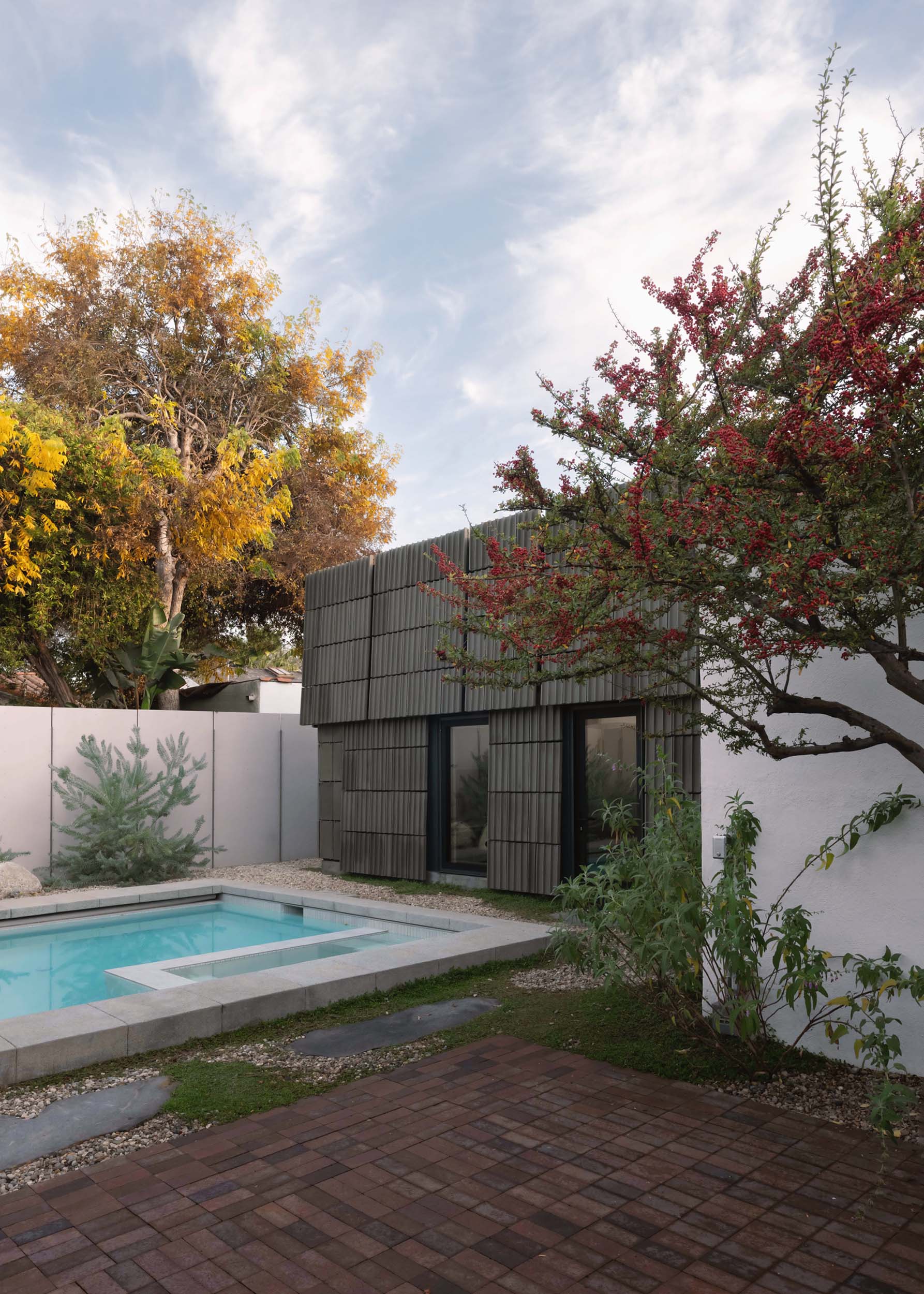
Los Angeles owes some of its romanticism to its Spanish Revival style, which brought the warmth of terra-cotta to the city’s buildings since the 1930s. A home for a young family of two stems from such a lineage. Its Spanish tiled roof became the starting point for a new ADU by Current Interests, a firm that was recently featured in AN Interior’s Top 50 list. The firm eschewed pastiche of the revival style in favor of a more inventive approach: creating a new terra-cotta tile to clad the building.

“Because this is an addition to an existing property, we were looking at the ways in which houses from the 1930s build up with age and carry a presence over time, of material overlapping and things being overgrown,” Mira Henry, cofounder of Current Interests, told AN Interior. “We wanted to find a way to respond to the overgrown context in a more relaxed way.”

Immediately, the firm knew they wanted to use a terra-cotta facade. They reached out to Sandkuhl Clayworks, a fourth-generation, family-owned company in Ohio. “We couldn’t afford to create our own new extrusion dye. It was Anne, head of the company, who was like, ‘We’ll just split it when it comes off, and you can create your own new ones,’” explained Henry. From there, the companies collaborated on a new tile, borne from cutting a standard three-chamber terra-cotta hollow in half. This created a new piece, then coated in a deep green, with vertical ribs on one side and a flat face on the other. The idea adds texture and context to the facade while skirting some of the financial roadblocks.


“Because these were split, they ended up being a little bit warped here and there,” added Matthew Au, the other cofounder of Current Interests. “So in order to kind of affix it onto the building, what we ended up doing was building a series of aluminum shelves that the tiles would sit on, and we clip them onto the shelf.” The aluminum system provides contrast and depth, lending a larger presence to the ADU. It also made the architects think of each terra-cotta tile, whose slight warping is delightfully exposed, think of the facade as “a collection of objects sitting on a shelf.”

The weighty presence of the facade and ADU helps organize the yard. Part of the brief was reconfiguring the space from its car-centric layout to a space conducive to social gathering. As such, the architects reversed the layout of the yard, siting the ADU at the back corner to make room for a patio and pool, featuring new landscaping by Phil Davis Landscape. “The backyard, the pool, the fence, and the building itself all kind of complete the interior walls of this backyard space,” said Au. The terra-cotta shingles are seen thus in context with the fence, pavers, and original home.


Inside, material inventiveness continues. The compact ADU, which organizes a couch/bed, kitchenette, and work desk, is clad in concrete the architects designed. The flooring consists of pigmented green and an aggregate of river rock. They’re lined with base boards, an unground version of the mix, that continues the idea of overgrown landscapes, as outside loose gravel surrounds the property, while inside this same composition is visually extended yet fixed in place.
The walls are finished in a walnut paneling, fabricated by the architects and stained with Linolie to create a silvery green finish with purple undertones. This makes up the color palette of the project, selected to honor the native wildlife of California.


“We thought about the interior almost like it was a piece of furniture or a cabinet; We really wanted it to feel like everything was kind of built in, like you’re entering into a piece of furniture,” said Henry. In this way, everything is organized and concealed into the walls with very few roaming pieces. Finished with a series of skylights and transom windows, the interior feels calm and natural like a quiet retreat behind an “overgrown” facade.