Rua de Santa Catarina 1299 was once a street home to a civic court building in Porto, Portugal. After a decade, the building has been adaptively reused as a long-stay apartment hotel, Vila Catarina Apartments, whose careful spatial editing was carried out by architecture firm MASSLAB. The team eschews nostalgic preservation for a sensitive yet new design that unfolds in playful twists, turns, and unexpected proportions.

MASSLAB approached the project with a balance of past and present in mind, beginning with the exterior. The street-facing facade retains its original design of stonework and ceramic tiling, which the team restored after years of previous renovations and interventions had diluted it. While the front reads as an undisturbed public face, interventions abound at the rear exterior. A patchwork of exposed pipes, machines, and additions previously made up an incongruent rear facade. To do away with this, the architects attached a second skin to the existing surface, using balconies to project a mix of circular and rectilinear shapes. This approach adds depth and rhythm to the exterior, while tying back to the geometric fencing at the front facade.


Inside, geometry continues to create layers to the space. When laying out the 16 apartment units, MASSLAB looked to early 20th-century Portuguese bourgeois dwellings. In these homes, rooms transitioned into one another without corridors, preferring instead a sequence of spatial chambers. Circulation that’s ambient rather than directional thus informs the layout of Vila Catarina Apartments. A dynamic unfolding of form, planes, and curves makes the interior navigation feel pronounced and elevated.


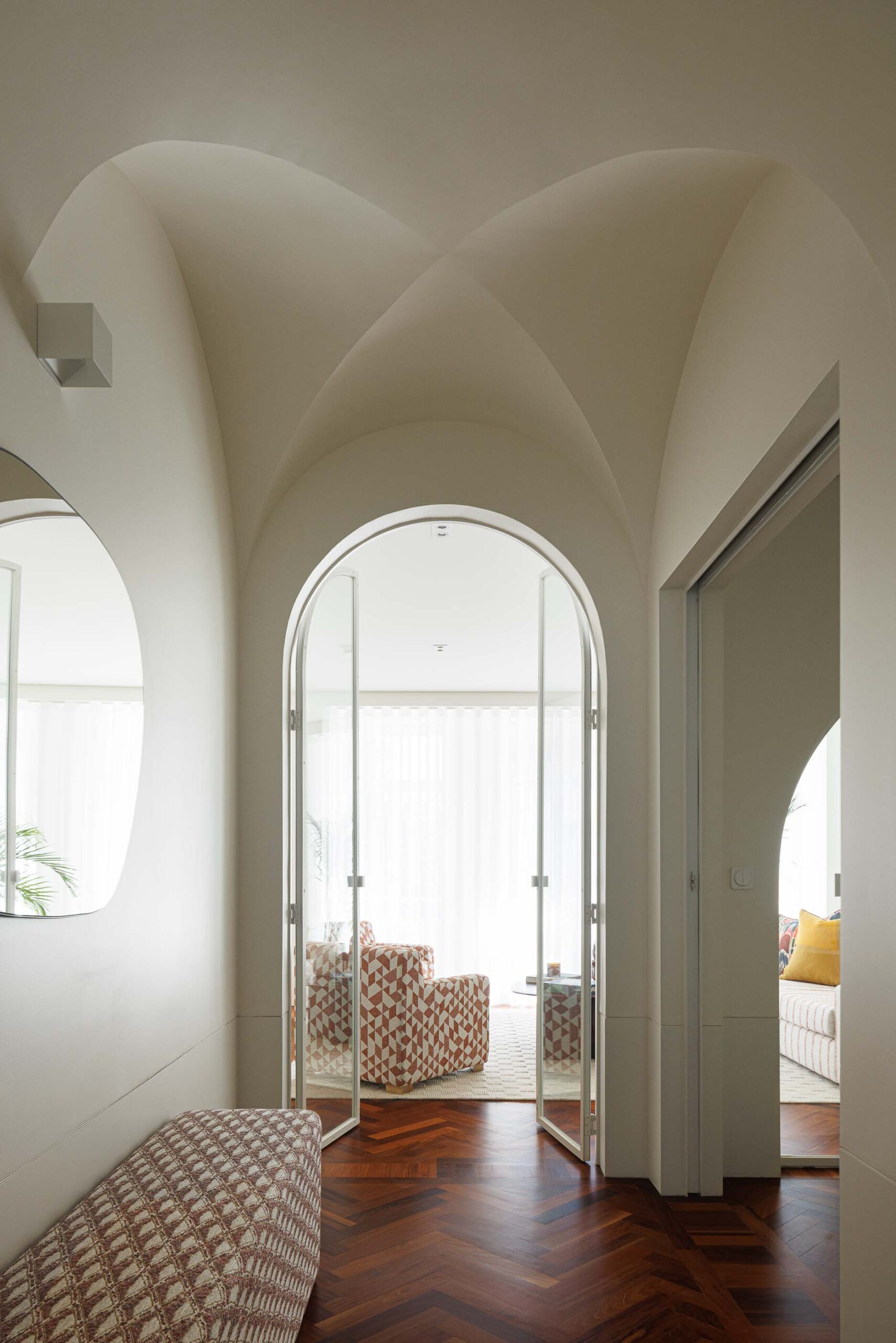
Take, for instance, the many vaulted ceilings that populate the interior. At times, the ribbed vaults are preceded by an arched opening, making each transition between rooms a heightened and special moment. Simultaneously, a rectilinear doorframe will lie nearby, creating a sequence of shapes when viewed from the aligned openings.


More unexpected moments of geometry appear in the apartments, from the linear yet slanted ceiling to the arched dormer window that lies just beyond it. On the staircase, the planes of the banister twist and fold around each other like pieces of paper. It falls alongside a curved railing, built into the wall in a rectilinear recession.


Outside, the hotel integrates a pool where the exit stairs fall under a circular aperture. When viewed from outside, the circular cut-out strategically falls underneath the arched frames of the rear facade, another playful mix of geometry, volume, and void orchestrated by MASSLAB.