From their window in yellow frames, the residents of this distinctive brick-base, corner building can look out at the trees lining the park just across the street. It’s hard to believe there was once a highway out there, the view through the former glass and aluminum facade one of cars, smoke, and noise.
Built in the 1970s, the mixed-used residential and industrial building in Madrid was once a plumbing and construction materials warehouse at its lower level. Today the former warehouse has been transformed into a colorful apartment complex. Designed by local studio OOIIO Architecture, Apartments in a Warehouse reflects what the studio’s founder, Joaquín Millán Villamuelas, described as a vibrant transformation to the once-industrial area.


Between 2003 and 2011, the city buried the highway underground for a swath and planted a green corridor on top. With the goal to revitalize the Manzanares riverfront, Madrid Rio, as the highway-capping project is called, not only opened up a former barrier, it transformed the neighborhood into a buzzing residential area where vacant warehouses and industrial buildings have been converted into unique housing solutions. “Our little project is just a consequence of this huge intervention,” Villamuelas told AN Interior. “The entire area is a vibrant transformation.”


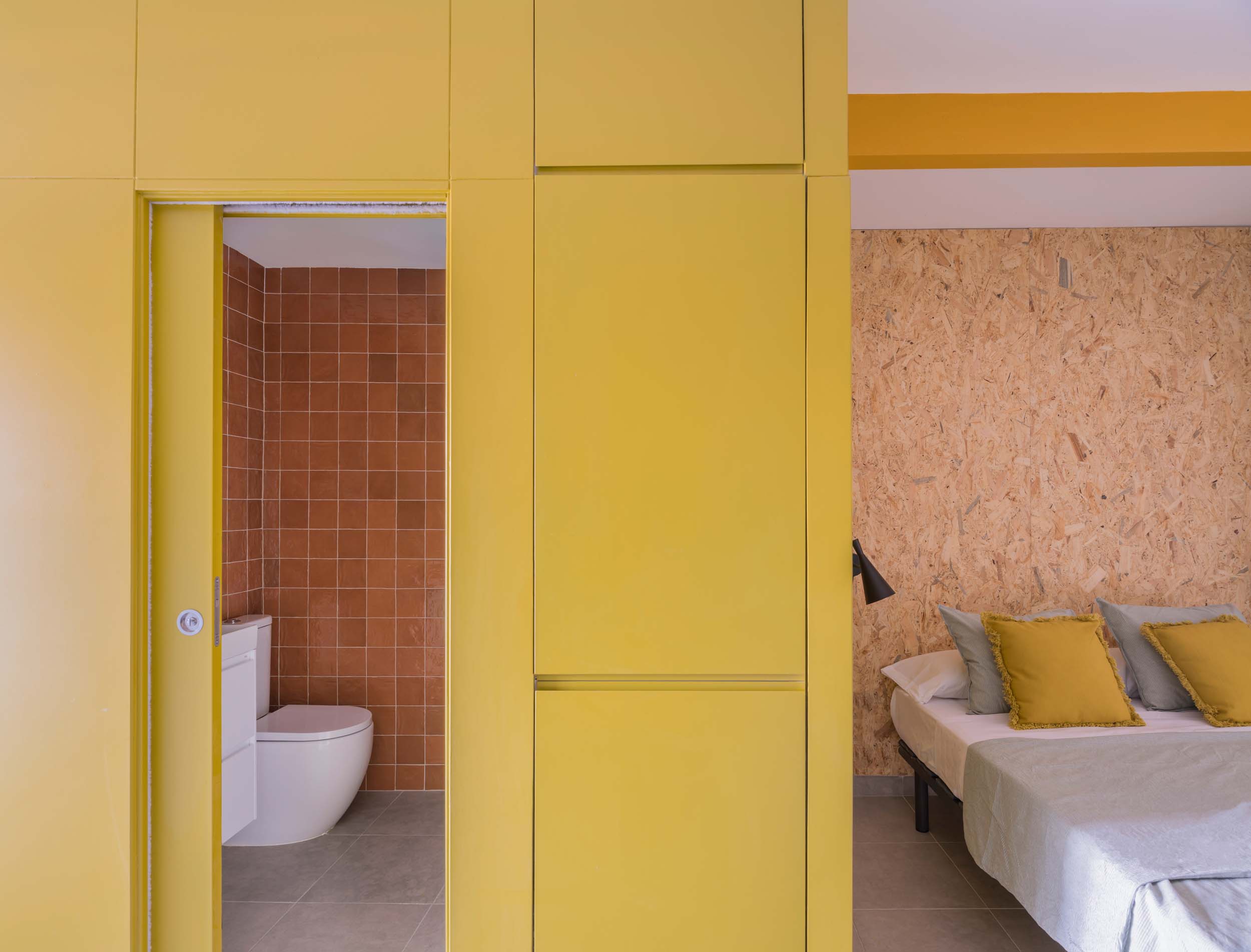
Spread across two floors and the basement where each resident has a dedicated storage unit, Warehouse Apartments includes four apartments on the ground floor and five on the floor above. One unit occupies a linear footprint, another was carved into a corner, while others take on a boxy U- or L-shape, each of the approximately 430-square-foot units blend bold color with wood and ceramic tiles to bring new life to the space, while incorporating existing features of the once warehouse to respect the past.


The challenge of the low-budget project was meeting the client’s request to maximize the number of the units while fitting in all the necessary functional elements, maintaining quality and working around “spatial complications,” including existing pipes and beams. “The floor plan is like a Tetris game,” said Villamuelas. “The entire project is an exercise in how to be unique and, at the same time, repeatable to make it easier for building.”


Colorful, long linear built-ins in blues, greens, and yellows were carefully configured to maximize the space and prioritize natural light. Color, a defining element of OOIIO’s design DNA, was used as a solution to create variation among the apartments. It is sensitively layered with glazed ceramic tiles in bathrooms and backsplashes, and engineered wood panels with exposed chips used as headboards, counter tops, and playful room dividers made from hanging slats. “In this way we highlight those more unique points without overloading the design in these very small spaces,” Villamuelas noted. Painted bright yellow, existing pipes and beams add further dimension to the space and become a part of it. “It is great to modify and reuse old and vacant structures,” Villamuelas said. “But it is even more satisfying for us when you manage to leave part of the old as part of the new, allowing us to read the history of that place.