In Pardubice, Czech Republic, the Automatic Mills was one of the first buildings designed by Josef Gočár, known in the country as an early father of modernism. Construction on the complex completed in 1909, though you’d be forgiven for mistaking its facade—clad in geometric brick patterns, a skybridge, and crenelated roofs—for something more civic in nature. The dignity and care Gočár leant toward industrial buildings and its laborers has helped preserve the mills a century later. In 1924, a grain silo and a series of multiple buildings were added to the complex. It’s since undergone renovations by Zdeněk Balík, Jan Šépka, Petr Všetečka, and now Prokš Přikryl architekti who maintains and reuses the site as a multifunctional cultural space with otherworldly results.

The architects refer to the site as “a true building-machine” as it comprises three main parts: the milling technology, the skeleton framework, and the outer shell. The approach serves to highlight the beauty of this work, thus the team restored the outer shell of the original brick facade designed by Gočár.

While interventions were restrained to best preserve the architectural legacy of the mills, the architects opened up parts of the building, revealing the inner framework, just as the building reveals itself to the public after a century. Opposing sides of the ground floor were opened, extending the public square into the silo. This reveal further exposed the pyramidal grain bins which drop down into the space from the ceiling.

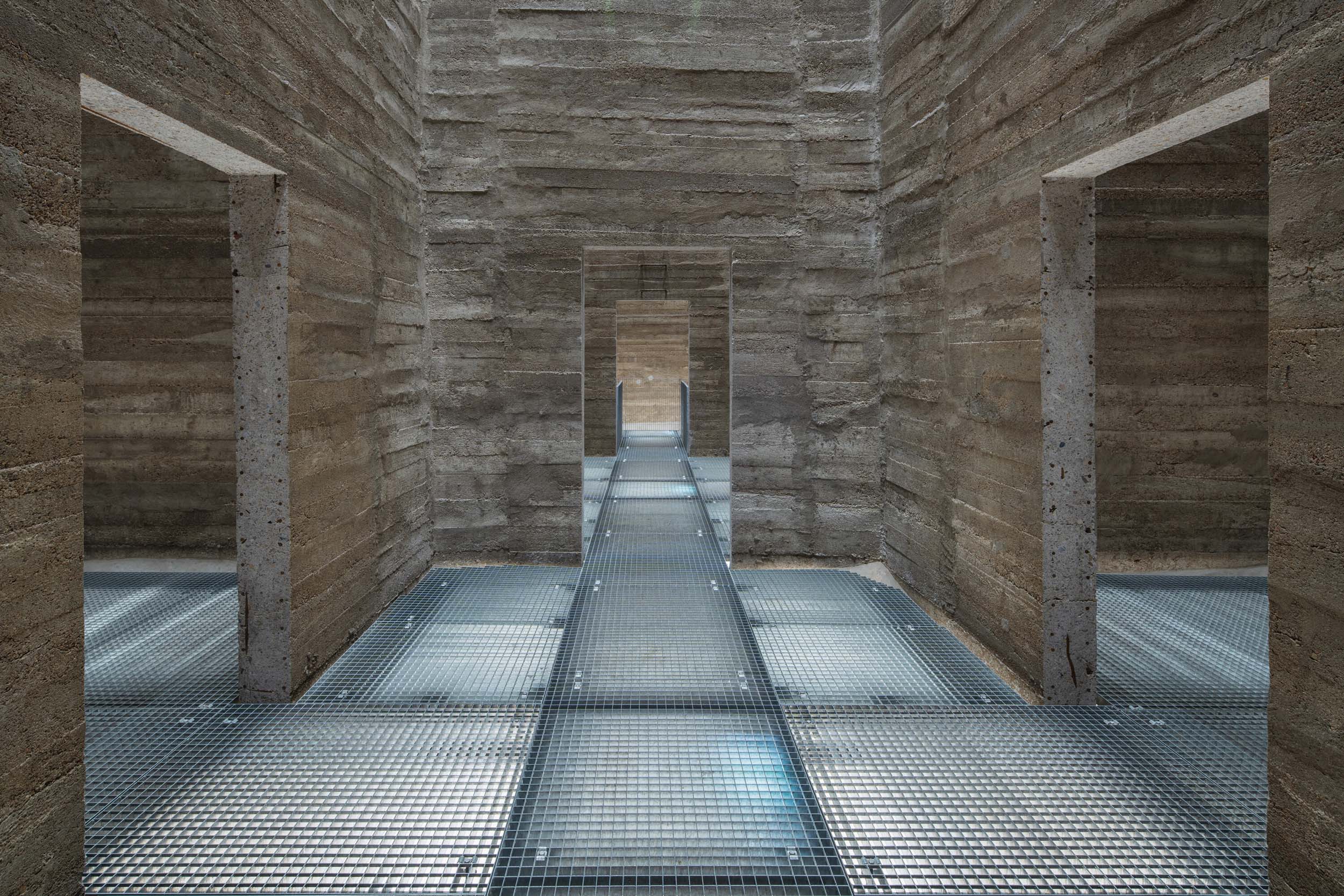
The grain bins continue onto the first floor. Here the architects make more creative use of them, constructing steel mesh pathways that snake through the bins. Lit from below and ensconced between vast walls, the space feels like a different futuristic dimension, fitting perhaps for its new use as gallery space.


The interior modifications are just as spare as the exterior. The architects preserved any original surfaces and materials as much as possible, including keeping pre-existing drill holes, scars, marks, and patinas. Where new items were introduced, they complement the old material. Steel continues through the building as flooring, stairways, and railings. The transparent materials coupled with the glass-concrete floors help exaggerate the verticality of the five-story building as light comes through from below in the glass grids, visually connecting each level.


On the fifth floor, a new hall was inserted with the original ceiling, columns, roof slab, and attic removed. This level hosts theaters, lectures, concerts, and social events. The concrete and glass flooring continues here while white walls and windows create a brighter interior.


The roof slab was demolished, so the architects inserted C-shaped columns atop the existing columns and built a new flat roof. Now wheelchair-accessible, the roof serves as a rooftop bar and terrace for outdoor activities.

Using the site’s own logic, Prokš Přikryl architekti converts the grain silo into an ethereal offering for the community. The interior reveals the building’s inner machine and history. “Simply put,” said the architect, “the aim is to develop the building in its rationality and monumentality.” Aim achieved.