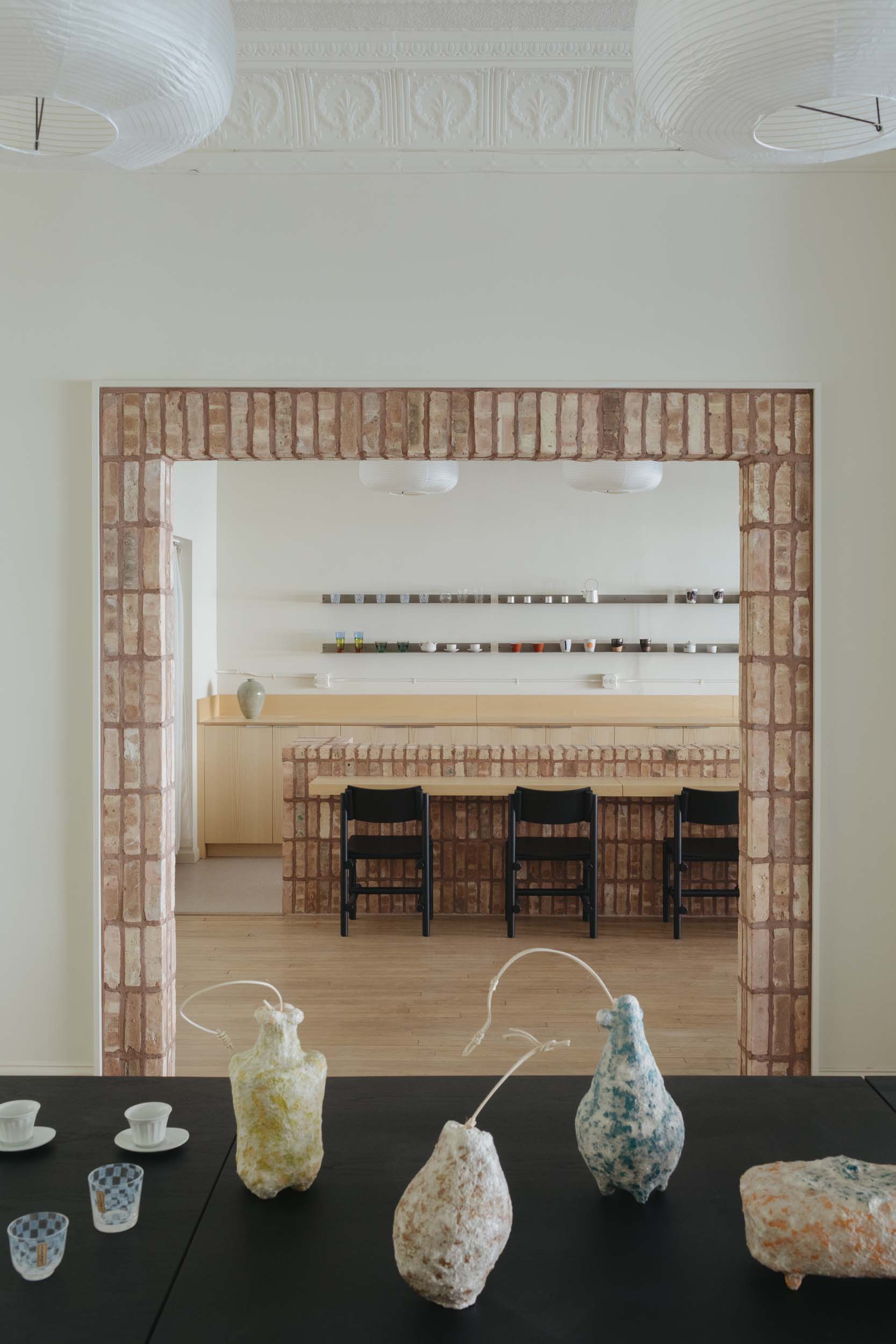
At No Longer Human, a tea house in Evanston, Illinois, tea is presented as the antithesis to being online. The beverage offers a chance to slow down, be present, and become intentional. The brick-and-mortar outpost also offers a place to connect to others. Naturally, the 1,900-square-foot space is an ode to being offline. SCPA, an architecture practice in Chicago by Sam Sang Chai Park, reworked an early 20th-century storefront to build a calm, materially restrained shop for No Longer Human.


As with many old buildings, mismatched renovations cluttered the space. Park stripped down the incremental layers to reveal a shell of pressed-tin ceilings, plaster walls, and maple floors. This makes up the new calm base of the tea house.

When it came to making new additions, SCPA was challenged with incorporating Japanese design while honoring and preserving the historic bones of the building. To balance old and new, Park worked in abstractions, evoking concepts of Asian design without explicit imitation.
Upon entry, a custom 28-foot-long display runs the length of the store. The black-stained ash piece with cruciform legs cohere with Japan’s minimal and lightweight aesthetics. It’s topped with the brand’s teaware and accessories, as well as papier-mâché boulders created by a local artist.

The rear of the space accommodates private tea tastings. Demarcated by a series of linen curtains, the rear makes for an intimate setting, set against a soft, billowy background, for tea ceremonies.


The flow of the space continues into the adjacent storefront bay, housing the tea room. A new masonry opening emphasizes the transition, as well as the contrast of culture and temporalities within the design. In the tea room, the Chicago common brick continues to clad the custom bar counter. Its design necessitated cutting some of the bricks into special shapes to achieve the different faces of the bar. The earthy material, both a reflection of Chicago and an alignment with Japan’s natural materiality, is further contrasted by metal shelving.

Furnishings liken back to the East. More ash is used to create barstools, wood creates small side tables, rice paper pendants hang from the historic ceiling, and the window bays are filled with bluestone gravel and more papier-mâché rocks to create landscapes within the interior.