On the outskirts of Boston the residential neighborhood of Jamaica Plain is defined by single-family houses built during the 1960s and 1970s in pursuit of the American Dream. However, with the influx of people moving to this area, many homes are being altered to accommodate current demands. One of these, Periscope House, a 1964 ranch-style home, was vertically expanded by local architecture firm Studio J. Jih. Like its name suggests, the home epitomizes a periscope: It allows the homeowners to have unobstructed views of the Boston skyline from the privacy of their home.

From its exterior, Periscope House draws intrigue in its use of curves and application of windows in various sizes and shapes. One side of the home is clad in horizontal Hardieplank lap siding. It juts out toward the road, resembling a more traditional facade. While on the other side, vertically laid blonde Accoya cladding wraps the swooping form and periscope window located above the entry.

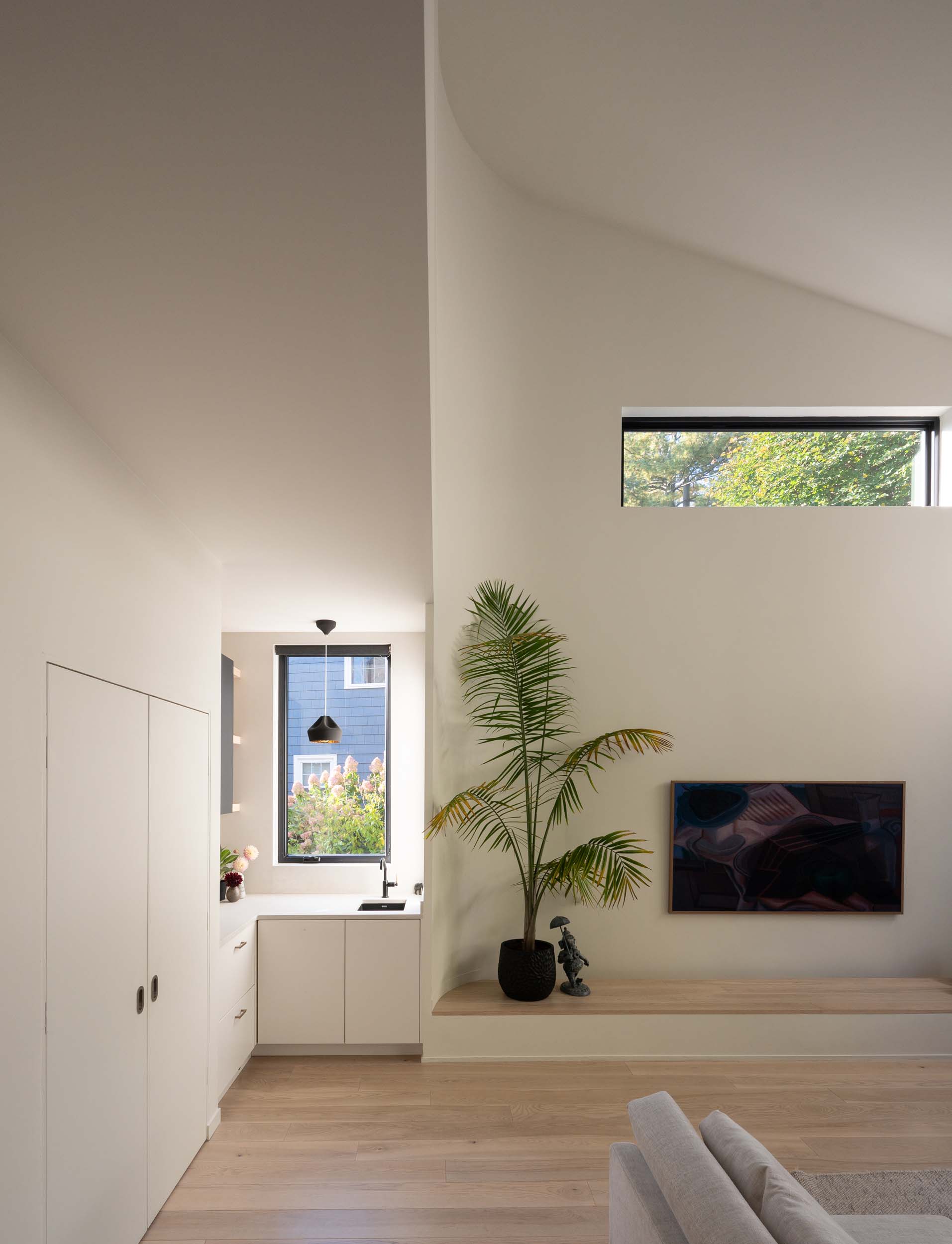
While the apertures may seem to be of random shape, size, and placement, each was strategically located to correspond to the daily rituals of the homeowners. A south-facing clerestory, for instance, was placed to allow a modulating beam of light to hit the dining room, living room, and kitchen throughout the day. The fenestration and sculptural curvature also consider privacy and introduce nature to the interiors. J. Roc Jih, founder of Studio J. Jih, shared with AN Interior, “Rather than compromise on one or the other, or produce sharp turns and dislocations, we tried to smooth these transitions and apparent incompatibilities with a periscope—allowing the curve to produce continuity between a public view and a private interior without sacrificing the dispositions of each, and allowing a gradient of light across the curved surface to link between the two.”
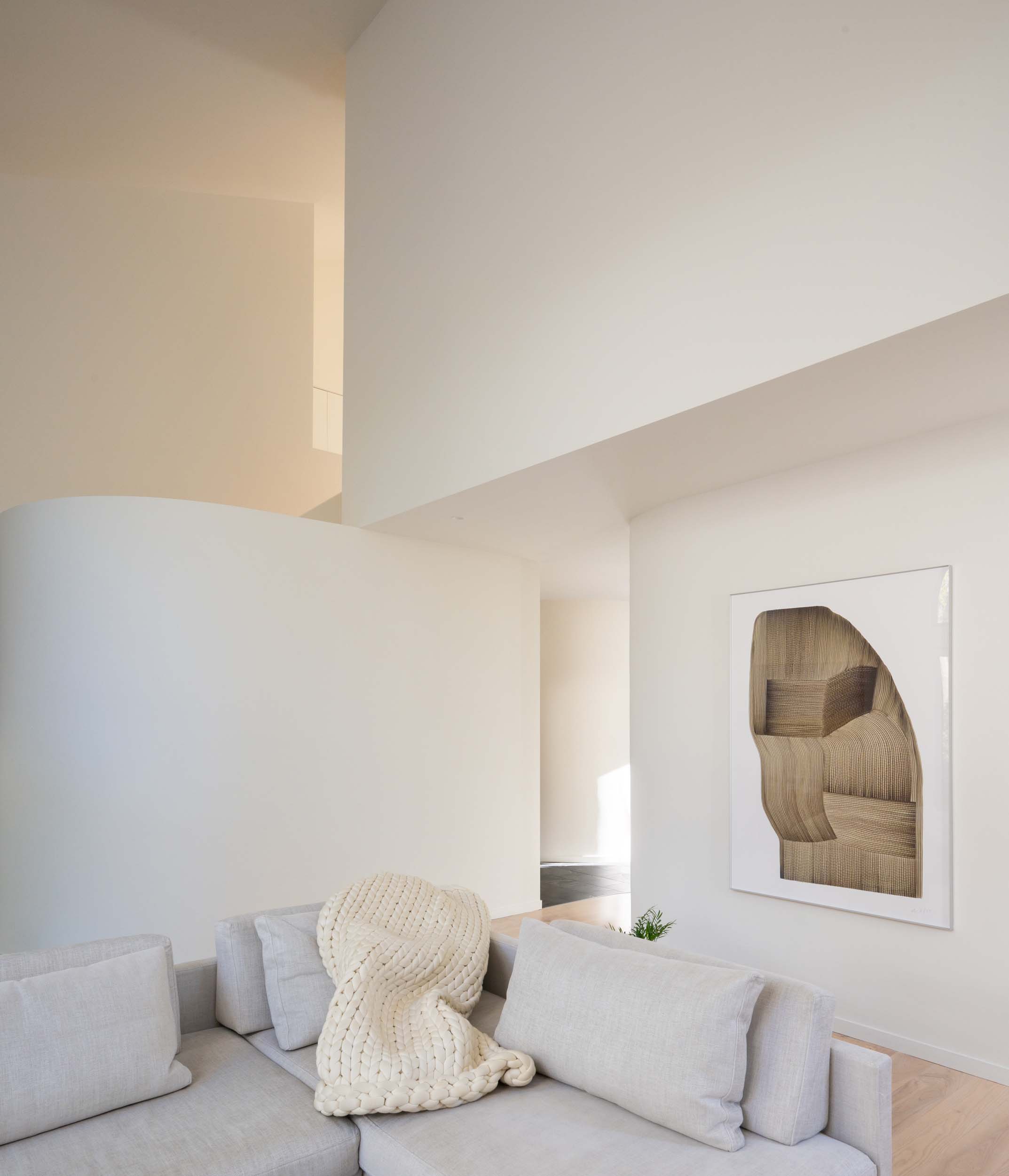

The interior’s design is composed through quiet tones introduced by the matte white base applied to the entry and continued throughout. Floors are white-oiled ash wood, adding a subtle warm touch to the space. Despite the walls and floors being mostly bare, the space doesn’t feel that way thanks to the strong geometry continued from the exterior to the interiors. Inside, planes intersect creating uniquely shadowed moments. Jih commented, “This exterior curve introduces a series of rounded volumes within, which all play multiple roles: organizing programs, softening corners, refracting light, and softly guiding the body and gaze. The result is a blend of private but still light-filled spaces in what might otherwise be a confrontational cubic interior.”

The first floor is open, allowing the living room to flow to the kitchen and dining room. Nods to nature can be found in the Eilersen Plano Sofa, the Hem Dune rug in the living room, and the Omnia wooden table and dark gray Foyer chairs, both by Calligaris. Above the dining room table three large Foscarini Aplomb light fixtures further the curved and linear languages of the home. Additionally, there are a number of Ronan Bouroullec prints on the first floor, providing a unique visual similarity to the overlapping curvatures and straight lines found in the renovation.


The grand rectangular periscope window is located at the top of the stairs on the second floor. Through it views of the distant skyline are visible. It connects to the funneling wall, creating a soft curve that also completely submerges the hallway with natural light. Adjacent to the curved wall is a reading nook located in the corner of two glass windows. The primary suite is located on this floor with its own bath, influenced by Japanese saunas. In the bathroom, cast concrete sinks pair with the narrow wood-tone Kendrige tiles installed in the shower and Kamari Gris slabs by Tilebar applied on the surrounding walls and floor.

When asked to describe Periscope House in one word, Jih said, “Mediated—between our understanding of domestic typologies, between the history of the neighborhood and its pressures to densify, between the owners and the community and the municipality, between ourselves and our formal desires with everyone.” The softy curved walls and windows were informed by the clients habits, while guiding them through the space. In turn, the design both looks outward while shaping the sanctuary-like interior. These contradictory acts, as Jih put it, “become linked ends of the periscope.”