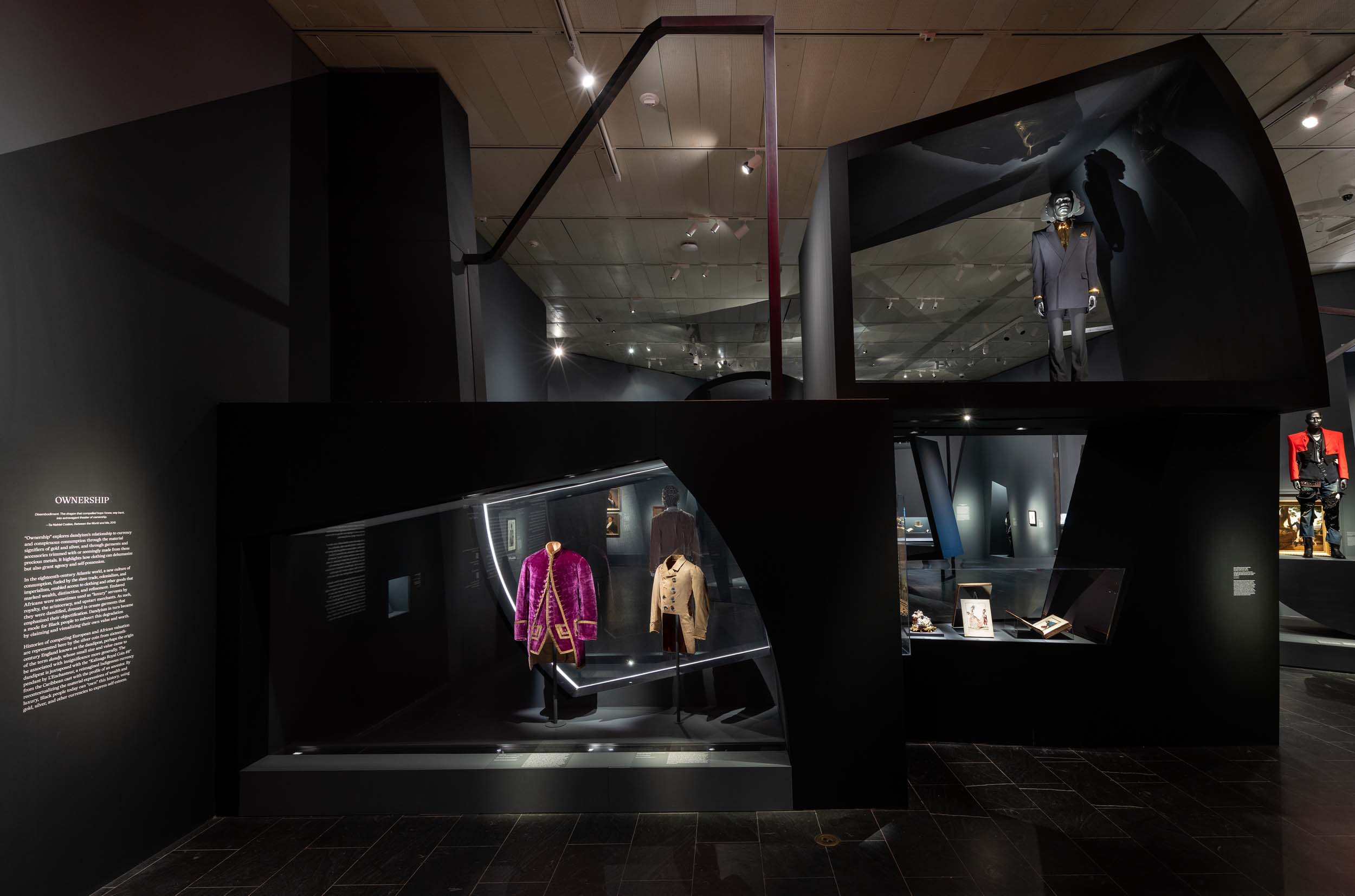
A dark, compressed hall acts as a sedate and spare entry to the Metropolitan Museum of Art’s new Costume Institute exhibition, Superfine: Tailoring Black Style. But it’s not the clothing on display that first commands attention after the hallway opens up—it’s the playground of abstract sculptures, some stacked atop one another or stretching through the room, which houses them. The forms are devised by artist Torkwase Dyson, whose work revolves around what she calls “hypershapes.” The sculptures were realized and organized with the help of local design and architecture firm, SAT3 Studio.

Superfine: Tailoring Black Style presents a cultural and historical importance of sartorial style to the formation of Black identities through the lens of dandyism, the sharp, impeccably groomed style that got its start in the late-18th century. The exhibition, which kicked off the star-studded Met Gala, is conceived of in 12 chapters, each exploring different strategies or facets of the style across different time periods. This concept draws from Monica L. Miller’s book, Slaves to Fashion: Black Dandyism and the Styling of Black Diasporic Identity.

For Dyson, an artist whose work often explores how Black and Brown bodies must receive and negotiate space, designing this exhibition was a new yet familiar opportunity to translate her architectural motifs into scenographie. She began with the concept of framing. “I wanted to take the idea of the frame, or framing Black life, and use it as a force multiplier,” the artist told Vogue. The resulting forms, clad in all black and built with wood and steel, continue to riff on the geometric motifs within Dyson’s practice but become rotated or expanded throughout the show.

At points the containers are heavy and enclosed, gleefully taking up space; at other times open-aired as if attempting to blend in. Some of the structures are defined by curvature, whereas others are composed of sharp, rectilinear lines. Some sculptures are standalone with others linked upon each other, displaying garments high above or around the bend. These slippery, multivalent forms are designed to hold questions about Black life—related to theatricality, scale, liberation, and creativity—mirrored in the narratives the clothing displays.

SAT3 helped the artist bring the concept to life, ensuring the structures met with the Met’s own strict rules on circulation, clearance, and accessibility. The studio, which also helped design 2023’s Karl Lagerfeld: A Line of Beauty exhibition, drove the spatial organization of these sculptures. “Each of [the constructs] came into being by accommodating their specific art for their specific section in isolation. It wasn’t really until much later in the design process that we had to think about them contextually,” Tyler Dusenbury of SAT3 Studio told AN Interior. The studio was conscious of maintaining sightlines, particularly through constructs as their openings align.

Unlike last year’s Sleeping Beauties: Reawakening Fashion exhibit by Leong Leong which employed a straightforward, linear plan to walk through the space, the spatial experience of Superfine is as Dusenbury described “ a choose your own adventure.” Dyson envisioned visitors going from left to right, forward and back when navigating the space. At times, the head must also go up and down to catch the pieces displayed in the upper vessels, and then their descriptions down below. Within the 10,000-square-foot space, the amount of work and sculpture on view can feel dizzying—and that’s before the amount of text incorporated into the design, which SAT3 helped display and carve space for throughout the show. This requires the viewer to mindfully move throughout the space, looking at and mapping their path, versus simply following one laid out. The choreography ensures visitors engage with the work and the often overlooked history being told. It’s also aptly freeing. As Dyson continued to Vogue, “I wanted people to feel held by a thoughtful system—not confined by it.”

The thick walls of the sculptures are also a nifty way to conceal all the technical details that go into preserving the materials and artwork on display. “There’s a lot of case work in the show, so there’s a lot of things that have to be behind glass, have to be in a hermetically sealed environment. Each of those cases are integrated into the architecture in a way that appears seamless,” explained Stefan Klecheski of SAT3 Studio.


The all-black color palette of the design acts as a neutral, meditative backdrop for the clothing, and a quieter base amidst all that there is to see. Strategic lighting gives the exhibition a futuristic slant. CS Lighting collaborated on the lighting design, helping integrate lighting channels that run through the geometric wall displays to continue Dyson’s visual language in other forms.

Much of the exhibition is fluid. The curation itself defies chronology, often pairing historical garments with contemporary ruminations. Breaking gender norms was also paramount to this fludity, from the included 1960s menswear ensembles boasting drapery, lace, ruffles, and sequins and memoir of William and Ellen Craft who escaped enslavement by donning well-tailored menswear. Equally, the exhibition design melds linearity and curvature, medial and lateral direction, a variety befitting the rhizomatic expressions that arose from dandyism.
Superfine: Tailoring Black Style is on view in New York at the Metropolitan Museum of Art from May 10 to October 26, 2025.