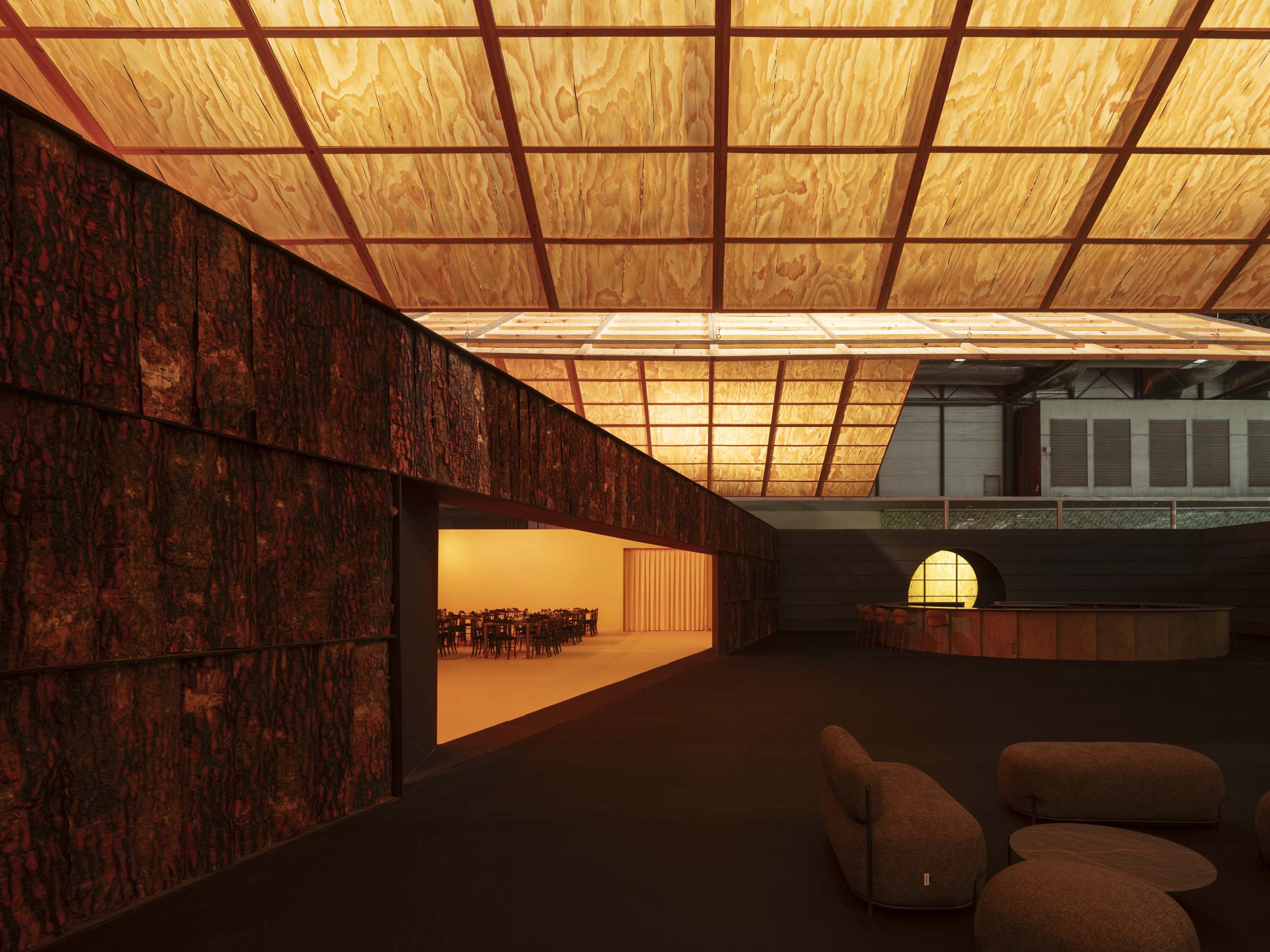
Earlier this month, 95,000 people descended onto Madrid’s international art fair ARCOmadrid. Within, Manuel Bouzas—an architect and educator based in Galicia, Spain and New York—and salazarsequeromedina, an architecture studio that also works between Spain and New York, outfitted the guest lounge with a moody, almost cocktail lounge–atmosphere. The duo’s project, titled 350,000 Ha, is constructed out of salvaged timber from wildfires that plagued Spain in 2025. 350,000 refers to the hectares of forests destroyed in the blazes.

The guest lounge serves as a place for visitors to rest, enjoy a drink, and for VIP guests to meet and dine at the lounge restaurant. Bouzas and salazarsequeromedina section the rectangular floorplan with a diagonal wall that asymmetrically designates an informal seating area and bar on one, larger side and a VIP area and restaurant on the other.


The architects worked with wood manufacturer Finsa to source and salvage materials. According to the designers, the wildfires generated 1.5 million tons of burned timber, almost half the annual volume of harvested wood. However, much of the wood is still usable, retaining a solid inner core. Along the brown monochrome seating area, the architects used costeros, the four outer segments of charred bark removed prior to sawing, as cladding. Its exposed grain creates depth and texture to otherwise smooth surfaces.


Round, soft seating populates this area while barstools surround the circular bar. The dark space is like sunset’s golden hour thanks to the installation’s focal point: six monumental-scale, diagonal planes of light, suspended 13 feet above ground using metal trusses. The planes are made from sawn timber and clad in a veneer crafted from peeling the inner core of salvaged wood. This leaves the grain of the salvaged timber exposed, lit softly by projections from spotlights.


This constellation of light, what the architects refer to as lumbre or fire, casts a cinematic illumination. The design is reminiscent of the sun installed by Olafur Eliasson at Tate Modern in 2003 and the candlelit scenes in Stanley Kubrick’s Barry Lyndon.

The large panels of timber light continue into the VIP and restaurant side. Here the architects and Finsa used branches, bark, and unusable trunks, and shredded them into fiberboard panels. Bright orange and red completely clad this space, a mix of diagonal and rectilinear zones and rounded private dining areas.

From the bright dining space to the dark informal seating area, the bright panels of light above to the shadowy corners below, the concept plays with light and darkness. It brings respite to long-walking visitors and recharges through its engaging and resourceful atmosphere.