Arzignano, west of Vicenza in Italy’s Veneto, is known for supplying high-quality leather for fashion goods. Plus, it is the site of the organic, modernist Church of St. John the Baptist, designed by Giovanni Michelucci and completed in 1970. But these days, something new is happening. Today the small town is host to a second office for AMAA, a collaborative architecture office for research and development, and several of its completed and ongoing works.

AMAA is led by creative partners Marcello Galiotto and Alessandra Rampazzo, who met and graduated from the Università Iuav di Venezia before founding their practice in 2012. Beyond a string of recent competition wins in Italy, the firm gained wider global prominence through its installation in the Arsenale at last year’s Venice Architecture Biennale, curated by Lesley Lokko. The piece, It’s Kind of a Circular Story, staged a salvaged piece of wall from a military base and concrete study models next to a large tablescape of offcut brass sheets from De Castelli, an Italian artisan metalworking company. Realized together with artists, the Venetian effort showcased the circular thinking—about existing buildings, cities, environments, and histories, as well as material processes—that is central to AMAA’s design process.
In 2015, AMAA created AMAA Workshop, which operates from a repurposed warehouse in Arzignano, Galiotto’s hometown. Here the office constructed a two-story, steel-and-glass interior pavilion; stacked eight shipping containers, which are threaded beneath the existing concrete structure; and installed offices in a low, dark room quieted with curtains and lit with circular skylights set within rotated square frames.

Seen on a spring day, the space is a convincing showroom for AMAA’s ideas about how to synthetically engage with what already exists and deliver formally strong architectural proposals built with materials that “sincerely reveal themselves,” as the practice wrote in a recent issue of AMAG. Brass flats from the show in Venice are spread out on the floor, and the concrete bunker relic is suspended above. Material samples are stacked on most available surfaces in the open area, and working models, printouts, architecture books, and Galiotto’s chair collection are evidence of the creative life underway.

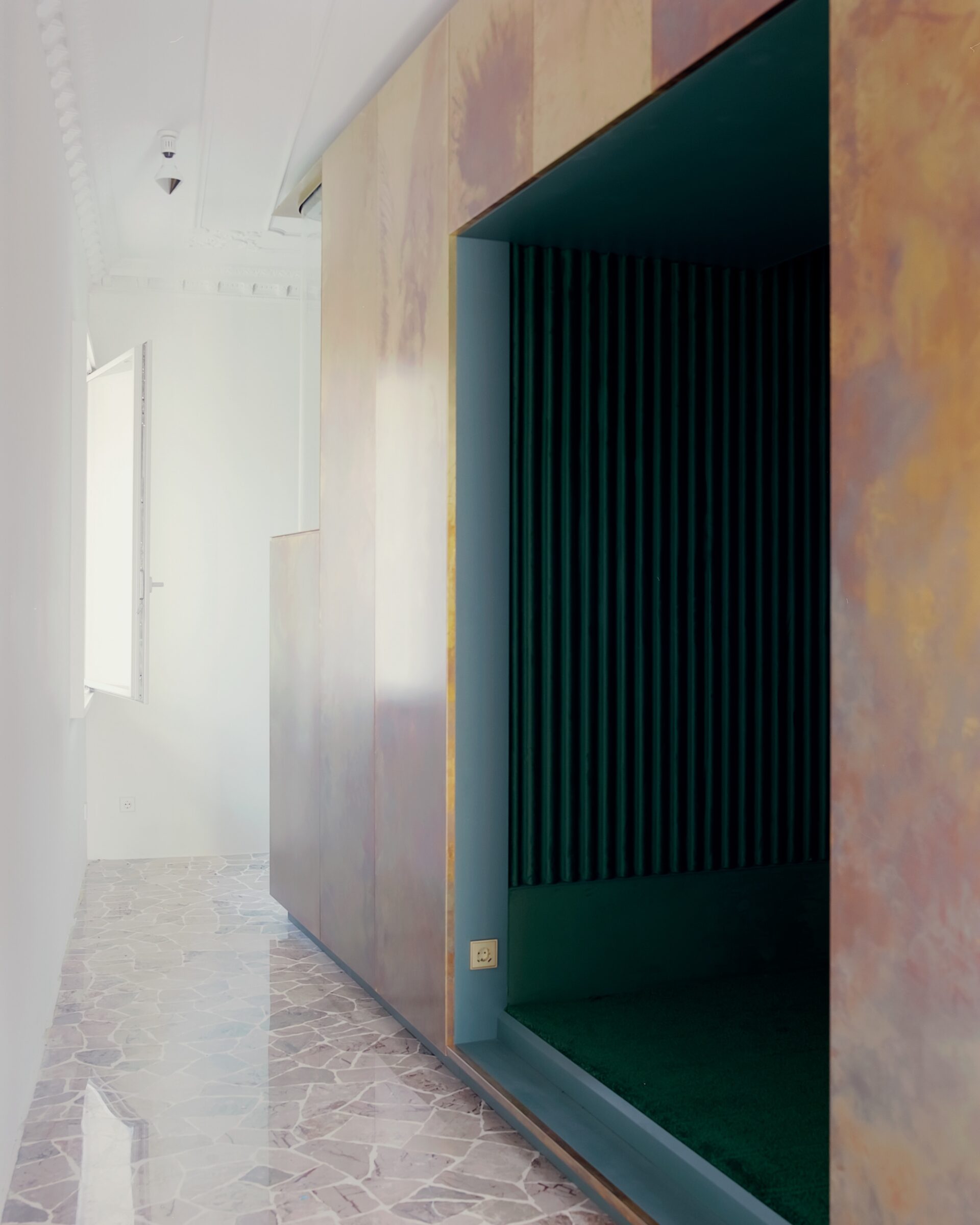
Follow the brass: The material also lines the perimeter of AMAA’s latest completed project, Golden Box, in Arzignano. For this interior, the architects have condensed the required spaces for living into a square, 5 meters on a side in plan, which is held back from the outer walls of the apartment. Rejecting the spatial suggestions of both the Palladiana terrazzo floor and the plaster molding on the ceiling, the rotated Golden Box is instead set parallel to the northern, roadside surface.

Within the Golden Box, the brass-faced panels conceal hidden storage accessible via touch-latch hardware. (The patinated etching was developed in collaboration with De Castelli and was previously a finish used on the back sides of the company’s metal slabs.) In tribute to the aged copper roof of Michelucci’s nearby church, the box’s insides are green, finished in imperial marble, rich velvet, and muted paint. The three occupiable “voids”—a stylish bathroom, relaxed seating, and a bed nook—are softened by filleted interior corners. The first space is illuminated by an elevated corner window resolved using curved glass, while the latter two are playfully connected with a circular aperture. A diamond window between the seating and the kitchen summons a similar window cut into the concrete wall at a nearby gallery, also designed by AMAA.
The petit refuge is a weekend getaway for its clients. But rather than pampering occupants, the Golden Box challenges them: Upon entry, one encounters a blank brass wall and faces a decision about how to circumnavigate the object: Left or right? The ambulatory space tapers, only to open up at the kitchen, which is the widest and brightest area of the interior. Throughout, the impressive millwork object is built with a high degree of craftsmanship.


Recently, AMAA has expanded to the U.S. Working from an outpost within BIG’s office in Dumbo, the studio completed a shop in Soho for Sorate, a Brooklyn-based Japanese green tea company helmed by founder and creative director Silvia Mella. Like at the Golden Box, geometry prevails within the warm interior: A counter pinches in to create four seats at a small bar, and a square grid of wooden shelves is set in front of a white circle, which references the shop’s logo.

The Golden Box evidences AMAA’s approach, which favors an attention to existing conditions met with rigorous architectural intervention. (This attitude parallels that of Donald Judd’s operations in Marfa.) The finished and forthcoming works in Arzignano are the start of a promising portfolio. Keep an eye on AMAA.