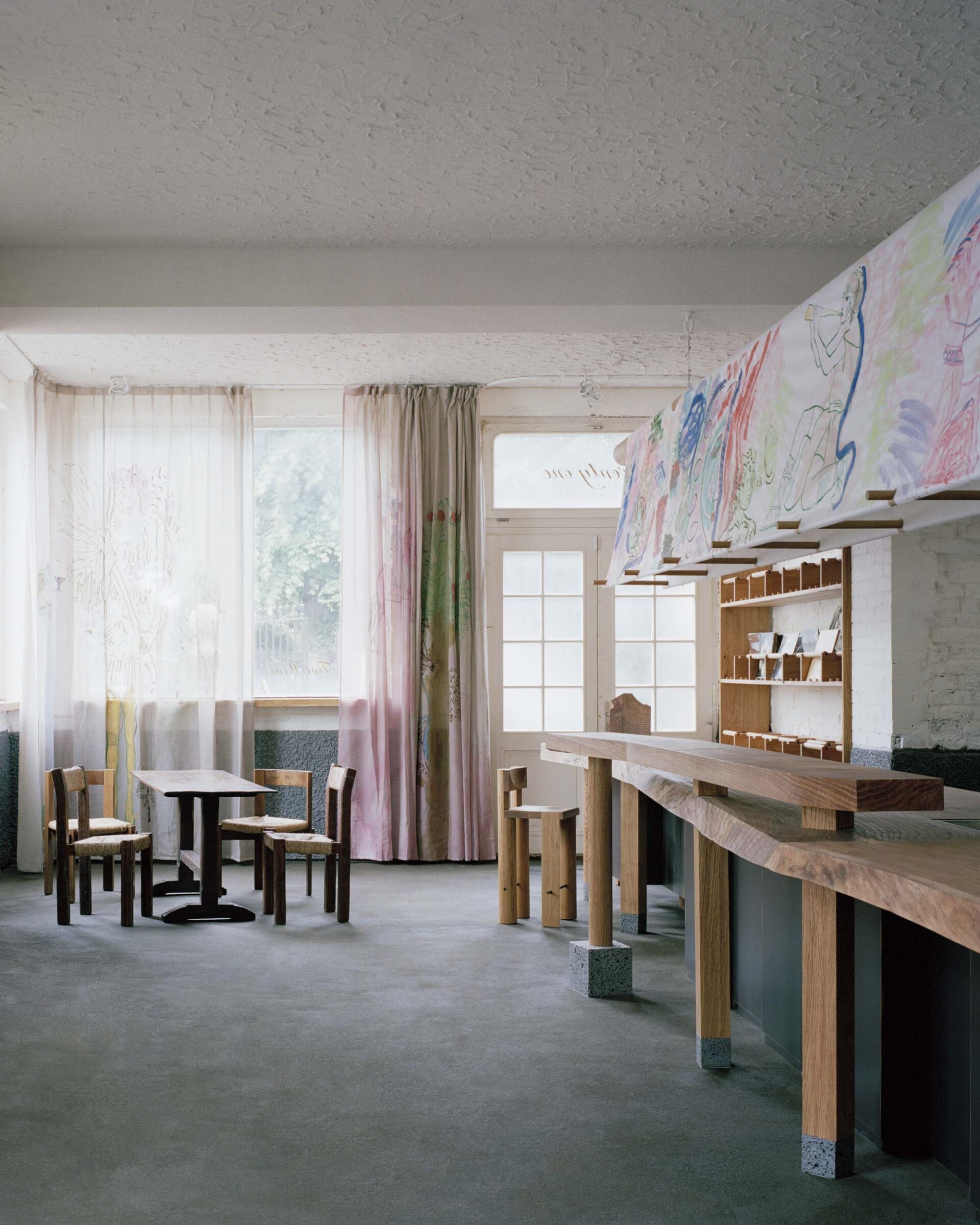
Japanese folk art, William Morris, and the wider English arts and crafts movement inform Goodbye Horses, a new wine bar in London’s De Beauvoir Town. The bar’s interior, outfitted by Leopold Banchini Architects, prioritizes natural materials, abundant lighting, local craftsmanship, artist collaboration, and swaths of colorful doodles. Drawing from these movements and local heritage, the bar takes a stance against our era’s never-ending focus on screens and stimulation. Instead, Goodbye Horses bids farewell to the overwhelming and hello to a sense of being present and convivial.

While the interior draws inspiration from across cultures, the bar has a distinct sense of regional sourcing. Located in an old brick building, original walls and materials are preserved and, where modified, were handled with local know-how. The existing walls are painted with limewash and old-fashioned roughcast. The dark green paint acts as a datum that helps proportion the space and add color. The flooring utilizes beaten earth, a mix of soil, straw, and clay with a natural linseed oil coating, commonly used in countryside pubs of yore.


The core of the wine bar is the ten-meter-long timber bar (nearly 33 feet in length) that acts as both the counter, kitchen bench, and dining table. The table, along with the rest of the furnishings, are made entirely out of a single oak tree. The counter’s butterfly joinery and other geometric shapes are left exposed, as well as the natural veining of the wood. Its legs are propped up on stone cubes of varying sizes for added quirkiness.


The rest of the furnishings are just as detailed. A wine rack is composed of a grid-like stack of wood pieces, a design that continues the table’s tradition of honest materiality and construction. Elsewhere, benches reveal the cracks found in the trunks of the tree. The same wood is used for the smooth chairs, whose heavy, large, and long legs contrast against the low-lying seat. Material continuity extends to the back of the space where wooden fencing blocks off the fireplace.


The bespoke stools and light also incorporate Japanese hemp fiber paper, hand-cast Italian glass, volcanic stone, and oxidized brass. The paper is decorated with colorful, playful artwork by artist Lucy Stein who also did the billowy curtains surrounding the bar. The artwork on the Hessian curtains are painted by hand and inspired by British folklore and mythology. Light is meant to hit the curtains and illuminate the work, much like the effects of stained glass.


Blending local and cross-cultural, contemporary and heritage, Goodbye Horses mixes references for a light and lyrical interior.
Prior coverage of Leopold Banchini Architects in AN Interior includes the office’s Dar El Farina residence in Morocco, which made it on the list of the our favorite projects of 2024.